

Protests grow in Alabama for voting rights after Supreme Court ruling
Where the Reverend Bernice King, daughter of Martin Luther King Jr., stated that these Court measures represent a direct attack on the legacy of generations
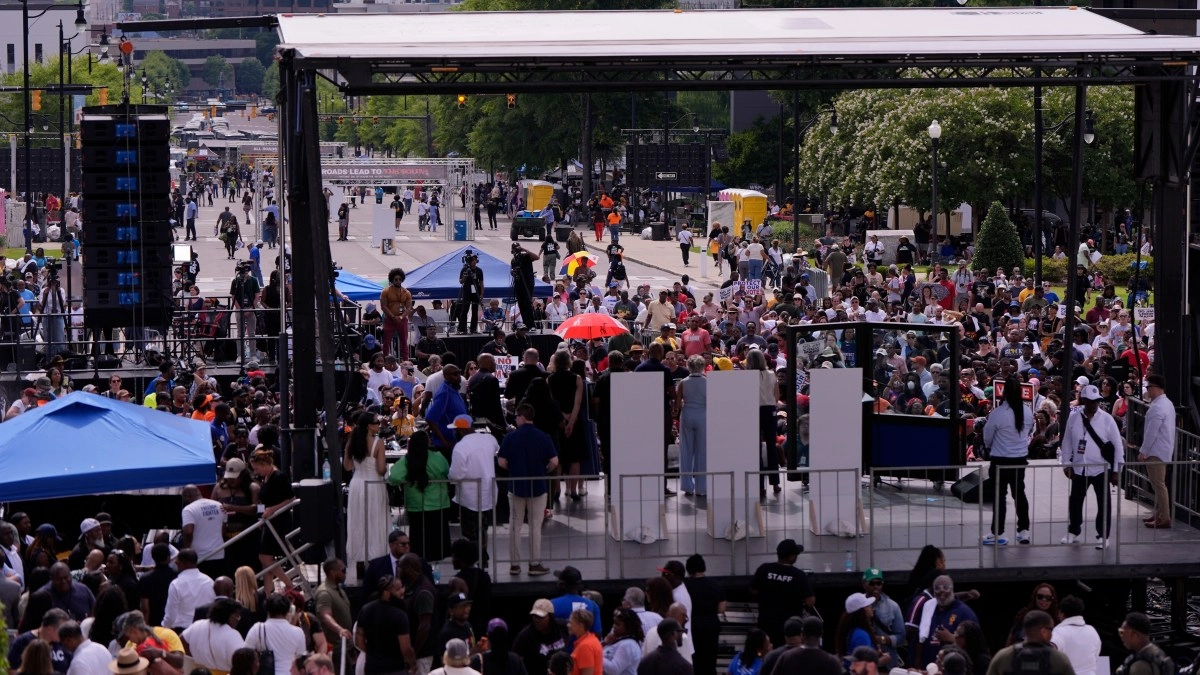

Decades after the historic marches led by Martin Luther King Jr., thousands of people returned to the streets of Alabama this weekend to warn that civil rights and voting access “remain under threat” in the United States, following recent court decisions that could reduce the political representation of African-American communities.
The mobilization brought together activists, religious leaders, legislators and human rights organizations in the cities of Selma and Montgomery, considered the cradle of the modern civil rights movement. Participants denounced that several southern states, governed by Republicans, have promoted new electoral maps that, according to critics, diminish the weight of the vote of racial minorities in federal elections.
Senator Cory Booker called Montgomery “hallowed ground” for the fight for equality and said the current generation faces a decisive moment to defend civil liberties.
“If we, in our generation, do not do our duty now, we will lose the achievements, rights and freedoms that our ancestors bequeathed to us,” Booker said before a crowd that chanted slogans such as “we will not back down” and “we will continue to fight.”
The protests come after the United States Supreme Court recently issued a ruling related to Louisiana that, according to civil organizations, further weakened the historic Voting Rights Act of 1965. That legislation was approved after years of mobilizations and racial violence in the south of the country to protect access to voting for African Americans.
Marches revive memory of “Bloody Sunday”
The day began in Selma with a march on the emblematic Edmund Pettus Bridge, the scene of the brutal police repression that occurred on March 7, 1965 during the so-called “Bloody Sunday.” That attack against peaceful protesters shocked the United States and accelerated the approval of the Voting Rights Act promoted by then-President Lyndon B. Johnson.
Protesters later moved to the state Capitol in Montgomery, where Martin Luther King Jr. delivered his historic 1965 speech "How Much Longer? Not for Long."
The Rev. Bernice King assured that the recent judicial decisions represent a direct attack on the legacy of those who faced violence and discrimination to guarantee the political participation of marginalized communities.
“Entire generations faced dogs, batons and bombs to ensure that African Americans could fully participate in this democracy,” he said.
Also among those in attendance was Shalela Dowdy, a plaintiff in a case about electoral redistricting in Alabama, who rejected the new congressional maps promoted by conservative legislatures.
"We will not give up without a fight. We will not accept electoral maps typical of the Jim Crow era," he declared.
Fear of loss of African American representation
Various civil groups maintain that recent electoral changes could have direct consequences on the representation of black legislators in the federal Congress.
Congressional Black Caucus Chair Yvette Clarke warned this week that up to 19 members of the bloc could lose their seats due to new district redraws in southern states.
That figure would represent nearly a third of the roughly 60 members of the caucus, one of the leading advocates of civil and voting rights in Washington.
In front of the Alabama Capitol, where monuments dedicated to Confederate President Jefferson Davis and activist Rosa Parks coexist, organizers promised to maintain the protests and expand the mobilizations in the coming months.
For many participants, the fight for the vote in the United States does not only belong to the past, but remains a current battle in the middle of 2026.