

“Pushed into darkness”: from Myanmar to Venezuela, how people defy internet blocks
Clandestine cafes and people linked to the resistance are helping to avoid internet blackouts

Inside a small bamboo kiosk in Myanmar, Min prepares to open his business.
Tangled cables connect a self-contained solar energy system to several outlets. Plastic chairs await customers, while a handwritten menu offers meat appetizers and salads.
Min, whose name has been changed for their safety, knows his customers will have a good time there. They come for one reason only: the internet.
He says that every day about 30 people visit his cafe.
He states that when it first opened, more than two years ago, these types of establishments were scarce and it had between 300 and 400 customers daily.
“The demand was overwhelming,” he adds.
The area has been affected by one of several blackouts imposed by the military junta that rules Myanmar since it seized power in a coup in 2021.
During the five-year civil war that followed, some internet outages in the country have lasted days and others have lasted months.
In 2022, UN experts noted that these blackouts applied to areas where the junta faced strong resistance from opposition groups.
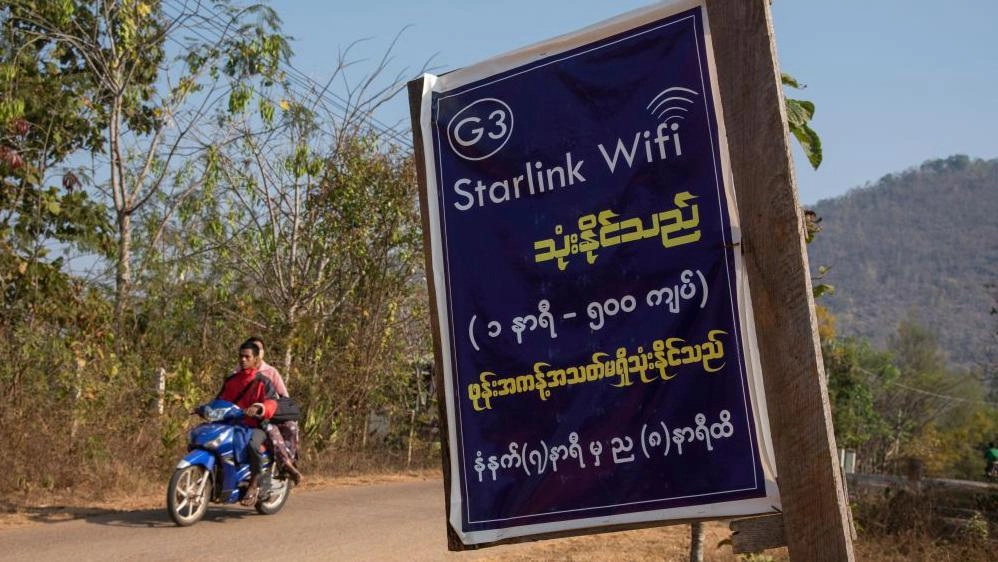
Min offers a way to get around the blackout, using Starlink, which connects to the internet through a satellite network owned by Elon Musk's SpaceX company, bypassing the national telecommunications infrastructure.
Their business depends on a flat, rectangular antenna, purchased on the black market in Thailand, smuggled across the border and mounted on the corrugated tin roof of the kiosk.
A dangerous business
Min says he operates at a loss, charging 1,000 kyat per hour ($0.25), an affordable rate for people who have been displaced and local residents, whom he wants to help.
But handling that cafe is dangerous.
Businesses like his are not permitted by military authorities and their owners risk arrest or having their equipment confiscated.
The store is only open three hours a day, partly due to power supply limitations.
Furthermore, although the area is controlled by a resistance group, it fears that its solar panels or the Starlink antenna will be detected from the air when government planes fly over the area.
He has moved the cafe twice, each time to a more discreet location, for fear of being discovered.
Myanmar Internet Project (MIP), a digital rights organization, has recorded more than 450 internet shutdowns in different parts of the country since February 2021, affecting more than 20 million people.
The organization sees a relationship with the junta's attacks.
“According to our research, almost 90% of the blackouts are related to bombings… They want people to stop communicating so they can destroy the area,” says Nyan, a digital rights analyst at MIP, who also speaks under a pseudonym.
There is a lot of surveillance. Myanmar citizens are prohibited from offering and using VPNs without a license from the military government.
These tools have been used for years around the world to bypass internet restrictions using remote servers that hide users' IP addresses and location.
Armed resistance groups have also at times disrupted internet access in Myanmar, either by imposing temporary bans on the use of Starlink in areas under their control for security reasons, or by attacking communications infrastructure.
Blackouts are on the rise
Min's operation is small, but it is one of a growing number of people and groups seeking to circumvent internet restrictions used by some of the world's most repressive governments.
A report from international digital rights group Access Now notes that internet shutdowns have increased globally since 2020.
According to the report, they reached a new high in 2025, with 313 blackouts in 52 countries. With a total of 95, Myanmar was the country with the most cases, according to the same report.
It also indicates that in 2025, 94 blocks were identified globally on platforms such as Facebook, WhatsApp, Telegram and X, triple the number in 2016, when they began to be recorded.
Unfiltered News in Venezuela
Thousands of kilometers from Myanmar, Andrés Azpurúa has been working from Madrid, leading a team of volunteers who developed an application to bypass censorship blocks in his home country, Venezuela.
The media landscape in that country is strongly conditioned by the government.
Many independent media outlets are blocked and there have been intermittent restrictions on international platforms, including X and Facebook, as well as news sites such as The Wall Street Journal.
The Azpurúa team's application, Noticias Sin Filtro, is a free platform that aggregates independent Venezuelan and international news sources and incorporates integrated VPN technology.
Azpurúa claims that the app makes it easier for people in Venezuela to access VPNs.
“You don't have to log in, you don't have to create an account, you don't have to pay anything… you just watch the news,” he explains.
It notes that the app, launched shortly before the widely disputed presidential election in July 2024, has been downloaded 140,000 times.
Azpurúa, a digital rights activist who frequently denounces censorship, left the country later that year because he was afraid of being arrested.
“Everything indicated that they were trying to locate and capture me,” he says.
Following the detention of former President Nicolás Maduro by the US earlier this year, many Venezuelans celebrated, believing the door was opening for political change.
However, Azpurúa assures that there have been few changes in terms of media and internet censorship after Delcy Rodríguez took charge.
The news app has been developed primarily by volunteers, with other costs funded largely through donations, according to Azpurúa.
“It is a way to support the exercise of human rights, including access to information and freedom of expression,” he says.
China's “Great Digital Wall”
Meanwhile, another expatriate in a different country, Echo, a fictitious name, is part of a group of developers taking on another internet censorship system: China's Great Digital Wall.
In China, many international news sites, social media platforms, search engines and streaming services are blocked.
Instead, users can access state-controlled apps like WeChat and Weibo, which are heavily monitored.
Echo used to work in IT and left China three years ago.
He co-founded a service that uses third-party software to help people in China access blocked sites, including Google, YouTube and Facebook.
He claims to work with a business partner in China, operating cautiously to avoid detection.
“In China, if you are caught trying to help people freely access the internet, you will be arrested,” he adds.
Echo says its initiative offers free subscriptions to users in China and finances its costs through more comprehensive payment plans.
He points out that he currently lives off his savings.
He describes a constant fight against censorship in China: “Sometimes developers like us have the advantage and other times they don't.”
Echo is also offering free subscriptions to users in Iran, where internet blackouts were imposed during protests in January and following the ongoing war with the US and Israel.
UK-based human rights group Article 19 has documented what it claims Iran has adopted technologies and tactics from China to control the digital space.
In Myanmar, customers who use cafes like Min's say the impact of internet blackouts is very serious.
“Almost all aspects of life are affected: daily life, the local economy, education and family communication,” says Khin, a 27-year-old girl who lives in the center of the country.
He says that during the first blackout he was unable to contact his relatives who live far away and do not have a reliable telephone line.
“Our communication was completely cut off,” he adds.
He says that sometimes he has had to walk up to an hour to connect to the internet.
Nay, a 25-year-old student whose name has also been changed, routinely travels more than two kilometers to reach a cafe with Starlink.
"We, young people, must work to develop our region. Now, with the internet blackout, we can't do anything," he explains.
She claims that the future of young people like her is “pushed into darkness.”