

The impact of the Venezuelan earthquakes on a rescuer who worked 18 days in La Guaira
A month after the earthquakes, Daniela Villarroel remembers the corpses she passed to reach the survivors under the rubble

Warning: This article contains descriptions that may offend readers.
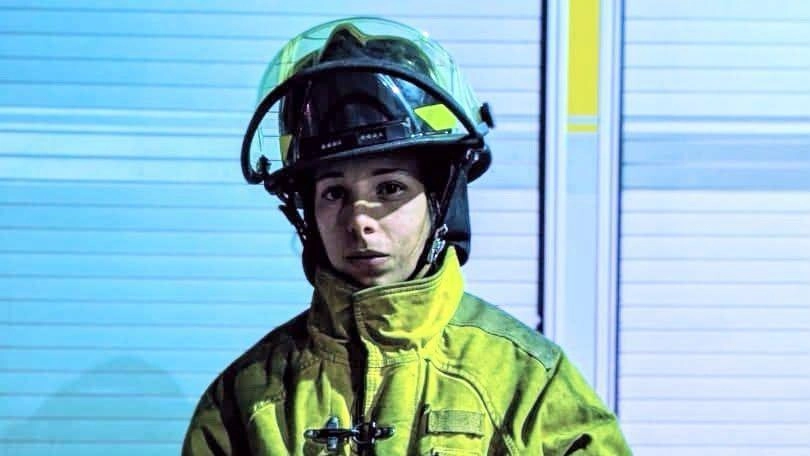
Daniela Villarroel preferred to take off her boots and uniform in the garden. She wanted to prevent the rooms of her house from being impregnated with the smell of death that accompanied her after searching for survivors of the double earthquake in Venezuela.
Before petting his dogs, he shook his hair and wiped his face to rid himself of dirt and debris. After her parents died and her siblings emigrated, Emma, Chimuelo and Sisi were the family she had left in Caracas.
The 28-year-old suspended her work as a nutritionist for three weeks, to help rescue survivors and recover bodies in La Guaira, the state most affected by the earthquakes that shook northern Venezuela a little over a month ago.
During the seven years that she has belonged to the Volunteer Fire Department of the Central University of Venezuela (UCV), Daniela has dealt with fires, accidents and urban rescues. What he had never faced was the challenge of freeing people crushed by collapsed buildings.
“As soon as they saw you, the survivors took you by the hand to take you to the place where their relatives had stayed,” he says, remembering the moment he arrived in La Guaira for the first time after the double earthquake.
“When you looked into the structures, you saw skulls crushed by columns, feet imprisoned, people crushed in half and fresh blood without seeing the person who had been crushed.”
But Daniela did not back down. For 18 continuous days, he adopted the routine of the UCV volunteer firefighters: they left the headquarters at 8:00 in the morning, traveled about 40 kilometers to the disaster areas in the back of a roofless truck, and entered fallen structures to carry out rescues and recoveries.
At midnight they returned to the fire station in Caracas, cleaned the tools they had used during the day and then went home, after 2:00 in the morning.
Inside a “little hole”
Because it is a volunteer fire department, Daniela and her colleagues do not earn a salary and have the equipment they buy with their own money.
“When the earthquake occurred, I only had my personal gloves and a cord, which is a five-foot rope that you carry in your pocket in case you have to tie something.”
In addition to training in the UCV fire department, Daniela was certified as a paramedic in Dublin before beginning her university studies, during a season in which she went to visit her brothers who live in Ireland.
Measuring 1.60 meters and weighing 58 kilos made her the perfect candidate to enter the narrowest holes, which in some cases she describes as the area that would add up to “four sheets of letter paper” arranged in a square.
“Imagine that you are inside a tunnel, there inside that little hole, and an aftershock occurs and the first thing you hear is people saying: ‘It is shaking again.’ Then you see stones or earth falling,” he remembers about the first days.
"At that moment, the most important thing is psychological support for the survivor. Tell him to calm down, tell him that we are already helping him. That's why you have to stay calm, because you are the support. If you break, the faster he will break."
Gabriel's Rescue
The first time Daniela supported a victim under the ruins was during the rescue of Gabriel, a 22-year-old man who was breathing thanks to “a kind of air mattress” created around him by the bodies of his father, his mother and his pregnant wife, which prevented him from being crushed by the rubble.
"I went down about six meters through a tunnel one meter in diameter. I had to enter as if I were a little worm. Out of discomfort, I started to free up space to have both hands free and push with my feet."
When Daniela reached Gabriel, she discovered that he was face down and she could only see his feet, abdomen and head. When asked if he had anything in his pockets, he replied that he had the watch that he had taken from his father's wrist, a necklace that his mother wore around her neck, and his wife's wedding ring.
“Please, don't throw them away, take good care of them, because that's the only thing I'm going to take from them,” Gabriel reportedly told him just before Daniela's companions began the maneuver to remove him from the rubble on a rescue board.
That night, after cleaning herself and hugging her dogs, Daniela took a long hot shower and slept soundly, satisfied with the feat of having saved a life.
But as the days passed and the rescues became more complicated, the bedtime routine was overtaken by the need to wash clothes to counteract the putrid smell of the corpses.
"That smell sticks to your uniform, your gloves, whatever you're wearing. I had to throw away clothes, wash and wash my uniform because I only had one. Afterwards everything smelled the same, even the towels."
“We're going to get you out.”
The longest rescue in which Daniela participated in La Guaira lasted for 8 hours. The survivor was the aunt of a fellow firefighter in Caribe, one of the areas of the Caraballeda parish that collapsed almost completely during the earthquakes.
“The first four floors of that building were left like pancakes and the woman was imprisoned on the 2nd floor,” says Daniela. The ruins were so unstable that they organized themselves in pairs to work in 20-minute blocks and progressively clear access.
Once again, being small and light gave her an advantage in locating her aunt, as they began to call her from the beginning of the rescue. "I stuck my head and flashlight in and asked, 'Is there anyone there? Can you hear me?'"
The woman responded. “Aunt, explain the context to me so I can help you,” Daniela told her. He asked her to describe how her body was, if she could move her hands and legs and what elements surrounded her.
When the aunt knocked on a door that imprisoned her, the sound revealed to Daniela where she was. Thus, the firefighters discovered that they had to dismantle a wooden table to remove it.
"It sounded far away, at that moment we saw it as so complex that it seemed impossible, but we went in and out, discussing how we could get to it until we did."
After removing debris for a long time, Daniela came across two bodies. “I put some pictures over the girl and the man so I wouldn't have to see them or step on them every time we passed by.”
Hours later, Daniela managed to see her aunt. “She had a pink robe, she was sitting in the fetal position and you could see her buttock and lower back.”
The rescuer reached out and managed to touch her. "She was hot. When I asked her if she felt it, she said yes." Once she reached her, Daniela cleaned her head and neck. “I was so imprisoned, so compressed, that I didn't know what to do.”
“We're going to get you out,” Daniela told her as they took turns using the grinder to cut the legs of the table that was blocking the aunt's exit. “Everything fell on her hip, she had to be pulled out by her feet.”
As Daniela helped her stretch her legs to prepare for evacuation, her aunt screamed in pain. “We had to push, pull, sit her down and lift her up.”
“At that moment you feel nothing but the urge to help,” he says. What he didn't expect was that all those images would come back at night to prevent him from sleeping.
“Rip off that smell of death”
Every night Daniela took off her boots and uniform in the garden of her house, shook her hair to remove the dirt, and cleaned her face. Then she petted her dogs and did the laundry as much as she could.
But from the second week onwards, when he tried to sleep, the voices calling for help under the rubble sounded inside his room, as did the noise of grinders cutting furniture and rods.
"I couldn't sleep, I had no appetite, I heard voices. The strongest thing for me was the smell... It was such a strong smell that there was no comparison. I feel like I will never be able to get rid of that smell of death."
Daniela did not manage to cry until three weeks after the earthquake, in a consultation with her therapist, who helped her understand that the memories were so vivid because all her senses were involved.
“The feeling that haunts me is that I could have done more,” he says with the same firm and serene voice with which he tells everything he has experienced.
Emma, Chimuelo and Sisi waited for Daniela all day without eating. When she sat with them to rest in the garden, they licked her even though she did not have the strength to respond.
Four weeks after the earthquakes in Venezuela, in which more than 5,000 people died and 50,000 were reported missing, the dogs do not leave Daniela's feet when everyone goes to sleep.