

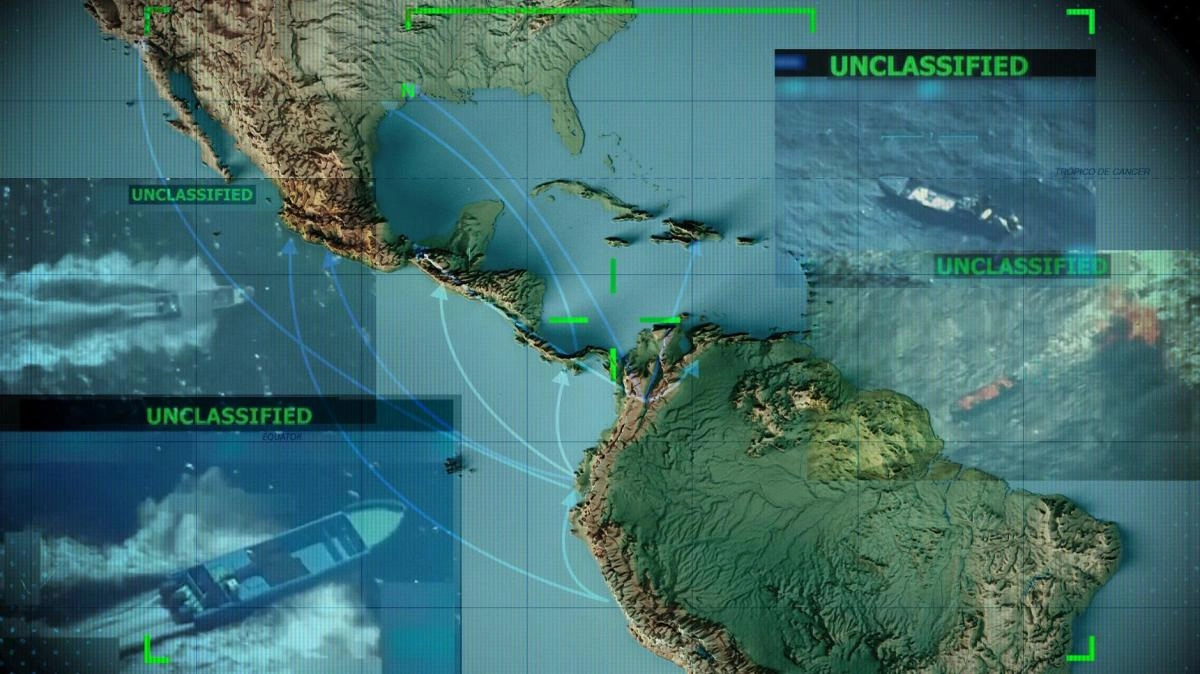
Maps showing drug routes from Latin America to the U.S.
U.S. forces have been targeting suspected drug boats, mostly in the Caribbean. But is that the route the narcotics are arriving by?

“If people want to stop seeing drug boats explode, they should stop sending drugs to the United States.”
That was the message from U.S. Secretary of State and National Security Advisor Marco Rubio when, last Wednesday, U.S. forces extended their operations to the Pacific. operations against vessels allegedly carrying narcotics.
The US attacks, which began on September 2 and, except for three occasions (October 21 and 22, and this Tuesday the 28th), have been carried out in Caribbean waters, have now resulted in 57 deaths.
Tuesday's attack targeted four boats and killed 14 people, according to the US Department of Defense. The Mexican Navy (Semar) reported that they have an ongoing search operation for a possible survivor 400 miles (about 643 km) from the coastal city of Acapulco.
President Donald Trump and officials in his administration justify the attacks as a necessary measure to combat the cartels, which they have designated as "terrorist organizations" and with which they claim to be engaged in an "armed conflict."
The attacks, carried out without congressional approval, have generated condemnation in the region and from experts Human rights officials designated by the United Nations have questioned their legality, even labeling them “extrajudicial killings.” But the US government has already stated that it does not intend to change its strategy. “The attacks will continue, day after day, because these are not simply drug traffickers, they are narco-terrorists who bring death and destruction to our cities,” said Secretary of Defense Pete Hegseth, without offering evidence or details, after one of the most recent bombings. But the fact that analysts agree that the deadliest drug in the US, a powerful synthetic opioid called fentanyl, is produced in Mexico and trafficked across the land border, leads many to question the true objective of US operations.
Also, the fact that the number of cocaine seizures in the Caribbean, where the US has reinforced its military presence and where most of the attacks on speedboats have occurred, represents a relatively small percentage of the total.
There is a growing consensus that the ultimate intention is to force a change of government in Venezuela. Trump has long sought to increase pressure on President Nicolas Maduro, whom the US and other governments do not recognize as the legitimate leader of the South American country following the disputed presidential elections of July 2024.
US officials have alleged that Maduro himself is part of an organization called the Cartel of the Suns, which they say includes high-ranking Venezuelan military and security officials involved in drug trafficking.
Maduro has rejected the accusations, asserting that Washington wants to overthrow him.
Be that as it may, from which Latin American countries and through which routes do drugs reach US territory?
Cocaine from South America
The routes and methods depend on the narcotic in question, experts emphasize.
There is a variety of substances—from fentanyl, methamphetamines, and marijuana, to heroin and cocaine—that originate in different countries and follow diverse routes, although they ultimately enter the US primarily through the border it shares with Mexico.
But in terms of drug trafficking from South America to the US market, cocaine is by far the most concerning, although other substances cannot be completely excluded, Antoine Vella, a researcher at the United Nations Office on Drugs and Crime, told BBC Mundo. (UNODC).
Almost all the cocaine consumed not only in the US, but also in the rest of the world, is produced in three Andean countries where the coca leaf is cultivated: Colombia, Peru, and Bolivia.
“The coca leaf is processed predominantly in laboratories in these three nations to transform it into the consumer product (mainly cocaine hydrochloride), or sometimes into an intermediate product, since some parts of the process can also occur at a later stage of the international trafficking chain,” explains Vella, who heads the Data, Analytics, and Statistics Section at UNODC.
And from there it goes to various markets, generally indirectly, transiting through one or more countries first.
From the producing nations, it may first cross into neighboring countries, such as Ecuador or Venezuela, and then be transported by some type of vessel—speedboats,fishing boats or semi-submersibles—to the coastal area of ??Central America or directly to Mexico, either via the Pacific or the Caribbean, to continue overland north.
In 2019—the most recent figures available from the U.S. Drug Enforcement Administration (DEA)—less than 1% of cocaine destined for the U.S. was smuggled directly, according to a U.S. government database that includes detected seizures and smuggling.
According to DEA estimates, based on the number of seizures and movements identified, the vast majority of cocaine bound for the U.S. passes through the Pacific.
Approximately 74% of shipments destined for the U.S. in 2019 passed through there, while 16% passed through the Western Caribbean—where most U.S. attacks on cocaine have occurred.
alleged drug-running boats—according to the 2020 National Drug Threat Assessment.
BBC Mundo contacted the DEA to request updated data, but received an automated response stating that, while the current disruption to budget allocations (the government shutdown) lasts, the anti-drug agency's functions will be limited to national security, violations of federal laws, and essential public safety tasks.
The Joint Interagency Task Force of Southern Command, one of the 10 commands of the U.S. Department of Defense whose jurisdiction includes Latin American countries, with the exception of Mexico, responded similarly to the recent information request.
However, experts consulted by BBC Mundo agree that the percentages mentioned above would still be valid.
“We are talking about illicit markets, so all we have are estimates based on seizures,” Elizabeth says. Dickinson, an analyst with the International Crisis Group.
“But based on the number of seizures, official data, and conversations with regional security forces, everything points to the Pacific being the dominant route,” he adds.
The International Center for Research and Analysis against Maritime Drug Trafficking (CIMCON) reaches a similar conclusion: “In the last five years, the Pacific has consolidated itself as one of the main exit routes for cocaine produced in Colombia, Peru, and Bolivia.”
Based in Cartagena, CIMCON is part of the Colombian Navy, but it has researchers and naval officers from other nations such as Brazil, Mexico, Ecuador, and the Netherlands.
Cocaine seizures reported by the organization in the Pacific region between 2020 and 2024 total around 1,500 tons.
“Drug seizures in the region have increased significantly, especially in Ecuador, where maritime seizures have grown by 380%. This increase suggests both greater drug trafficking and greater effectiveness in interdiction operations,” notes a recent report from the organization.
The Caribbean and the “bladder effect”
Although the Caribbean is no longer the predominant route it was in the 1980s, when Colombian cartels trafficked drugs to South Florida, its relevance should not be underestimated.
This is emphasized to BBC Mundo by Lilian Bobea, a professor at Fitchburg State University in Massachusetts (USA) whose research focuses on the drug industry, especially in the Caribbean region.
“The Dominican Republic has always been an important point (in drug trafficking through the Caribbean area), as has Puerto Rico,” she explains. sociologist. “And in the last decade or 15 years, smaller island nations, such as Trinidad and Tobago and Curacao, have also been incorporated into the European route, but also the route to the US.”
Today, increased US pressure on Mexico to combat drug trafficking, coupled with the rise in both production and consumption, “are revitalizing the Caribbean,” he asserts.
He calls it the “bladder effect” or balloon effect: “You squeeze one side and the air goes to the other. That perfectly describes the issue of the routes.”
With more than 3,708 tons, estimated global illicit cocaine production reached a new peak in 2023—the most recent data, included in the UNODC World Drug Report 2025—almost a third higher (34%) than the previous year.
According to the same source, the number of Global cocaine use has also continued to grow: an estimated 25 million people used the drug in 2023, up from 17 million in 2013. North America, Western and Central Europe, and South America remain the largest markets. With the U.S. consumer in mind, traffickers also transport cocaine, albeit in smaller quantities, via clandestine flights, primarily to Mexico and Central America. Venezuela shares a border with Colombia, the world's largest cocaine producer, and is a departure point for these flights, according to data collected by UNODC in its 2025 World Drug Report. As with other trafficking methods, once cocaine arrives in Mexico or Central America by air, it is mostly transported north by land and enters the U.S. across the border, often through official ports of entry. Fentanyl,from Mexico
Experts agree that fentanyl, the drug linked to an “overdose epidemic” in the U.S., does not travel along any of the cocaine routes.
Although these types of deaths fell by 27% from 2023 to 2024—to their lowest point in five years—and by 37% in the case of those linked to the use of the synthetic opioid, it remains the leading cause.
Last year it caused 48,400 overdose deaths, approximately 60% of the total, according to recent data from the U.S. Centers for Disease Control and Prevention (CDC).
“We have no evidence that the illicit fentanyl supply chain involves South America at significant levels,” notes Vella of UNODC.
Also used in medicine And in veterinary medicine, there is a percentage, albeit a very small one, of fentanyl in illicit markets that has been diverted from the legal supply.
According to the DEA, the Department of Justice, and the Congressional Research Service, illicit fentanyl is produced almost entirely in Mexico with precursors imported from Asian countries, including China, and both its production and trafficking are controlled by Mexican cartels.
However, when announcing the attack in the Caribbean on a submersible in which two people died, Trump wrote on his TruthSocial network that “US intelligence confirmed that the vessel was loaded primarily with fentanyl and other illegal drugs.”
He added that the operation prevented “the overdose deaths of 25,000 Americans.”
“They should provide the evidence, if they have it. We have never seen it,” says Elizabeth Dickinson of the International Crisis Group.
Drug Warfare or regime change?
Dickinson also raises a question that other analysts have already echoed: Does the Trump administration really intend to combat the cartels with the attacks on the alleged drug boats, or does it have another objective?
“This is an attempt at regime change,” Christopher Sabatini, a research fellow at the Chatham House Latin America, US and the Americas Program, told the BBC, referring to the bombing of vessels and the increased US military presence in the Caribbean.
Trump has deployed eight warships, a nuclear submarine, and fighter jets to the Caribbean, which will be joined by the world's largest aircraft carrier, the USS Gerald R. Ford.
Trump confirmed that he has authorized the Central Intelligence Agency (CIA) to carry out covert operations inside Venezuela.
“They probably won't invade the country.“The hope is that this is a warning,” Sabatini added. Meanwhile, tensions between the Trump administration and the government of Colombian President Gustavo Petro continue to rise following attacks on alleged drug boats in the Pacific. Trump has accused his Colombian counterpart of being a “drug kingpin” who “heavily encourages the mass production of drugs, in fields large and small, throughout Colombia.” And last Friday, the U.S. government added Petro to the State Department’s Office of Foreign Assets Control list, which designates and imposes economic and trade sanctions on individuals who pose a threat to U.S. national security, foreign policy, or the economy. “Fighting drug trafficking for decades and effectively has led to this government action against the society we have helped so much to stop its cocaine consumption.” “Quite a paradox, but not one step back and never on our knees,” Petro responded to his inclusion on the OFAC list.
It is expected that this will not be the last chapter in a story of escalating tensions and threats.
* Maps by Caroline Souza and promo image by Daniel Arce, from the BBC Mundo Visual Journalism team.