

'We don't want to disappear': Merchants from Placita Olvera ask for help to save their businesses and pre
Immigration raids keep customers away from the historic place
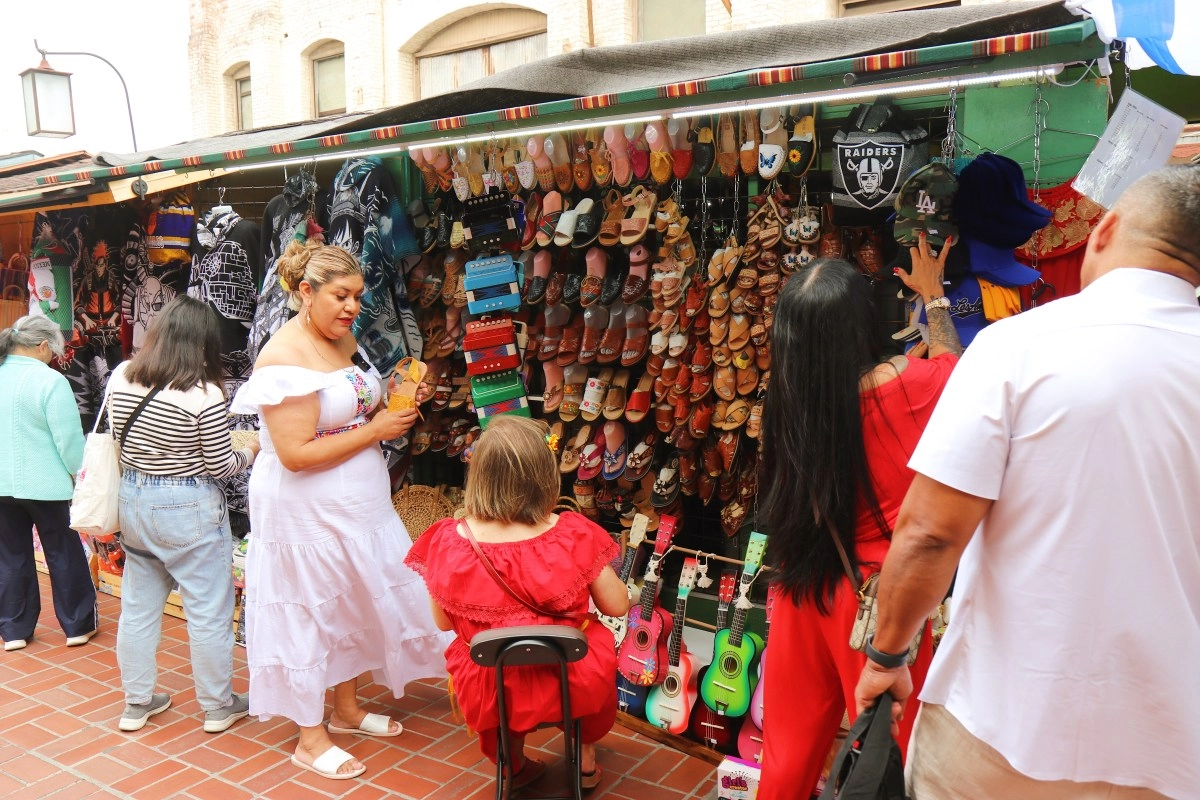

A few days ago, Daisy Ángel, a merchant at the Mexican crafts stall called “Carmelitas,” was full of joy, smiling from ear to ear, as she saw how Placita Olvera was filled with people. An image that, according to her, is not usually seen, especially in the last five years.
“It's a blessing because, in itself, there are many businesses here that are on the verge of closing because of how the situation has been,” says Daisy as a family of three stopped in front of her stand in search of some sandals.
Located in the place where Los Angeles was born, Olvera Street has been a cultural market full of life for all generations for more than 95 years. Families from Mexico and elsewhere founded businesses here that pay tribute to the gastronomy, crafts, music and traditions that define the city's roots.
But now this magical place is at risk of disappearing, and the local merchants and businesses of Placita Olvera are raising the alarm as they try to save a cultural and significant space for many of them.
“For us, it's about preserving tradition and culture, and continuing the legacy of this position,” explains Daisy. “It has been terrible to see how the original owners of several businesses here, with a history of several generations, have had to close because sales are no longer what they were.”
According to Daisy, she inherited the stall from her mother, who bought it from the original owner several years ago. To her, this little piece of Los Angeles means everything. She says that before they were open every day and now only on weekends, when she says there are usually a little more people. It is also stated that she and her husband now have another job during the week to complete what they do not do in their position.
“The pandemic affected us a lot and since then, things have not fallen into place,” Daisy said. “But I think nothing has affected us as much as the immigration raids that scared people.”
According to the Department of Economic Opportunity (DEO) and the Los Angeles County Economic Development Corporation, 82% of businesses interviewed reported negative effects resulting from immigration control measures, and 44% lost more than half of their income. The report on the beginning of the raids reported that 52% of businesses have reported a decrease in sales or daily income, and 51% have reported a decrease in customer attendance.
Many of these businesses are multi-generational family businesses that have been serving the community for more than half a century. However, today, the future of Olvera Street is in danger.
Another merchant, who prefers not to reveal her name, said she has seen a 60% drop in sales since the raids began. Her stall, which also sells Mexican crafts, has been in her family for four generations. Something of which she is very proud: that Sunday she showed us her pin that was given to her in recognition of her family for their long-standing business.
“You try to stay positive, but the truth is it's hard,” she said. "My daughter helps me sell, but we don't open during the week because it's empty here; we don't know what else to do to attract people. We don't want to disappear."
The donkey will be evicted
Ricardo Hernández, owner of the famous cart that many, including celebrities, have visited over the years to take a photo with the donkey, says he feels disappointed when thinking about the future of this place, which preserves so many memories for many.
In the 1960s, his parents, Jesús “Don Chuy” and María Tránsito “Tancho” Hernández, founded La Carreta, the home of the famous stuffed donkey known as Jorge. Now this business is about to close; On March 13, a Los Angeles judge ruled that Hernandez, the stall's owner, should be evicted.
In his final weeks of operation, Hernández found himself behind his computer at his post. Families still stopped to take photos with the famous donkey, adorning themselves with Mexican royalties.
“It's very sad to see the change; business has gone down and crime has gone up,” Hernandez said. "This is a very magical place, very familiar. The mayor's office should do everything possible to help these businesses, but it does nothing; it is impossible for us to negotiate with it."
He says that although his case is a little different from other businesses, he has also faced the same battles as other merchants. And in its final days of opening, he says he's only left with the memories he's made over the years.
"For me, the little square is my home; I grew up here; this business and my family have been part of people's memories, and I feel lucky. This small business is everything to me," he says. “When people come up to me and show me photos from when I was five years old, and now they come with their children, it's beautiful, it makes me sad to know that we will no longer be here.”
“I hope the mayor and other officials try to preserve this place as it should be; if not, I don't think everyone can stand another three years of this,” he added.
They ask for donations
For decades, millions of visitors from around the world have walked this historic street, discovering the heart of Los Angeles through the merchants who have kept its culture alive. Now, those same merchants are raising funds on GoFundMe to help businesses in the little square stay afloat and open.
Daisy and other businesses La Opinión spoke to said they are trying new strategies to attract more customers, such as hosting events or collaborating with other groups, as they did on a recent weekend with Queer Mercado, which held an event there and brought them new customers. On the account where they are fundraising, they say: “Our goal is not only survival, but also the preservation of a historic community.”
“When I was a little girl, I didn't realize how important this place was; to me, it was just my mother's job, but now that I'm older and bring my kids and walk around here, I appreciate every corner,” Daisy said, tears filling her eyes. “I don't want them to kick us all out, I don't want this place to disappear, it's too special.”