

“We lacked the penny for the peso,” coffee fans lament
The miracle they expected did not happen and Colombia said goodbye to the Soccer World Cup
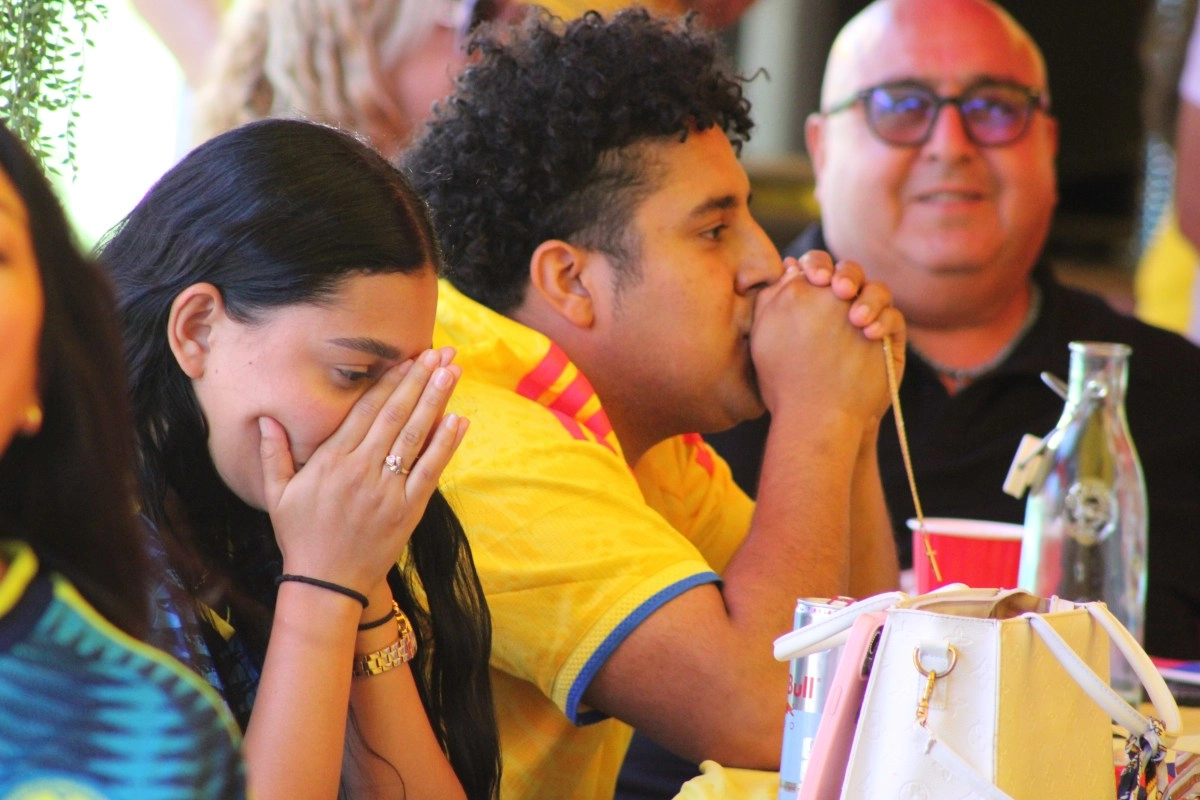

For more than 120 minutes, Fabrizio Méndez, an economics student at Cal State Northridge, clung to a crucifix and prayed with great faith to God for a “miracle” so that the Colombian soccer team would win the match against its Swiss counterpart.
However, the request of the young son of Colombians from Medellin did not come true: Colombia was eliminated in the penalty shootout of the Soccer World Cup.
"God is almighty. He is the one I asked for us to win, but his ways are not the same as those of man," said the coffee fan.
Disappointment took over the fervent Colombian fans, who could not believe the failure of their forward Jaminton Leandro Campaz, in the final minutes of regular time where he was able to define the destiny in favor of the South American team and bounced the ball over the crossbar.
"Unfortunately we reached the lottery and the lottery is like that. He who doesn't score the goals sees them scored," said Orlando Camargo, a worker in the production department of a Los Angeles garment factory.
Camargo said that Davinson Sánchez's penalty shot that hit the crossbar and the failure of Juan Camilo "Cucho" Hernández, whose penalty was saved by Kobel, the Swiss goalkeeper, were "fatal."
"We were short a cent for the peso," said Camargo, who never tired of shouting "Let's go Colombia! Let's go Colombia!"
The best participation of the coffee team occurred in the 2014 FIFA World Cup Brazil. In that edition, the South American team achieved a historic fifth place and reached the quarterfinals, where they were eliminated by Brazil, the host (2-1).
In that tournament, Colombia won all of its group stage matches and James Rodríguez established himself as the championship's top scorer with 6 goals, winning the Golden Boot and receiving the Puskás Award for the best goal of the year.
The lack of definition
“In the last game against Ghana I saw Colombia very strong,” said Ecuadorian Rafael López, husband of Colombian Yenny Salazar, from Bogotá. "In the penalty shootout the victory was for either of the two; the Colombian players arrived tired from so many trips between Mexico, the United States and Canada." The couple, residents of Los Angeles, were accompanied by their daughter Leslie.
Meanwhile, Tito Pineda, a 59-year-old Mexican-American carpenter, said that the coffee team "had been playing with strength in defense, and in attack, Lucho [Díaz] is very good, but he was not given the opportunity to score. Colombia lacked definition."
His wife, Adriana Godoy, a housekeeper and originally from Bogotá, stated that her love for football was inherited from Guiomar, her mother.
“My mother knew all the players on the national team by name,” he said.
At La Casita con Sabor Colombiano, Cristóbal Aguirre, a half-Salvadoran and half-Colombian bartender who lives in Los Angeles, shared his table with his compatriot Ariela Duarte and Guatemalan Rachel López.
“I had three tickets and my friends didn't come, so I didn't have any problem inviting the girls,” Cristóbal said.
While he enjoyed a mixed rice dish, Ariela said she could not eat anything that was not kosher food, food prepared according to the dietary laws of Judaism, which are based on biblical origins.
“The game was tight in the midfield,” said Juan Carlos Benavides, from Ibagué, who came to the United States to experience the Soccer World Cup with his wife Martha Guzman, his son Andrés, and his wife, Juliana Montero.
“Don't worry, when the weekly comes back there will be a goal from Colombia,” shouted Betty Valdez, an employee of the Colombian restaurant.
“Let the dessert come for free!” added Orlando Camargo, when the television signal went away, at minute 62 of the game.
Undeterred, his wife, Rocío Moreno, enjoyed a delicious ajiaco valluno, a traditional dish that originated in the Colombian Andes region, specifically in the Sabana area of Bogotá. It is a thick soup that is prepared with different types of potatoes, shredded chicken, corn, guascas (an aromatic herb), onion, garlic and heavy cream.
“Double dessert!” Camargo demanded when, for the second time, the broadcast signal was lost, at minute 79.
Orlando Camargo analyzed that it was a close match between two teams that used all their tactics to maintain containment.
“As we said when we played in the street, whoever scores a goal wins and will advance to the next round,” he commented. "Colombia made history in the World Cup with a compact team and notable sacrifice. We played a good game and we died with our boots on...and well, whoever wins enjoys it, and Switzerland beat us."