

What role is the US playing in Venezuela after the devastating earthquakes that left thousands of dead?
The US has been the country that has provided the most economic and operational aid in the face of the emergency that Venezuela faces after the double earthquake

A few hours after the shocking US military operation in which Nicolás Maduro was captured on January 3, President Donald Trump surprised the world with a no less controversial statement: “We are going to lead the country [Venezuela] until we can carry out a safe, adequate and sensible transition.”
Seven months later, the United States is leading international efforts to help Venezuela after the double earthquake that hit that country on June 24, causing more than 3,500 deaths and leaving tens of thousands of people homeless.
Less than a day after the double earthquake, Washington had already announced that it was going to allocate US$150 million to help address the emergency in Venezuela and that it would send more than 250 people, including firefighters trained in rescues under collapsed structures, doctors, paramedics, and engineers specialized in risk assessment in buildings.
Additionally, through the Southern Command, the US has assigned transport planes, helicopters, Navy ships and heavy machinery to deal with the Venezuelan tragedy.
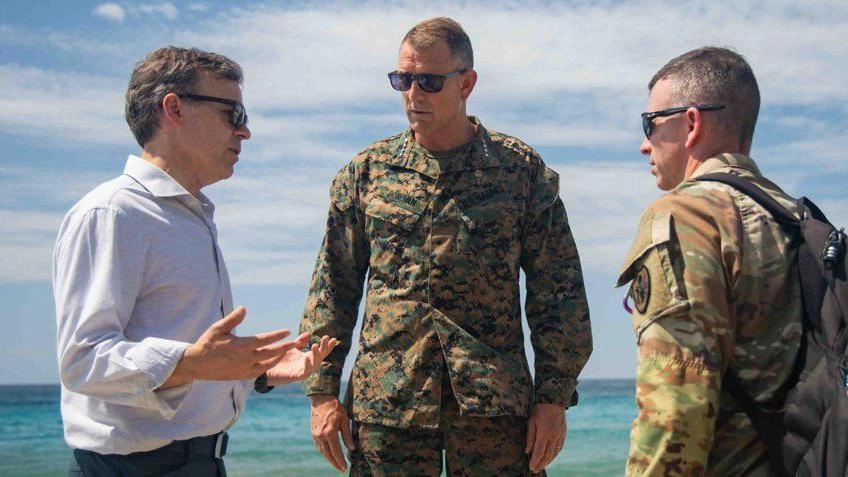
But its officials, led by the head of the Southern Command, General Francis Donovan, and the charge d'affaires of the US embassy in Caracas, John Barrett, have also met with the Venezuelan authorities, among them with the most controversial member of the interim president's cabinet, Delcy Rodríguez: the Minister of the Interior, Diosdado Cabello, whom Washington accuses of being a narcoterrorist and for whom it offers a reward of US$25 million, which has generated controversy.
These elements, together with the “excellent” relations with the interim president that Trump often brags about, as well as Washington's alleged refusal to allow the opposition leader, María Corina Machado, to return to Venezuela, are raising doubts about the role that the US is playing in the current emergency that Venezuela is experiencing.
“The gringos have arrived, dad.”
In a video that went viral in the days following the double earthquake, a man wearing a yellow helmet is seen celebrating the arrival of US forces while in the background the flight of an MV-22B Osprey helicopter can be seen.
"Bravo. Let's go. The gringos have arrived, dad, the humanitarian aid," the man shouts to the camera with a Venezuelan accent while behind him you can see a Venezuelan military truck in which several uniformed men are getting into.
One of them approaches and greets him. He is a blonde man who wears a field uniform with what appears to be the patch of Delta Force, the special operations unit of the US Army, on the shoulder.
The man in the helmet greets him and says: “Welcome to Venezuela!”
After the catastrophe, the US has been - by far - the country that has allocated the most resources to Venezuela.
Until July 8, Washington had allocated more than US$386 million in aid to the country.
It has been channeled through different non-governmental organizations such as the International Federation of the Red Cross and UN agencies such as Unicef or the World Food Program “providing emergency medical aid, food assistance, water and sanitation, shelters, protection and logistics,” as noted in a press release by the State Department.
The State Department claims to have delivered "more than 400 metric tons of basic aid - shelter kits, hygiene kits, buckets, tarps and kitchen sets - benefiting some 70,000 people. These supplies, financed by the United States, provided immediate relief to communities throughout Venezuela," the statement said.
In addition, it announces the establishment of a “humanitarian air bridge” in which the State Department, Amazon and Airlink will participate, an NGO that serves as a link between the aeronautical and humanitarian sectors to deal with disasters.
The idea is to carry out weekly flights to send humanitarian aid from Miami directly to Maiquetía, the Caracas airport, where a World Food Program aid logistics center will receive it and deliver it to the NGOs that will be in charge of distributing it on the ground.
In that effort, the State Department will be in charge of coordinating with the government of Venezuela, Airlink will organize shipments according to the priorities of the moment and Amazon will transport the aid for free to Venezuela.
But US assistance has gone beyond search and rescue operations for victims and survivors or the provision of humanitarian aid.
From day one, Washington inserted itself into the center of crisis management and, in fact, the day after the double earthquake, forces from the Southern Command were at the Maiquetía International Airport - which is not only the most important in Venezuela, but is located in Vargas, the state hardest hit by the earthquakes - to evaluate the damage it had suffered and put it into operation as soon as possible to deal with the emergency.
Since then, US forces assumed control of air traffic at the airfield, as well as the logistics of humanitarian aid arriving in Maiquetía, as General Donovan explained this Tuesday during a virtual press conference.
Washington also undertook a massive mobilization of resources that included Air Force C-17 aircraft to transport search and rescue equipment, and cargo-moving machinery; Army CH-47 Chinook helicopters to transport personnel and supplies; Marine Corps MV-22 Osprey aircraft; and Navy ships to support ground operations and transport supplies.
One of these ships, the USS Fort Lauderdale, had participated in the maritime blockade that led to the operation to capture Maduro and now, in the midst of the catastrophe, it became the first US Navy ship to dock in a Venezuelan port in decades.
By early July, Southern Command reported that there were almost 2,000 US troops participating in relief operations.
Logistics, one of the strengths of the US
Although American rescuers have already left Venezuela, Donovan said his country's forces will remain there until "we are no longer needed." He indicated that they are focused on helping to manage the airport and seaport, providing air and land transportation, as well as heavy machinery and logistics.
And logistics is, precisely, one of the greatest strengths of the United States.
"The United States has such a logistical capacity that I don't think there is any other country with a comparable capacity. I think not even China," says Charles Scawthorn, a structural engineer with extensive international experience in managing disasters caused by earthquakes, to BBC Mundo.
Scawthon adds that, given the geographical proximity to Venezuela, “I believe that the great contribution of the US will be logistics: the transportation of food, construction materials and heavy machinery.”
Money and politics
The US$380 million it has contributed to the emergency in Venezuela clearly places the US at the head of all international efforts to help that country.
Until this Wednesday, the Ruta de Ayuda website, prepared by the NGO Transparencia Venezuela, placed Washington as the first donor with US$300 million, followed by China with US$14.7 million and, in third place, Italy with US$10.8 million.
But that notable contribution has not saved the US from criticism.
Speaking to The New York Times, Javier Corrales, a professor of political science at Amherst College, pointed out - for example - that it is difficult to consider US aid as generous if one considers that since Maduro's capture the Trump government assumed control of Venezuela's oil revenues, which are many times greater.
According to estimates published by the Council on Foreign Relations, Venezuelan oil sales during the first four months of 2026 were almost 100 million barrels, worth approximately US$8 billion.
However, to date the US government has not reported exactly how much oil has been sold, how much money has been generated and what has happened to those resources.
"When you analyze, given the amounts and proportions, it is not that this aid is an exorbitant thing. Rather, it is a very small thing for the magnitude of the needs," Carmen Beatriz Fernández, political consultant at the firm Datastrategia, tells BBC Mundo.
Despite this, overall the volume of US aid has not been a particularly contentious issue.
In fact, a survey carried out in the days following the earthquake, to which BBC Mundo had access, shows the US as the international actor in which Venezuelans have the most confidence that it will contribute to the management of the crisis and the reconstruction after the earthquakes.
According to the survey, 75% of those surveyed had confidence in Washington, while only 11% did not. Trust in the European Union stood at 59%, in the UN it was 48%, while in China it reached 39% (the same proportion that did not trust that country).
The biggest noise surrounding the United States' actions seems to have focused on two different, but linked, elements. The first of them has been the public meetings of Donovan and Barrett with Diosdado Cabello.
The publication in the media and social networks of photos of Cabello greeting and chatting animatedly with senior US officials has generated doubts and discomfort on social networks.
"See you at the voting stations on Tuesday, November 3 and you will see the embrace of the Latino vote in the US. Great speeches that do not want socialism, communism, drug trafficking and terrorism in the US but embrace and praise the biggest bosses and representatives of the American continent. Shame," wrote political analyst Esteban Gerbasi in a message on X.
In the publication he warned about the negative effects that these images could have for the Trump government in the midterm elections, and accompanied the message with the photo of Barrett talking and placing her hand on Cabello's arm.
The photographs were taken in the context of the meetings that the US representatives held with the Venezuelan authorities with the aim of coordinating humanitarian assistance to respond to the emergency caused by the earthquakes.
Humanitarian aid or rapprochement with Chavismo?
However, they were interpreted differently: in some cases as a reflection of the ongoing emergency; in others, as a sign of an approach by the US government towards Chavismo, which would indicate that the US has no real plans to promote a democratic transition in Venezuela.
"What is surprising is the image. Perhaps the cordiality of the moment is surprising. That is what people question, but evidently the United States is assuming that very pragmatic position [of dialogue with the Venezuelan authorities, including Cabello], but that does not necessarily mean that it is the definitive position," says Carmen Beatriz Fernández.
“These images create a short circuit in a population that is very sensitive and, in addition, very indignant at the government's inaction during the first hours after the earthquakes,” he adds.
The discomfort caused by the photos with Cabello is explained in part due to the high levels of rejection that he has among a large part of the Venezuelan population.
According to the survey carried out at the end of June, 9% of those surveyed have a positive assessment of Cabello and 73% have a negative assessment.
Fernández considers it “very hasty” to come to the conclusion that these photographs announce that there will be no transition due to an understanding between Chavismo and the Trump government.
"I don't see it that way. I think the US is having a rapid response in the context of a catastrophe and that means keeping the goats inside the corral. It's something that makes sense. In addition to the fact that they already understand each other with those authorities. It's not that they are enemies of those authorities, quite the opposite," he points out.
The second element that has made noise about the US's actions is the information that suggests that the Trump government is upset with the requests of the opposition leader, María Corina Machado, to be allowed to return to Venezuela, where she left last December to receive the Nobel Peace Prize.
According to the digital media Axios, unidentified US officials described Machado's attempts to return to Venezuela as “political opportunism.” “She wants to take a photo delivering our help,” said one of them.
Officially, the United States has not made a clear statement on whether it is blocking Machado's return.
The head of the Southern Command and the charge d'affaires in Venezuela implied in a press conference that this was not the case, and pointed out that the United States did not control the Maiquetía airport, but rather "helped with air traffic control."
There was also no direct response from them to the question of whether the meetings with Cabello implied any change in the US's perception of him and whether they had eliminated the bounty on his head.
Paradoxically, Cabello's photos with US officials have also generated noise in the Chavismo ranks.
“You can't see more photos of our supposed leaders hugging, touching their shoulders or talking to the same people who bombed us or who at least are representatives of the government that bombed us on January 3,” complained Mario Silva, a radical Chavista who for decades hosted the program “La Hojilla” on the state television station VTV, which came to an end after the capture of Nicolás Maduro.
“Those photos should cause the most sting to those who are Cabello's allies and the people who have been listening to his anti-imperialist and 'they will not pass' speech for decades and now see him as obsequious to the Americans,” explains Fernández.
In any case, beyond the controversies surrounding the role that the United States plays in managing this crisis in Venezuela, the expert attributes credit to that country for the large volumes of aid that is reaching Venezuela.
“Actually, a lot of humanitarian aid is coming because the United States is allowing it,” he says.
Fernández points out that this situation contrasts with the one experienced in 2017, when in Venezuela there was a hunger crisis but humanitarian aid could not enter because the government "did not let it in or took it for itself."
"Now aid is being received by NGOs directly from the State Department or directly from donors. In other words, it is different and I believe that the United States is having more influence in decision-making," he concludes.