

Who must earn a $25 minimum wage in California starting July 1
California raised the minimum wage to $25 per hour for certain workers starting July 1, 2026. Who should start receiving it?
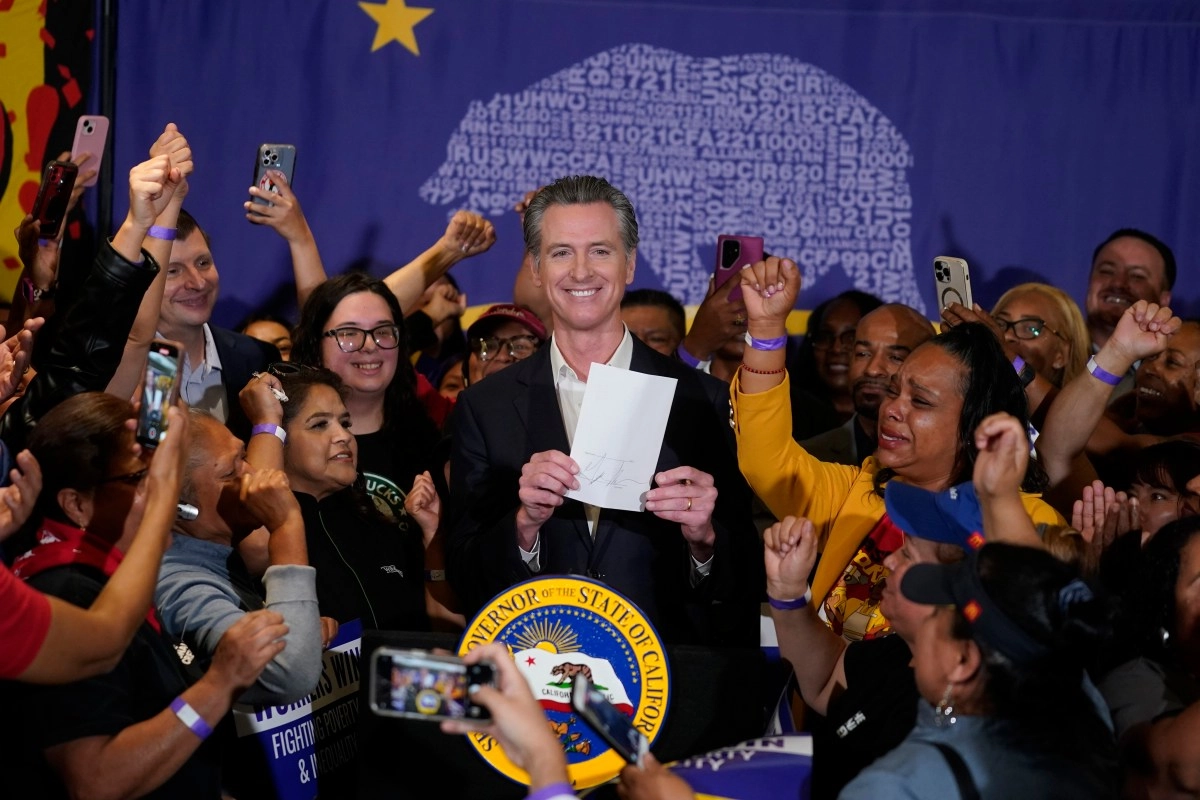

Starting in 2023, the California government established different gradual minimum wage increases for certain productive sectors in the state. Applying that law, as of July 1, 2026, a specific group of employees must have received a minimum wage of up to $25 per hour. This is important to know, because if you are one of the beneficiaries, you should see it reflected in your next paycheck.
After clarifying that the change does not apply generally to all state workers, in reality, it is a progressive expansion linked to the Senate Bill, SB 525, signed in 2023 by Governor Gavin Newsom, which establishes differentiated salary increases within the health system. The objective is to increase income in one of the sectors with the highest labor demand in California.
According to the University of California, Berkeley Labor Center, the $25 per hour increase will take effect for employees of healthcare facilities with more than 10,000 full-time workers. This category includes large hospital systems and dialysis clinics.
This increase is part of a salary ladder that already began in previous years: the salary in this industry rose to $24 dollars last year and increased again in July 2026 until reaching $25 dollars per hour, it was detailed in the CDF Labor Law LLP.
Nor are all healthcare workers in California included in this wage level; SB 525's outline divides employers into different groups based on their size and type of operation.
In a second category are community clinics, urgent care centers and medical groups with 25 or more doctors. For these employees, the minimum wage increased to $22 as of July 1, 2026. In this case, the payment of $25 per hour will be reached until 2027.
Another group includes smaller hospitals and health agencies. In these centers, the minimum wage will start at $23 during 2026 and will reach $25 until July 1, 2028.
Workers who work in independent hospitals or facilities that care for patients on programs such as Medi-Cal and Medicare face an even more extended schedule. They currently receive about $18 per hour and, according to the California Medical Association (CMA), the adjustment to $25 will not occur until 2033.
This process of phased increases occurs in a context in which California has already applied a general adjustment to the state minimum wage since January 1, 2026. The base payment went from $16.50 to $16.90 per hour, as part of an automatic cost-of-living adjustment.
Furthermore, workers in the health sector are not the only ones who have benefited from salary increase schemes. Fast food workers employed by chains with more than 60 national locations currently receive $20 per hour, reflecting the trend of sectorized wages within the California economy.
Additionally, in various parts of the United States, more than a dozen states have updated their salary floors in 2026, while others keep the federal wage of $7.25 per hour unchanged, marking a strong disparity in the country's labor market.
In parallel, some states continue to schedule staggered increases during the rest of the year. Alaska will adjust it to $14 dollars from July 2026, Florida will reach $15 dollars in September, while states like Washington and New York maintain levels higher than $16 or $17 dollars per hour, depending on the region.