

The graphics that show the Colombia that the next president will inherit
Gustavo Petro's successor will govern a country with fewer poor people, but with serious public order challenges
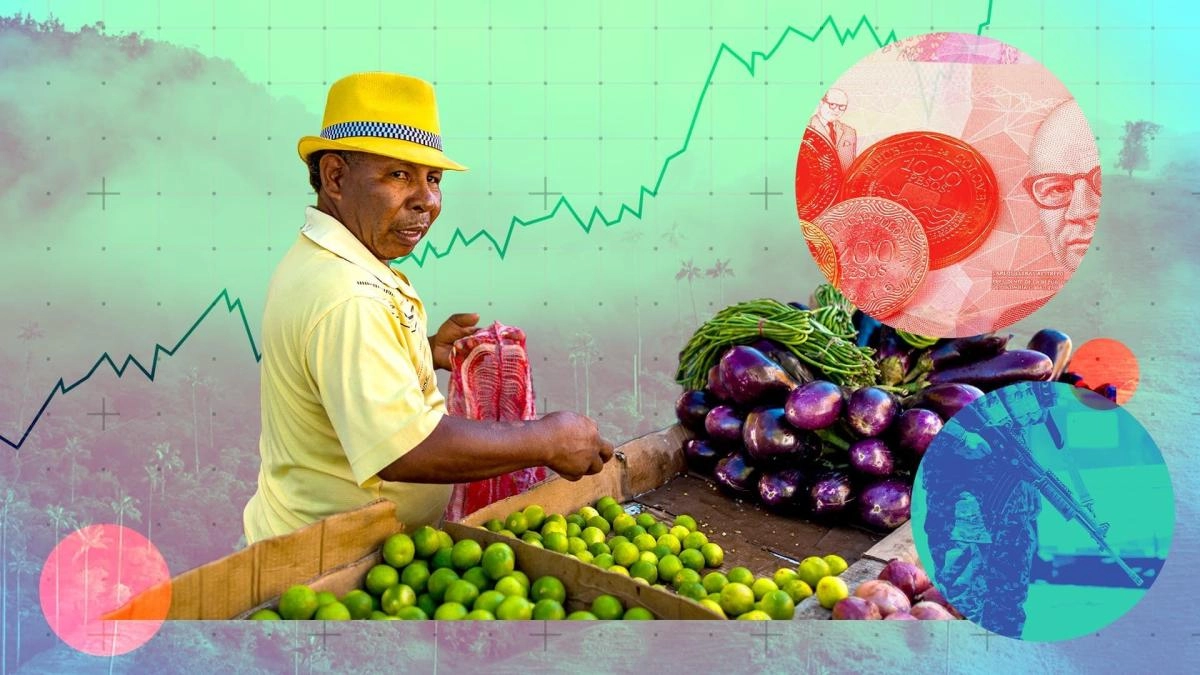

Which Colombia will the new president find?
According to the polls for this Sunday's elections, the Petrista senator Iván Cepeda, the right-wing lawyer Abelardo de la Espriella and the Uribe senator Paloma Valencia are those who have the best options to pass the second round on June 21.
Whoever wins will inherit from Gustavo Petro's government a country with less poverty and a growing economy, but one that faces serious security challenges and whose health system has citizens increasingly dissatisfied.
These are some data that show what the country that whoever takes office on August 7 will govern is like.
1. Homicides do not stop and armed groups grow
According to the most recent Colombia Opina survey by Invamer for Noticias Caracol and Blu Radio, 40.8% of Colombians consider that Colombia's main problem is public order.
It is an issue that the candidates themselves, especially on the right, have had as a banner during the campaign.
The concern of voters recorded in the polls coincides with a deterioration in several security indicators, according to figures from the government itself.
Reports show a growth in armed groups, coca crops and crimes such as kidnapping and extortion in recent years.
Theft, in its different modalities, was reduced, although experts warn of great under-reporting.
In 2025, the homicide rate – the indicator most often used to evaluate security globally and compare countries – was the highest since 2021, according to data from the Ministry of Defense.
And it surpassed that of all other Latin American countries for which comparable data is available, except Ecuador, according to the InsightCrime think tank.
Despite the demobilization of more than 13,000 armed men and women following the peace agreement with the FARC guerrilla in 2016, the homicide rate in Colombia has remained relatively stable over the last 10 years. It is four times higher than the global average.
In 2025, 14,000 people were victims of homicides, of which 93% were men. Valle del Cauca, Guaviare and San Andrés were the most affected departments.
Independent reports explain that violence and insecurity have in part to do with disputes over territorial control and illicit income between armed groups.
Actions such as the simultaneous attacks in several parts of the country in August 2025 and April 2026, and the assassination of the right-wing presidential candidate Miguel Uribe are signs of violence that, despite the multiple transformations it has undergone, does not end.
The Clan del Golfo —which emerged from the demobilization of the paramilitaries during the Uribe government—, the ELN —a historical guerrilla that was born in the 1960s and now operates between Colombia and Venezuela— and the different FARC dissidents that emerged after the 2016 agreement are the main players in a series of regional power struggles for control of businesses such as drug trafficking and illegal mining.
Petro's government sat down to negotiate with all these groups as part of its total peace policy.
But neither those negotiations, most of which arose without reaching any agreement, nor the military operations that intensified since the middle of the Petro period managed to stop armed expansion.
According to the Ideas for Peace Foundation, in 2025 territorial disputes increased and displacement grew.
According to the CORE Foundation, all but one organized armed group grew stronger militarily, economically and politically between 2018 and 2025.
As a whole, the organized armed groups in Colombia currently reach a number of armed men similar to those who demobilized after the 2016 agreement, according to the count made by the Public Force.
2. More coca, more seizures
The strengthening of armed groups is related to drug trafficking, although this is not their only business.
For years, the area cultivated with coca has been one of the main indicators to evaluate the results of the fight against drug trafficking, which has a central importance in Colombia's relationship with the United States.
That figure, in the latest report published by the United Nations Office on Drugs and Crime, was at an all-time high.
In 2023, more than 252,000 hectares of the national territory were planted with coca, about six times the size of Medellín.
After the publication of that data, Colombia's fight against drug trafficking was decertified by the US government. The State Department described the Petro government's anti-drug policies as “disastrous and ineffective.”
The president argued that the United Nations made methodological errors that overestimated Colombia's potential cocaine production.
“The Trump government decertified us on the basis of this trap, this lie,” the Colombian president said in October.
In a statement, UNODC acknowledged that its potential production data “is limited to have a more accurate picture.”
The discussion between the government and the UN over the methodology delayed the publication of the 2024 data not only on potential cocaine production, but also on cultivated hectares, which is why there are no known figures that account for the results of Petro's anti-drug policy during most of his mandate.
The president, however, emphasizes that cocaine seizures increased significantly during his government. In 2025, they reached close to one million tons and exceeded those of 2021 by 47%, the best year of the government of his predecessor, Iván Duque.
Some experts speculate that there may be more seizures simply because there is more cocaine.
At the same time, eradication fell drastically during the Petro government: it went from 103,257 hectares in 2021 to 8,051 in 2025.
BBC Mundo asked the Directorate for Substitution of Illicit Crops for data on hectares substituted per year, but did not receive a response until the time of publication of this article.
3. Less poor, higher minimum wage
The deterioration in security contrasts with a series of relatively favorable economic indicators.
According to data from the National Administrative Department of Statistics (DANE), the monetary poverty rate in Colombia in 2024 was 31.8%, the lowest since the measurement was carried out with the current methodology.
This was highlighted by President Petro in a recent speech. “We have managed to reduce monetary poverty in Colombia to where no president had achieved.”
According to a study by the Bank of the Republic, the reduction registered between 2021 and 2024 is equivalent to 3.4 million people having managed to escape poverty.
The same study indicates that factors such as the recovery of labor income after the pandemic, government aid and remittances influenced the fact that there are fewer poor people in Colombia today.
DANE data also show a growth in the middle class, which went from 28% of the population in 2021 to 34% in 2024.
However, ECLAC estimates that the poverty rate in Colombia continues to be one of the highest in Latin America.
Among 12 countries in the region for which that institution had comparable data, Colombia registered the second highest poverty rate in 2024, only surpassed by Honduras.
Colombia's monetary poverty rate exceeded that of Brazil by 18 percentage points, Mexico by 9 points, and Argentina by one.
At the same time, the purchasing power of the 2.4 million Colombians who earn the minimum wage (approximately 1 in 10 workers in the country) increased between 2025 and 2026 more than ever before in the country's recent history.
President Petro's controversial decision to increase the minimum wage by 23% at the end of last year resulted in each worker earning that wage now having 250,807 pesos a month (about US$66) more to spend than last year. It's about the price of a blender or a low-end cell phone.
The increase—well above inflation and without a significant increase in productivity—was strongly criticized by economists, who warned that it would end up triggering inflation, unemployment and informality.
The figures so far this year show that unemployment did not increase, but inflation did. That of the first quarter of 2026 was the highest since the first quarter of 2023.
4. Growth and deficit
After a couple of years with low growth (2023 and 2024), the Colombian economy rebounded and reached growth of 2.6% in 2025.
With this, it reached a level similar to that recorded in the years prior to the pandemic and was slightly above the regional average, according to ECLAC data.
DANE states that the country's recent economic growth has been driven mainly by public spending, commerce, transportation, tourism and restaurants.
For the dean of Economics at the Universidad de los Andes, Hernando Zuleta, this raises alarm bells.
“The recovery has to do with public spending that is growing rapidly,” says Zuleta. "That is not sustainable. We already have a gigantic debt. The government is in primary deficit, which means that to finance current expenses it needs new debt."
Therefore, he argues, a large fiscal adjustment is needed, and “when there is one, we will have a recession.”
ECLAC, however, estimates that Colombia's GDP will grow by 2.5% in 2026, again slightly above the South American average.
5. Health complaints
The health system in Colombia is going through a crisis.
In the Invamer survey, when asking Colombians what issues the next president of Colombia should focus on, 72% mentioned quality and health coverage.
More than 95% of the country's population is covered by the health system, but this does not always imply effective care.
Figures from the Health Superintendency show that, from 2024 to 2025, requests, complaints and claims from Colombians for the care they receive from Health Promotion Companies (EPS) increased more than 27%.
Patients complain that they are denied medications and procedures, and that there are insufficient medical appointments available, especially with specialist doctors.
In Colombia, the State delivers health resources to companies (public, private and mixed) that are responsible for managing them and insuring Colombians.
These companies have been saying for years that the money they receive is insufficient to guarantee the service, in accordance with what Colombian law and jurisprudence requires.
Precisely because of its financial problems, the Petro government intervened in eight EPS, including some of the largest in the country, which means that it assumed the management of these and their 20 million affiliated patients.
If the government fails to save them from bankruptcy, these patients (64% of the total number of members of the system) will be left in an uncertain situation. They will have to be transferred to other entities, which may not be able to care for them.
The Comptroller's Office says that companies that were intervened by the government are experiencing “critical and sustained deterioration” and have more dissatisfied users.
For all these reasons, health has been, perhaps more than in any other recent presidential election, one of the nodes of the discussion between the candidates.
On this, as on other issues, the debate has largely revolved around the role of the Petro government: Iván Cepeda represents continuity, while Abelardo de la Espriella and Paloma Valencia propose a change of course.
In any case, both in health, security and economy, whoever is elected this Sunday (or on June 21 in the second round) will find a country with structural challenges.
And it will have to demonstrate that it can confront trends that, in many cases, come from much earlier.