

The “World Cup album of missing people” from a search group in Mexico
The Luz de Esperanza Jalisco collective created a series of stickers in the style of albums of soccer World Cup players, but with missing people
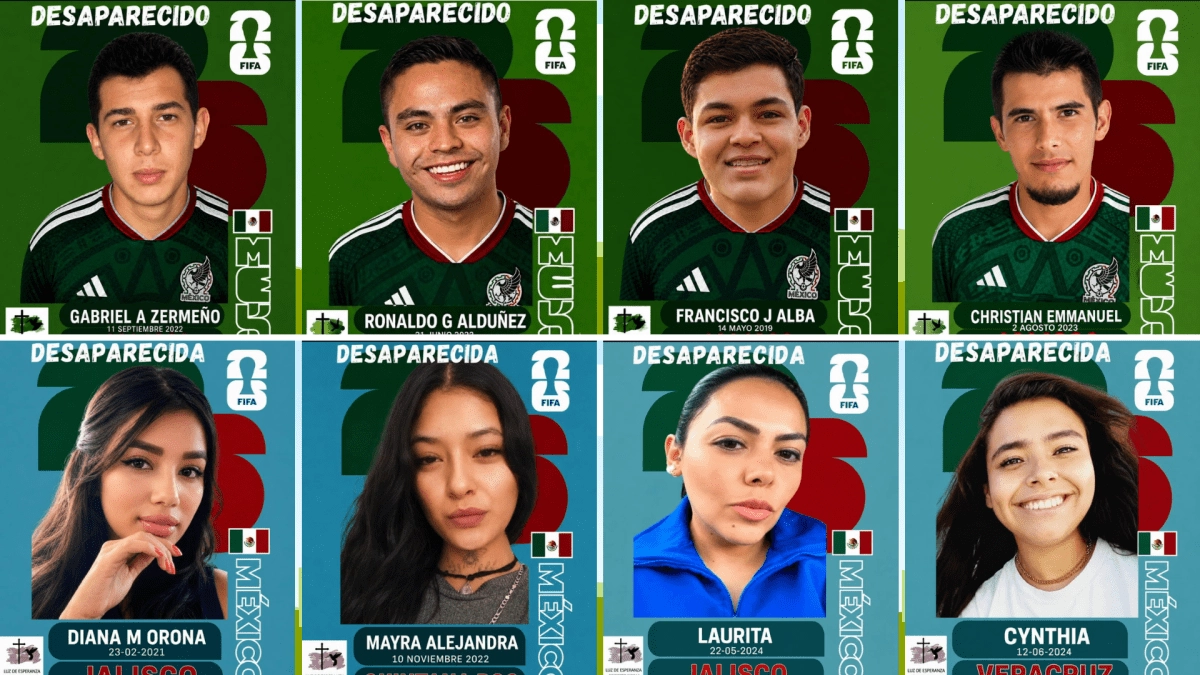

Amid growing excitement over the upcoming start of the Soccer World Cup on June 11, a collective of searchers for people missing due to violence in Mexico is creating a moving sticker album.
The activists of the Luz de Esperanza collective of Jalisco, many of them fathers and mothers of men and women missing in that state, have published a series of World Cup-style prints with images of their unlocated loved ones.
With photos of the families, in which the young people appeared smiling, the faces appear on the cards with the same design used in the popular Panini album of the 2026 World Cup being held in the US, Mexico and Canada.
One of the venues for the championship is Guadalajara, a city located in the state of Jalisco that holds the first place in disappearances in all of Mexico.
The vast majority of those not located are young people, under 30 years old.
The idea of this album, says the collective's spokesperson, Héctor Flores, is that the international attention that it will attract to the city of Guadalajara - host of four matches of the 2026 World Cup - also helps to make visible the fight they carry out every day to find their loved ones.
"We hope that visitors join in the memory actions that we are going to be carrying out during the World Cup. There will be cascaritas (short soccer games) and mobilizations and we hope that people join in, are empathetic and that the reaction crosses borders so that the serious human rights violations that are happening in the country stop," Flores tells BBC Mundo.
Pain in the middle of the party
With at least 16,000 formal complaints (to which are added thousands of unreported cases), Jalisco is the state in Mexico with the most cases of missing people.
The western state of Mexico also has a high rate of violence, a product of the drug trafficking and extortion activities of organizations such as the Jalisco New Generation Cartel (CJNG).
The criminal group is also responsible for the forced recruitment of young people, many of whom are deceived with common job offers and end up being forced to collaborate with the CJNG and are left incommunicado.
That and the slow action of the authorities in response to reports of disappearance has led many relatives of the missing to organize and search for their loved ones on their own, such as the Luz de Esperanza Jalisco collective that emerged in 2021.
“We started in 2021, following the disappearance of my son (Daniel),” explains Héctor Flores.
Since then, dozens of parents and activists have joined the group to carry out search work, including the excavation of sites where there are indications that those who died from criminal violence were buried.
And with the World Cup atmosphere that has been experienced in recent weeks in Guadalajara, the group had the idea of generating visibility to the problem of disappearances with the stickers.
“We started this campaign on social networks with the help of artificial intelligence when we saw that our children were talking about the World Cup and how there is a forgetfulness towards disappearances,” explains Flores.
In addition to the “World Cup pictures,” they created other images of fans of the Mexican National Team supporting the team, but also asking about their absent sons or daughters.
“The ball is back on the court, what about our missing people?” is the message that accompanies their publications on social networks.
"The idea is that, with this campaign, it is shown that those we are missing are also Mexican, they are important, they are people who should be named. But with this fury of the World Cup, it seems that they are going to second or third place," says Flores.
“It is an effort to continue naming them and draw attention, raise awareness and make people who like football empathize.”
Although the majority of missing youth in Jalisco and other parts of Mexico are men, there are also a high number of women who are victims of kidnapping or forced recruitment, and in the worst cases, feminicide.
That is why they have also been included among the World Cup cards for the men's soccer championship that begins in June.
“We will continue to demonstrate”
Like other World Cup venues, the city of Guadalajara has been preparing its public spaces and road infrastructure with an investment of close to US$200 million by the state and federal governments.
For critics, such an amount of resources in favor of the championship and for the benefit of the FIFA organization is not justified and masks problems that will continue to be neglected in the state, such as public insecurity.
The Akron stadium, where four games will be played, is in fact located a few hundred meters from undeveloped land where searchers have found at least 10 clandestine graves of human remains.
Collectives such as Luz de Esperanza Jalisco insist that they will not stop their activities and demonstrations for the missing during match days and the various festive activities for the World Cup.
"So far the authorities have not commented or hinted at anything to us. But even if they did, they are actions that families will continue to do regardless of the authority's position," says Flores.