

Gerrymandering: why a new electoral map made Democratic legislators flee Texas and could be arrested
The attempt to modify the electoral map of the Lone Star State has further sharpened the political dispute in the United States.
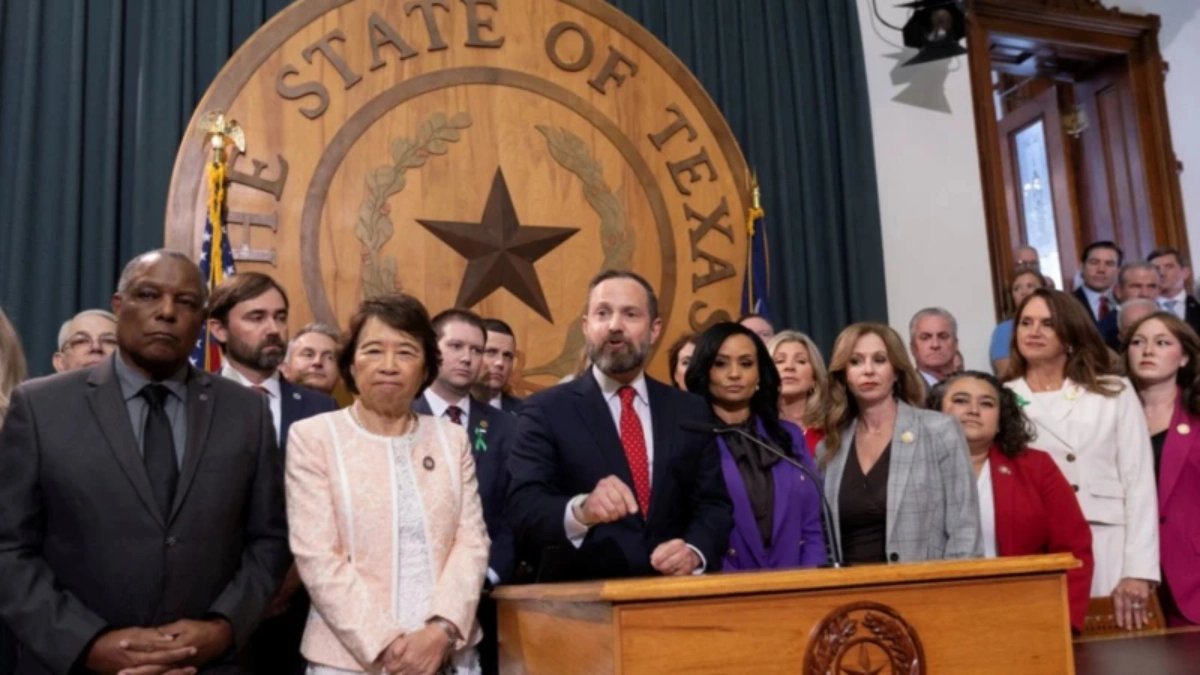

The design of a map in Texas has further aggravated the political battle between Republicans and Democrats in the United States.
The Republicans' attempt to establish a new electoral district map that would favor their interests in next year's legislative elections, allowing them to win 5 additional seats in the House of Representatives in Washington, met with firm opposition from Democrats in the Texas Assembly and has triggered a political standoff of uncertain outcome.
Dozens of Texas Democratic legislators fled the state to prevent the state Assembly from reaching the quorum required to approve the change to the electoral map promoted by the Republicans.
They accuse their rivals of pushing for a new distribution of voters to favor the electoral interests of the Republicans and Donald Trump, who personally asked the governor of Texas, Greg Abbott, the approval of the new electoral map.
Republicans reject the accusations and Governor Abbott issued search and arrest warrants for Democratic legislators to force them to vote.
This confrontation has at its center a new episode of "gerrymandering," a common practice in the United States of modifying electoral districts for partisan interests.
How did "gerrymandering" arise and why are Republicans trying to apply it now in Texas?
Where does all this come from?
Americans are familiar with the term "gerrymandering."
It was coined in the 19th century by Elbridge Gerry, the governor of Massachusetts who in 1812 signed a law that artificially divided the electoral strongholds of his political rivals.
Gerry is considered one of the Founding Fathers of the United States. The son of a wealthy merchant, He contributed large sums of money to the Revolutionary War effort against the British and participated in the Second Continental Congress in Philadelphia in 1775, where the foundations of the new nation were laid. A congressman since 1789, Gerry became vice president in 1815 under President James Madison. However, it was during his time as governor of Massachusetts that he used one of the most common electoral tricks in the US: the redrawing of electoral districts to maximize his own results and minimize those of his opponent. Gerry passed a new law that designed unnatural shapes and cut Essex County, until then a stronghold of his Federalist rivals, into several pieces, benefiting thus to the Democratic-Republicans of which he was a member.
One of the districts he drew was shaped like a salamander, so the press of the time coined the verb "gerrymander", combining the governor's surname with the salamander.
Since then, different parties have resorted to "gerrymandering" to boost their electoral representation.
In the past, it was also a resource to make the votes of African Americans and other minorities carry less weight.
It is common for states to redraw their electoral districts every ten years to reflect changes in population that result from the census.
The last U.S. census was completed in 2020, and changes to electoral maps like the ones being pushed for in Texas in the middle of a decade are unusual.
What's happening in Texas and why
The current controversy stems from the attempt by Texas Republicans to increase their number of seats in the Washington House of Representatives in order to retain the majority they currently have in that chamber, which could be jeopardized in the November 2026 midterm elections.
Democrats have their sights set on those elections. They want to regain their majority in the House of Representatives in an effort to curtail Trump's current hold on key institutions.
The Republican majority in the Texas state legislature is pushing for a redrawing of the state's electoral district map that would create five districts that include areas where Donald Trump won a landslide in the last presidential election.
Under the new electoral map, five of the Texas seats currently held by Democrats could potentially go to Republicans, according to forecasts.
Texas Democrats have denounced the new district lines as following "racial lines" and as a form of "racism."
Brian Harrison, a Republican representative in the state Assembly, told the BBC that the Democrats' accusations of racism were "grotesque, cynical, dishonest" and "completely absurd."
To prevent the change that the Republicans want from passing, the Democrats have absented themselves from the state legislature, since without them there is not a quorum required for the vote.
Two-thirds of the 150 legislators in the state Assembly must be present and the absence of more than 50 Democrats makes that impossible.
The Democrats decided to leave Texas until the special legislative period currently underway ends in two weeks.
With them absent, the Republican legislators voted on a motion that instructs Texas law enforcement to arrest them and hand them over to the state Capitol. Shortly afterward, Republican Gov. Greg Abbott issued warrants for the Democrats, accusing them of “abandoning their duty to Texans.” Fellow Republican State Attorney Ken Paxton wrote in X that he should “use every tool at our disposal to capture those who think they are above the law.” But both the Republican motion and Abbott’s arrest warrant are valid only within Texas, and J.B. Pritzker, the Democratic governor of Illinois, where the majority of Democratic lawmakers are located, said he would “everything I can to protect each and every one” of them.
Democratic lawmaker Ron Reynolds told the BBC from Chicago that the threats of arrest are nothing more than “a scare tactic.”
How it affects Trump
The latest attempt at gerrymandering in Texas comes just over a year before the midterm elections, which are shaping up to be a crucial milestone in the Democrats’ attempt to regain the initiative and begin to limit Trump’s power.
The battle for the legislature is looking fierce, and both Democrats and Republicans have launched a no-holds-barred fight for every seat in Congress.
Republicans now have 220 legislators in the House of Representatives, compared to 213 of the Democrats, a slim majority that Trump wants to maintain, aware that the party of the president in office usually loses support in the midterm elections.
Trump made his plan for Texas clear in a comment to the reporters following him: "A very simple redraw and we'll gain five seats," he said.
The president now has Republican majorities in the House of Representatives and the Senate, and a majority of conservative justices on the Supreme Court.
Observers agree that in the first months of his second presidency, he has attempted to de facto expand presidential powers, so taking back Congress and thus being able to stop Trump's agenda has become a vital objective for Democrats.
What are Democrats doing?
Democrats have also practiced gerrymandering in the past, and some are advocating for it now as well.
California Governor Gavin Newsom, whom many observers see as one of the most viable candidates to recapture the White House in 2028, has proposed redrawing California's districts to offset the effect of the one Republicans are promoting in Texas.
In California, as in other traditionally Democratic states, the drawing of the electoral map is the responsibility of an independent, nonpartisan commission of experts.
Now Newsom is promoting a redrawing of the districts that would have to be approved in a special election by Californians and with which Democrats would presumably expand their representation in Congress.
The plan has already sparked opposition, among others from the former governor who promoted the independent commission, Arnold Schwarzenegger, but Newsom maintains that "Trump and Texas are on the verge of rigging the election" and that justifies extraordinary measures.
"If we don't put a stake through the heart of this government, it may not there is an election in 2028,” Newsom said.
Another Democrat, New York Governor Katy Hochul, has also said she is considering a constitutional amendment to alter her state’s current boundaries.