

President Claudia Sheinbaum and those who amplify her message from the Morena party.
Trump has insisted on a military incursion into Mexican territory to confront cartels, but Sheinbaum reiterates the defense of Mexican sovereignty
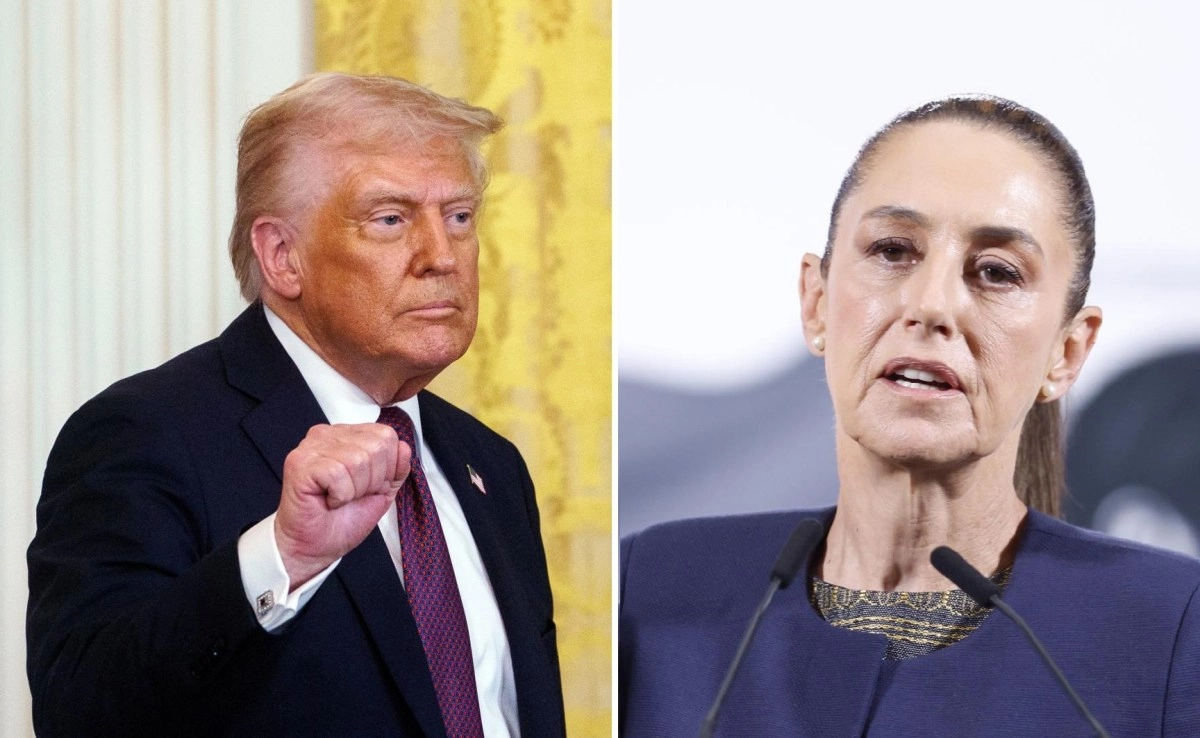

Following the discursive tradition of Andres Manuel Lopez Obrador, President Claudia Sheinbaum—and those who amplify her message from the Morena party, public and private media, and social networks—reaffirms an unrestricted defense of national sovereignty. However, despite the president's high popularity levels and the broad social support for the Fourth Transformation (4T) project, based on a nationalism with historical pretensions, reality seems to significantly contradict this discourse. Since 2016–2017, Donald Trump has repeatedly raised the possibility of sending US forces to combat the so-called "bad hombres" in Mexico, who he now labels as members of narco-terrorist organizations that, according to his narrative, possess "weapons of mass destruction," particularly fentanyl, and represent a direct threat to US national security. Trump has insisted on the possibility of a military incursion into Mexican territory to confront the cartels. Sheinbaum, for her part, maintains that this will not happen and reiterates her defense of Mexican sovereignty. However, Ambassador Ron Johnson systematically emphasizes, in his diplomatic communications, the existence of full coordination and a "more than excellent" relationship between the two countries. In turn, the Secretary of Security and Citizen Protection, Omar Garcia Harfuch—a central figure in the current government and, until now, a presidential hopeful—appears to maintain a particularly close collaboration with Washington, which inevitably harks back to previous stages of bilateral cooperation on security matters. Since the beginning of his tenure, his actions suggest a clear willingness to meet the expectations of the northern neighbor and demonstrate that Mexico is moving in the direction it considers appropriate. According to indicators such as homicide rates, drug seizures—especially of fentanyl—and the results of operations against fuel theft, Mexico seems to be aligning itself with the security objectives defined by the United States. In the economic and trade sphere, The country has also chosen to distance itself from China and adapt to the new rules imposed by its northern neighbor within the framework of a global realignment that puts an end to the (neo)liberalism that,In recent decades, the United States promoted through the so-called Washington Consensus. The decline of the liberal order is manifested in Trump's withdrawal from various multilateral agreements that emerged from the post-war international system. Mexico's participation as co-host of the World Cup, its commitment to the USMCA (so far), and its tacit acceptance of the tariff policy against China and other countries without trade agreements reveal, once again, a pattern of subordination to US interests and the elites that dominate the Western Hemisphere. Sheinbaum seems to have the approval of the transnational economic and financial elites, whom her government has openly benefited. The president maintains a close relationship with the richest men in the hemisphere—including Carlos Slim—to whom the Fourth Transformation (4T) has opened markets and opportunities. Also noteworthy is the Mexican government's good relationship with BlackRock, the world's largest asset manager, and with key figures at the World Economic Forum. In this context, Agustin Carstens, former general manager of the Bank for International Settlements (BIS), the so-called "bank for central banks," has expressed positive assessments of Mexico when analyzing what he calls the 2025 "experiment." Carstens suggests that the country could be regaining its sovereignty by abandoning the rules of neoliberalism and distancing itself from China with the backing of the United States. It is striking that both Carstens and Sheinbaum invoke the concept of sovereignty. It is surprising that the president rejects any form of interference and affirms that "sovereignty is not negotiable," when in reality there is a marked subordination to the United States. In a context where the northern neighbor seems willing to use all necessary means to reaffirm its control over the Americas, Mexico's room for maneuver and negotiation appears increasingly limited. The United States—the most powerful nation in the world in terms of military capacity—has the real possibility of intervening in Mexico if it so chooses. The profound economic and defense asymmetries do not support good intentions or sovereignist expectations. It cannot be ruled out that negotiations are already underway (through the physical presence of the Pentagon) that will allow the United States to exert control over strategic regions of Mexican territory under the pretext of a war against the cartels and the fight against fentanyl trafficking.
Footnote: Historically, The United States has treated the rest of the countries in the hemisphere—with the partial exception of Canada—as subordinate spaces and their leaders as dependent actors. The Trump administration's attitude toward various Latin American countries seems to reaffirm this logic. The case of Venezuela is particularly illustrative.Some interpretations have used the term "courtesans" to refer to figures like Maria Corina Machado and Delcy Rodriguez. Although the term can be problematic and potentially disrespectful when applied to female political leaders, its association with the idea of ??a court is not entirely unrelated to the current Venezuelan reality. Both seem to be symbolically bowing before a contemporary monarchical figure: Donald Trump. This dynamic connects with elements of the so-called Dark Enlightenment and the neo-reactionary thought of Curtis Yarvin, who is influential in certain Silicon Valley circles today. It is a shame that this applies to new female political leaders in Latin America.
The texts published in this section are the sole responsibility of the authors, therefore La Opinion assumes no responsibility for them.