

Although Trump now “hates” his own trade deal, he will find it difficult to undo it, analysts say
If an extension is not achieved, the agreement would expire in 2036, although the US retains the power to withdraw earlier by giving 6 months' notice.
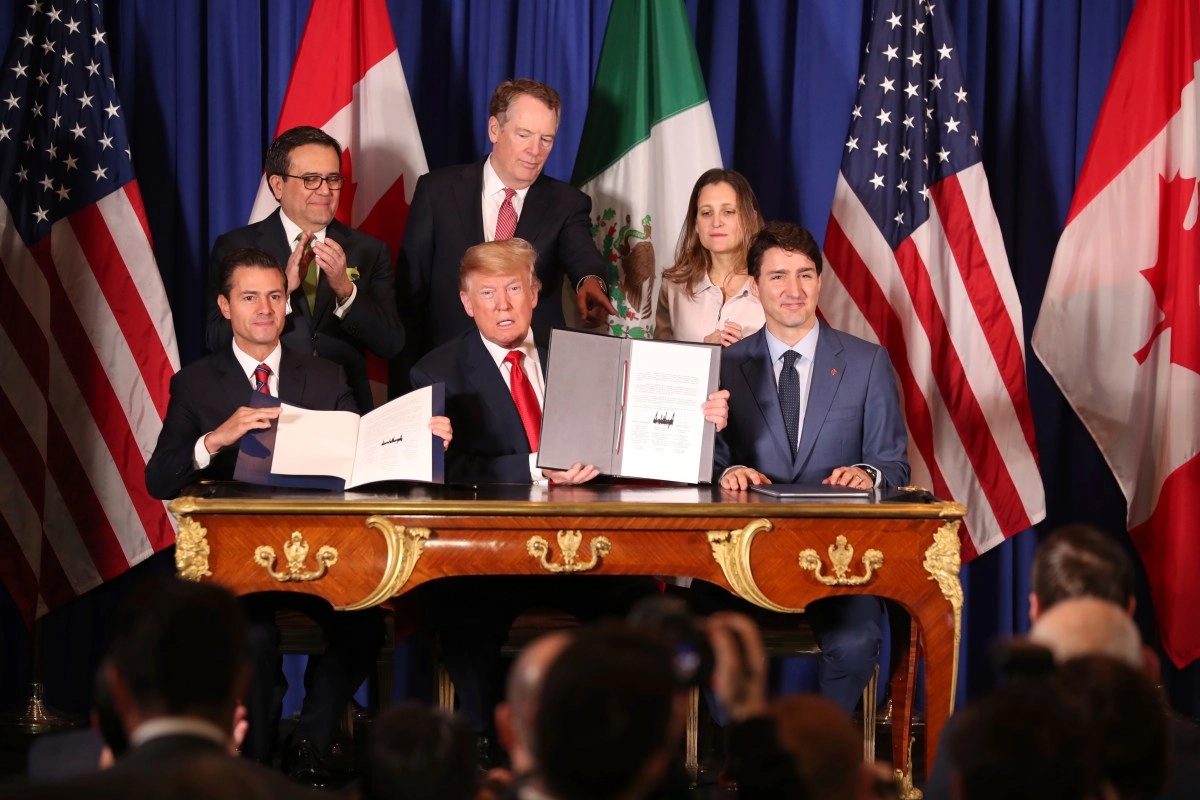

President Donald Trump's decision not to support, for now, an extension of the Agreement between Mexico, the United States and Canada (T-MEC) opened a new period of uncertainty for the largest trading bloc in North America, despite the fact that the president himself promoted and signed the agreement during his first term in the White House.
While Mexico and Canada have already expressed their willingness to renew the treaty for another 16 years, Washington maintains a different position and prefers to use the review process provided for in the agreement to press for changes that it considers favorable for the US economy, analysts say.
When Trump signed the USMCA in 2020, he called it “the largest and most balanced trade agreement in history.” However, his vision took a 180-degree turn due to his frustration with persistent trade deficits and legal loopholes that allow countries outside the bloc, such as China, to benefit from low tariffs. Recently, aboard Air Force One, he declared that he would prefer that the treaty be “terminated.”
Letting the agreement, whose deadline for automatic renewal for 16 years is this July 1, expire would force the three countries to undergo thorny annual reviews for the next decade. This scenario of instability worries business leaders. "Uncertainty makes business planning difficult. It's that simple," said Anne McKinney, vice president of the US Chamber of Commerce, explaining that companies lose the certainty necessary to project their long-term investments.
Canceling the T-MEC is not an easy task. An abrupt exit would disrupt more than $1.8 trillion in annual trade, skyrocketing prices for everyday goods from auto parts to avocados at a time when American consumers are already feeling the impact of inflation. “He knows he can't withdraw,” said Quebec special envoy Louise Blais, alluding to the fierce opposition Trump would face in Congress.
Companies fear greater uncertainty for investments
The possibility of keeping the treaty under constant revisions worries businessmen and international trade specialists, who warn that the lack of certainty could delay investments and affect highly integrated supply chains between the three countries.
Sectors such as automotive, agriculture and manufacturing have depended for decades on a regional market with stable rules, so any modification or eventual departure from the United States could increase production costs and translate into higher prices for American consumers.
Analysts also consider it unlikely that Trump will be able to easily cancel the treaty. The USMCA was approved by Congress with bipartisan support and has broad support among manufacturers, farmers and business groups who consider it essential to preserve the free flow of trade in North America.
Although the Republican administration maintains a critical discourse towards the agreement, several experts interpret this strategy as a mechanism to strengthen Washington's negotiating position before demanding new commercial conditions from its partners.
Mexico seeks to preserve the agreement as negotiations progress
The talks between the United States and Mexico are advancing separately from those between Washington and Canada. Among the central issues are the increase in US content in vehicles manufactured in the region and new measures to prevent products of Chinese origin from obtaining commercial benefits through the T-MEC.
Mexican officials believe that the negotiations could lead to complementary agreements without completely modifying the structure of the treaty, following a model similar to that the Trump administration has used with other trading partners.
For their part, Canadian authorities also recognize that some tariffs could be maintained, although they trust that the agreement will continue to guarantee preferential conditions compared to other international markets.
Beyond the political rhetoric, the future of the USMCA will be decisive for a trade relationship that moves more than 1.8 trillion dollars annually between the United States, Mexico and Canada. For companies and investors, the main challenge is not only the result of the negotiations, but the uncertainty surrounding the rules under which one of the most integrated economic regions in the world will operate in the coming years.