

They ask FIFA to investigate the Argentina team for posing with a banner in support of the Malvinas
Business Minister Peter Kyle said the agency should investigate what happened. In the United Kingdom they described it as "inappropriate"
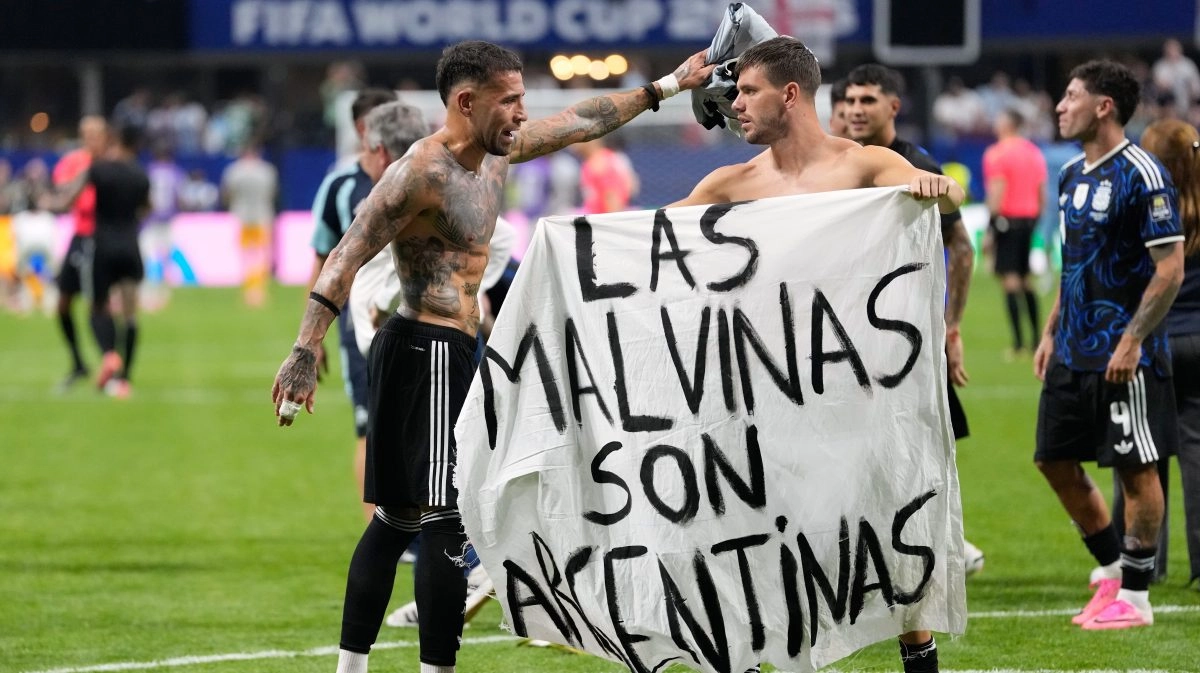

The British government urged FIFA to investigate the Argentine team after some players posed with a banner in support of their country's claims to the Falklands/Malvinas Islands.
Argentina beat England 2-1 in the World Cup semifinal played Wednesday in Atlanta.
The Malvinas/Falklands Islands, an overseas territory located in the southwest of the Atlantic Ocean, remain the subject of a sovereignty dispute between Argentina and the United Kingdom.
UK Business Minister Peter Kyle called the players' behavior “totally inappropriate” and said: “I hope that FIFA will carry out a thorough investigation.”
Downing Street said any possible action against Argentine players for displaying a banner in support of their country's claims to the islands is "a matter for FIFA", but backed Kyle's view that the body should investigate what happened.
“The World Cup may not be ours, but the Falklands Islands certainly are,” said the Prime Minister's official spokeswoman, Keir Starmer.
Starmer wished “good luck to Argentina and Spain in the final, especially Spain.”
The two nations went to war over that territory between April and June 1982. These were occupied by order of the then Argentine military dictatorship, which triggered a ten-week war won by the United Kingdom.
Argentina considers that this archipelago, located 482 kilometers from its east coast, should be under its sovereignty.
During the post-match celebrations, Argentine players held a banner given to them by fans from the stands, which read: “The Malvinas are Argentine.”
Article 34.3 of the tournament regulations prohibits players from displaying political messages or slogans before, during or after a match.
After the match, Argentine midfielder Leandro Paredes declared that the Falklands War was a “sad part of our history” and added that the match “was not just a football match” for his nation.
The leader of the British Liberal Democrats, Sir Ed Davey, said that the Argentine players who celebrated with the banner “must be excluded from the final.”
Argentina was fined by FIFA after displaying a banner with the same slogan after a friendly match against Slovenia in 2014.
Spanish players Rodri and Álvaro Morata were suspended for one match each by UEFA, European football's governing body, after singing about their country's claim on Gibraltar after winning Euro 2024.
Referring to these sanctions, Liberal Democrat leader Ed Davey called for the Argentine players who appeared holding the banner to be suspended for Sunday's final against Spain.
Former English international footballer Peter Reid described the display of the Argentine banner as “unacceptable”.
“It wasn't just any game”
For her part, the vice president of Argentina, Victoria Villarruel, published in X: “It was not just any match,” along with a video in which Argentine soldiers appeared to appear.
“The Malvinas are Argentine,” Villarruel published. “They prohibited bringing [the banners] to the stadium and they forgot that we carry them in our blood and in our hearts.”
Villarruel had previously published that the semifinal was about “putting the invaders in their place.”
However, before the semi-final match, coach Lionel Scaloni said that he was “not going to mix” football and politics.
"The reality is that this is a football game. I can't mix things up, especially out of respect for what happened so many years ago," Scaloni said.
“It was a very sad period in our history, and there's not much we can do about it, that's the reality.
"Things happen in other parts of the world, and we criticize the existence of war. Of course we remember those people. But it is a football match; we must not confuse the two," he added.
Download the new BBC World Service app. Choose BBC News Mundo and receive news alerts, documentaries and analysis, all in one place. Important: The new app is not available in the United Kingdom or the United States.