

Earthquake projections for 2026: what geographers and seismologists anticipate
What geographers and seismologists anticipate about seismic activity in 2026, which areas are at greater risk, and why earthquakes cannot be predicted.
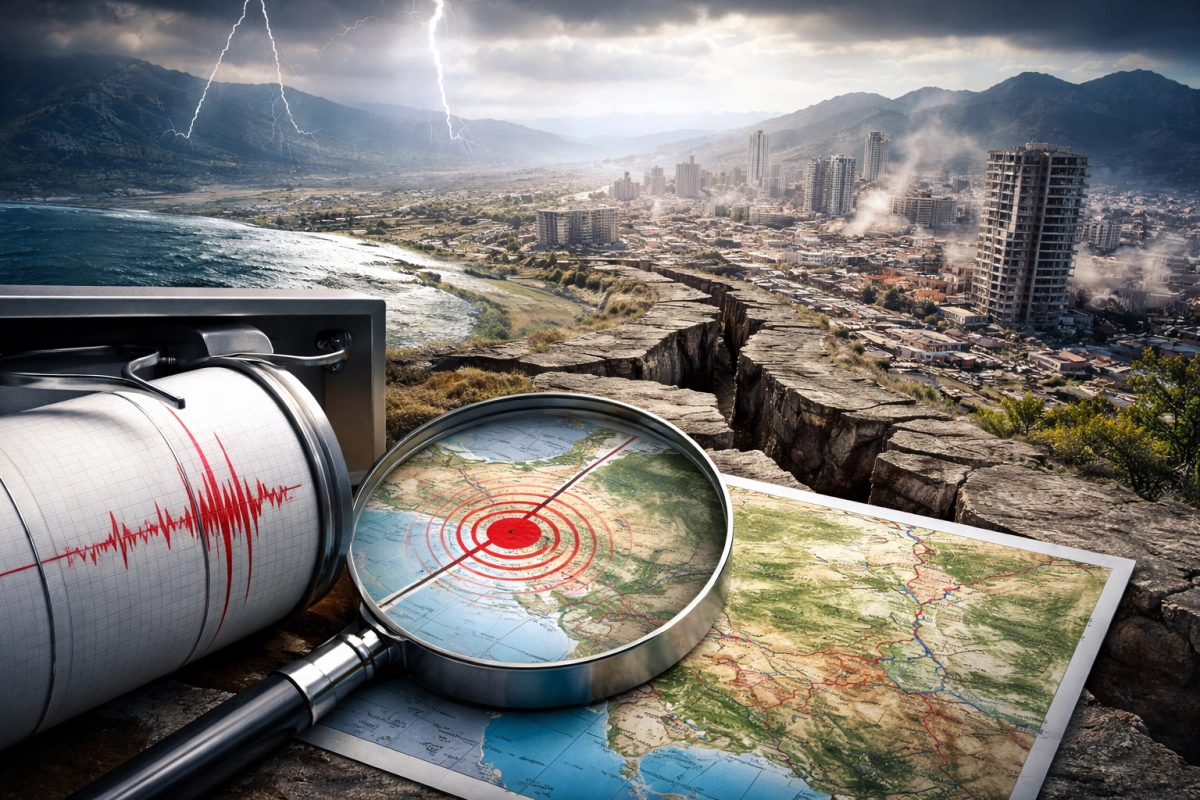

2026 began with the usual background noise (the Earth in motion) and with a question that reappears every time there is an earthquake somewhere in the world: "Can we know where the next one will be?" "A major earthquake?" The scientific answer remains uncomfortable for those seeking quick certainties: earthquakes cannot be predicted with exact date and location. What does exist (and is key) are hazard maps, probability models, and geographical readings that indicate where the greatest risk accumulates. In other words, geographers and seismologists don't "predict" the next earthquake, but they can explain why certain regions live with the latent threat, how this stress is measured on faults, and what it means (in practice) for an area to be within the Pacific Ring of Fire or on an active fault. For those living in higher-risk areas, especially on the West Coast and in Caribbean territories, these projections have concrete utility: they help to understand which areas are most exposed, why strong earthquakes are not a historical rarity, and what everyday decisions can reduce the impact (from building codes to family preparedness). Where is the greatest risk of earthquakes in 2026 according to geographers? The idea of ??accurately predicting earthquakes (date, location, and magnitude) remains an unsolved scientific challenge. There is no proven technique that allows us to predict with certainty when a major earthquake will occur. The main geological institutes, such as the US Geological Survey (USGS), insist that earthquakes cannot be predicted exactly, and that what can be done is to calculate probabilities from geological data and seismic hazard maps. Earthquakes cannot be predicted with precision. Scientists agree that no seismological center in the world can pinpoint exactly when and where an earthquake will occur. Current models allow us to estimate areas at higher risk over long periods (decades), but they do not predict individual events with certainty.
This means that specific predictions like “earthquake on such and such a date” lack robust scientific support; even when they circulate on social media or sensationalist media, they are unfounded.
Risk zones and probabilities for 2026
What geographers and seismologists can assess are patterns of tectonic stress accumulation and areas of high risk:
The San Andreas Fault is a fracture in the Earth's crust that extends for more than 1,300 kilometers along the western coast of California, in the United States. This fault has played a key role in the region's geology, as it forms the boundary between two major tectonic plates: the Pacific Plate to the west and the North American Plate to the east. Interpret “predictions” with caution. Some popularizers occasionally cite general projections or probabilistic models to suggest that a large earthquake “might occur” in a given year. These studies are based on historical seismic activity patterns, plate deformation rates, and statistical models. However, none offer a dated prediction or can state with absolute certainty that an earthquake will occur in 2026.
What Geographers and Seismologists Do
Instead of prediction, studies focus on:
These approaches are essential for urban planning, building codes, and emergency preparedness, not for guessing specific dates.
By 2026, the scientific community expects normal seismic activity to continue in tectonically active areas, but no entity has issued concrete or confirmed predictions of specific earthquakes for that year. Constant monitoring, improved early warning systems, and public education remain the most effective tools for reducing earthquake-related risks.