

How Trump's policies could make it harder to deal with the effects of a snowstorm in the United States
Since 2025, the Weather Service and FEMA have faced cuts of thousands of people, Climate Power In Action expert recalled
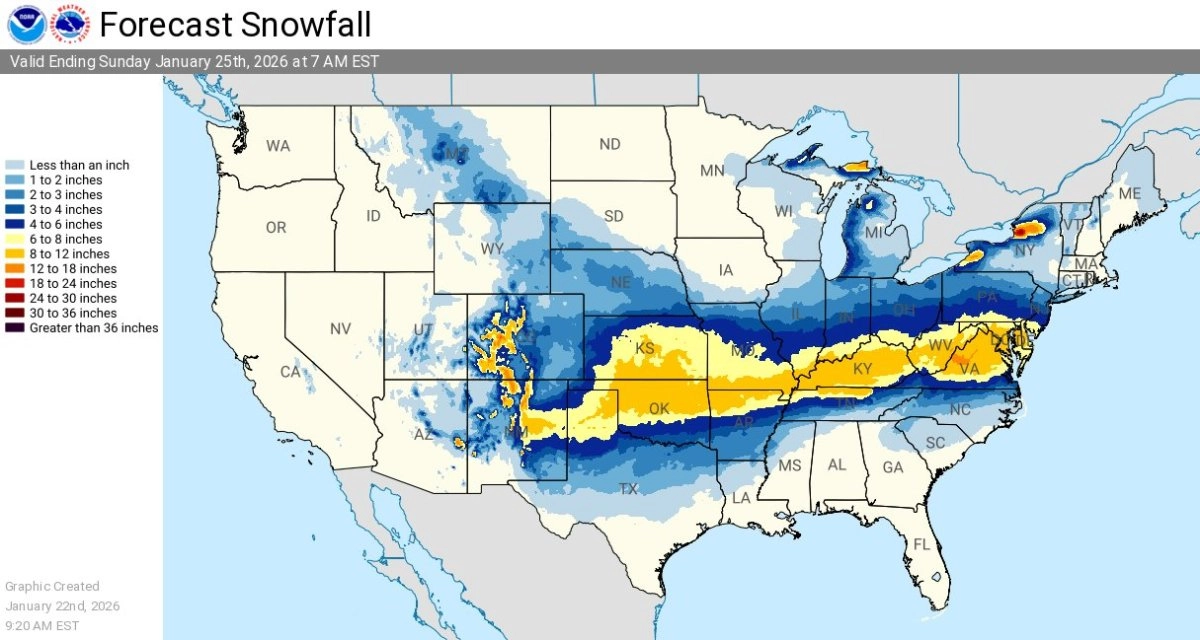

The Republican president also doesn't mention cuts at the Weather Service and in the emergency response system (FEMA) that could complicate addressing the consequences of the winter storm, which will affect 30 states and more than 130 million people. “What we know is that the climate change that is happening, global warming, makes this extreme weather a little more intense,” explained Luis Sanchez Armas, national press secretary of Climate Power In Action. “And that causes heavier rain and snow when the temperature does drop. But we're also seeing extreme weather happening all over these areas. We saw it in parts of North Carolina and South Carolina last year, and you never know what's going to happen.”
Sanchez Armas recalled that the Trump administration made cuts to both the National Oceanic and Atmospheric Administration (NOAA) and the Federal Emergency Management Agency (FEMA).
At NOAA, the initial layoffs were in February 2025 and included between 500 and more than 800 employees, with a new round of more than 1,000 layoffs in March 2025, including meteorologists and National Weather Service personnel.
“Cuts to all the staff at the National Weather Service. The National Weather Service and also at NOAA, which are these two organizations [responsible for] making all weather reports as accurate as possible, “And that’s what all meteorologists across the United States use,” Sanchez Armas explained. “It means we’re working with information and data that aren’t very accurate.” At FEMA, approximately 2,450 employees have left the agency since the beginning of 2025, but through voluntary separation programs and layoffs, the workforce has been reduced by almost 29,000 to approximately 23,000.
Part of the cuts affected the CORE teams, which are crucial for disaster response and recovery.
“[The Trump administration] also made cuts to FEMA, which is the organization that, […] when there is a natural disaster, are the first to arrive and provide aid, first aid, move trees, help people stay warm or cool, depending on the problem, and everything related to insurance and that,” added Sanchez Armas. “These cuts mean that perhaps that aid won't arrive as quickly as before, or that some people might miss out on certain assistance in certain places. I think this weekend and the following week are going to be a big test to see what has changed and in what ways we can count on the federal government to help us with this.”
Why is this winter storm so worrisome?
Sanchez Armas mentioned that the winter storm that will impact 30 states isn't just affecting the weekend.
“I mean, it's going to be this weekend, sure, but after that the low temperatures are going to persist, and that means that the snow, sleet, rain, freezing rain, is going to stay and create more risks for people,” he warned.
The expert acknowledged that there are states, like Texas, that are not ready for this type of weather and will face severe consequences.
“In these temperatures and with these conditions, there are many people, especially in the South. "The United States is not prepared for this kind of weather, this kind of ice. Perhaps they don't know how to drive in these conditions, and the cities and towns don't have the infrastructure to help with this," he acknowledged. Sanchez Armas recognized what happened in Texas in 2021 with the winter storm, where 200 people died. "For more than a week, there were people without heat, without electricity," he recalled. Latino populations will be among the most affected, as reports from Climate Power in Action have warned that climate change impacts regions with high Latino populations. "The cost is a big part of this, because what we know is that even before this storm, it was predicted that everyone would spend more money on heating and electricity," he explained. “I was watching a report this morning that said almost $1,000 more per family from November to March. That's for natural gas, because the winter is going to be a bit more intense and because prices have gone up, I think more than 25%, just in the last week, and electricity is also more expensive, I think 13% more expensive than last year.” She said that many of these affected families are Latino, noting that climate change does not affect all populations equally.
“Extreme weather affects everyone, but it doesn't affect us all equally. Latinos often live in warmer climates, and when problems like these arise, they sometimes tend to be less prepared for this kind of extreme weather,” she lamented.
See: 10 tricks to cope with the cold in sub-zero temperatures
FEMA boasts of coordination with states
Secretary of Homeland Security Kristi Noem stated that FEMA is coordinating with the states to address the winter storm.
“FEMA is actively working with the states to monitor and prepare for the severe winter storm,” the Department of Homeland Security (DHS) reported in a statement. “In preparation, the agency activated its National Response Coordination Center and Regional Response Coordination Centers in FEMA Regions 1, 2, 3, 4, 5, and 6 to synchronize federal preparedness and interagency coordination.” It was stated that federal authorities deployed Incident Management Teams to support the states of Louisiana, Texas, and Virginia, and have 12 additional teams ready to deploy if requested by the states. “FEMA distribution centers, strategically located in the South and East of the United States, have more than seven million meals, more than two million liters of water, more than 600,000 blankets, and more than 300 generators,” the DHS reported. “FEMA is also establishing staging points in Kentucky, Louisiana, and Texas with food, water, and additional generators to facilitate the rapid deployment of resources at the request of affected states.”
Except for Virginia, all the states mentioned by DHS are governed by Republicans.