

Resistance spreads in the face of escalating attacks against immigrants
The community responds to concerns with organizing, education, advocacy, and mutual aid
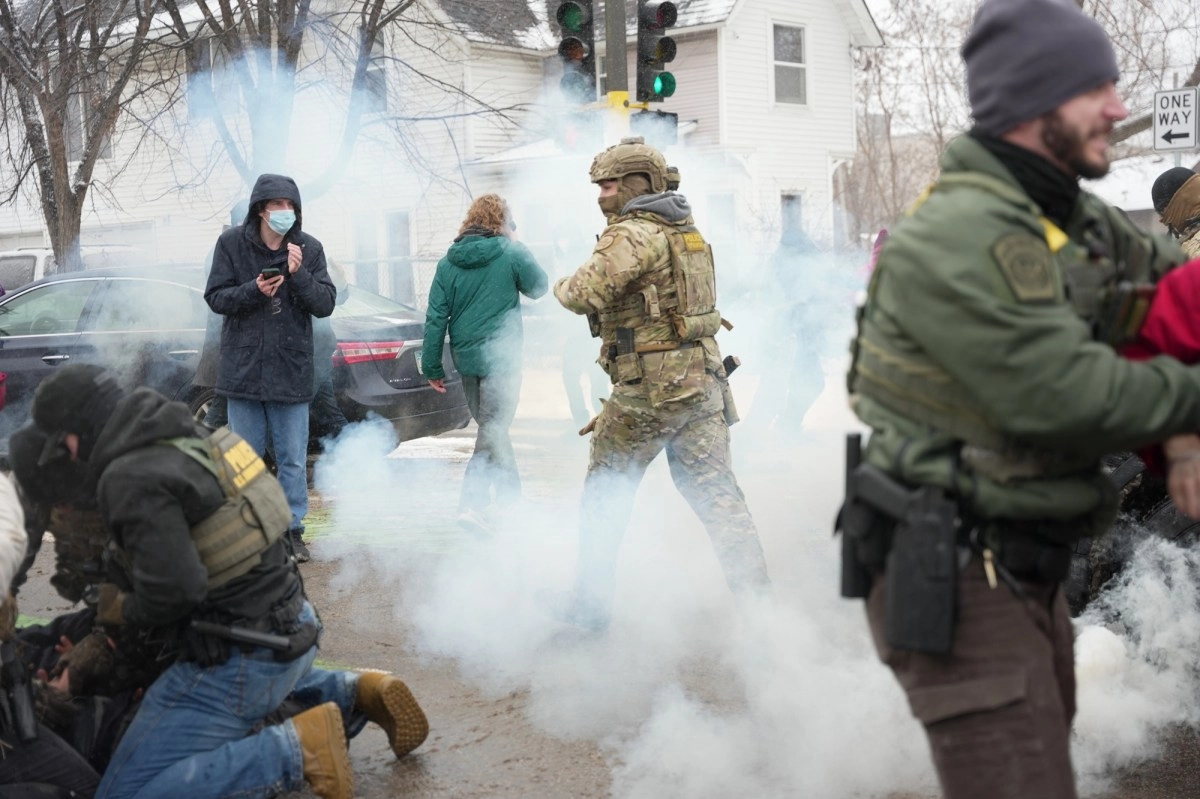

As violent immigration raids intensify across the country, communities have responded with a growing wave of resistance, ranging from lawsuits and reports of civil rights violations to organizing in schools and coordinated advocacy efforts at the local level.
On Saturday, January 24, federal agents shot and killed a 37-year-old man in Minneapolis, less than three weeks after an Immigration and Customs Enforcement (ICE) agent fatally shot Renee Good and amid a continued increase in immigration enforcement actions across the city.
During the videoconference “Amid Escalating Risks, a Wave of Community Resistance Spreads Against ICE Immigration Enforcement Operations,” hosted by American Community Media (ACoM), several experts on the topic discussed how the resistance is taking shape on multiple levels.
Organized Response
Amanda Otero, a mother with children in Minnesota Public Schools and co-executive director of Take Action Minnesota, said that truly horrific acts are occurring daily in communities, neighborhoods, and schools, but at the same time, she is very proud to be from Minnesota.
The reason is that tens of thousands of her neighbors are They have connected and organized into local teams, providing transportation, food, and rental assistance to families who are afraid to leave their homes. “They have been watching the streets and patrolling the schools to ensure our children can get to and from school safely. And these kinds of initiatives are happening all over the state.” She said she herself is part of a network of more than 1,000 parents in Minneapolis public schools who are doing this work, organizing to keep their children and educators safe. “The day before Renee was killed, at my son’s daycare, as parents were dropping off their children, just a block away,They saw federal agents launching tear gas and arresting legal observers.”
So she stated that every day, more and more people are driven to take action, to protect and keep our neighbors and communities safe.
“In the team of people I work with and throughout the state, I have seen incredible love for our people and our communities, and with incredible courage they carry out this work and keep people safe during these times.”
The Strategies
Seri Lee, assistant organizing director of One North, based in Chicago’s North Side, said they have focused on three strategies following the immigration raids in September and mid-November.
“Education, community advocacy, and mutual aid. We focused on the Know Your Rights campaign, providing training on how to identify law enforcement officers and ensuring people knew where to find help and resources.”
She added that they organized block by block in neighborhoods, with a central emergency phone number that everyone knew and saved on their phones.
“From there, we were able to train thousands of people; and I’ve never seen the city so united and acting so strongly as it did last fall.”
She detailed how they made sure to work with ordinary people—parents, students—and that those most directly affected received support.
“A daycare worker was arrested and detained on her way to work. I remember organizing with my councilor and other neighbors that same night, and over 400 or 500 people turned up in my neighborhood to protest and demand her release. And she was released. And I've never seen that level of organization before.”
Concern over the attacks
Vanessa Cardenas, executive director of America's Voice, said that the murder of Rene Nicole Good illustrated that attacks against immigrants are the tip of the iceberg of attacks against all Americans.
“This agenda of mass deportations is affecting everyone, both citizens and non-citizens.”
She stressed that Americans are seeing in real time an agenda focused solely on law enforcement, and are very upset and incredibly concerned about what ICE is doing in terms of violations of fundamental rights.
“They do not support ICE going after immigrants who have been in the country for a long time and are not committing crimes.”
However, she remarked that this administration is not going to stop, and they are redoubling their efforts because the Department of Homeland Security (DHS) has already received a large number of has the money and resources to continue this campaign,so they don't know where it's going to end.
“The ICE deployment in Minneapolis was the largest in history. Initially, they had 2,000 ICE agents, and then they added another 1,000, bringing the total to almost 3,000 deployed in one U.S. city.”
Despite everything, Cardenas expressed optimism because this year's elections are approaching, and this moment represents an opportunity to bring more people on board, broaden the coalition, and help people understand that the system is broken and that an approach based solely on law enforcement doesn't work.
Lawsuits to Stop DHS
Ann Garcia, an attorney with the National Immigration Project, said that in recent months several lawsuits have emerged to try to stop what DHS and federal agents are doing in Minnesota. He said there is a class-action lawsuit called Tincher, filed in December by six Minnesota residents who were prevented by DHS from exercising their First Amendment rights to observe, assemble, and protest. “It describes the abduction of U.S. citizens and how DHS pepper-sprayed, violently arrested, and pointed assault weapons at protesters and legal observers, and even followed some of them to their homes to try to intimidate them.” He specified that all the lead plaintiff, Susan Tincher, did was ask the agents if they belonged to ICE. “At that point, they threw her to the ground, arrested her, cut off her wedding ring, cut off some of her clothing, including her bra, and handcuffed her.”
He mentioned that a week ago, in the Tincher case, a district judge issued what is called a preliminary injunction to prevent the Department of Homeland Security from terrorizing and arresting people who were simply participating in peaceful and unobstructed protests.
But then he said the Eighth Circuit Court of Appeals temporarily blocked that preliminary injunction, which, in short, allowed DHS to continue terrorizing people in Minnesota.
“DHS and the White House are describing community members who are exercising their constitutionally protected rights by standing up for their neighbors as domestic terrorists.”
That is precisely how they labeled Renee Good, who was extrajudicially killed earlier this month.
Similarities with the Past
Mark Tushnet, professor emeritus at Harvard Law School, said that the events happening now bear a strong resemblance to some events that took place before the Civil War in the United States.
“In the 1850s, Congress passed a law called the Fugitive Slave Act,whose objective was to help the owners of enslaved people who had escaped to the North to reclaim their property.”
But they said that resistance movements arose in which people took to the streets, as in Minneapolis, and even more forcefully than in Minneapolis, vigorously interfered with attempts to recapture enslaved people and send them back to the South.
“These interferences with the extraditions, for the most part, failed to stop them, but what they did do was galvanize public opinion in the North. The behavior of the authorities was what sparked this kind of resistance and, ultimately, the movement against slavery.”