

The silent suffering of children in Gaza who have lost the ability to speak
Child psychotherapist Katrin Glatz Brubakk traveled to Gaza and fought to recover children whose traumas can leave scars on their brains.
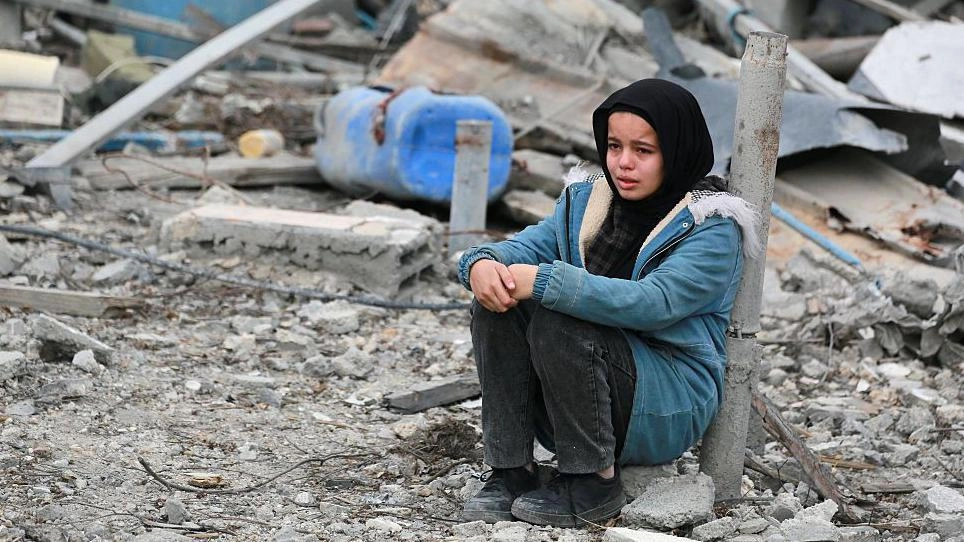

Adam was a happy and talkative child, but at the age of 5, he suddenly stopped interacting with the world.
Your case is no exception. In the face of violence, destruction and death in Gaza, some children's response to overwhelming suffering has been to remain silent.
“There is no child in Gaza who is not traumatized,” Katrin Glatz Brubakk told BBC Mundo.
“There are more than a million children who have suffered serious trauma”
The child psychotherapist from Norway undertook two missions to Gaza in 2024 and 2025 with Doctors Without Borders (MSF) to work with children who lost the ability to speak.
It is not known for sure how many children in Gaza stopped communicating, but Brubakk says he found dozens of cases. And local doctors told Al Jazeera that it is a “growing number.”
More than six months after the announcement of the ceasefire in Gaza, violence continues and “Israeli attacks continue routinely,” declared the United Nations High Commissioner for Human Rights, Volker Türk, in April.
At least 846 people - including many women and children - have been killed in Gaza in Israeli attacks since the start of the ceasefire, according to the local health ministry.
Israel, which justifies its attacks by the need to defend its troops and confront the threat from Hamas militants, claims, for its part, that five of its soldiers were killed in the same period.
Hamas and Israel have accused each other of violating the ceasefire agreement.
Since October 2023, following attacks by Palestinian militants on Israeli territory in which some 1,200 people were killed and more than 200 taken hostage, according to Israeli authorities, Israeli forces have killed more than 20,000 children in Gaza and left more than 41,000 injured, according to UNICEF. In total, the Israeli strikes killed more than 72,000 people, most of them civilians, and injured more than 172,000, according to Gaza's health ministry.
BBC Mundo spoke with Katrin Glatz Brubakk about the trauma that is leading Gazan children to lose their speech, the consequences on their brain, and why the road to recovery sometimes begins with a first step: blowing soap bubbles.
Why are there children in Gaza who stopped talking?
When a child suffers severe trauma and lives in conditions of great uncertainty for a long time, as children in Gaza do, they fear for their own lives, as well as those of their family, friends and acquaintances. And in Gaza children have been living like this for two and a half years. The level of stress and the impact on your nervous system is tremendous.
Each child's reaction is different. Some become very agitated or have trouble sleeping, get angry, shout; It is easy to detect this suffering. Others, however, are blocked completely. It's as if your nervous system is saying, “I can't take it anymore.”
And the way to protect yourself is to withdraw. Language is part of it. For these children it is a way of not interacting with this world that continues to make them suffer and inflict pain on them. So it's not a conscious choice, but a neurological response to extreme stress and trauma.
It is difficult for many to understand the magnitude of what the children in Gaza have experienced and are experiencing. Could you give us an idea of the extreme trauma they suffer?
There is no child in Gaza who is not traumatized. There are more than a million children who have suffered serious trauma. Of course there are differences, but they have had to flee, they have lost their homes, they have all experienced the impossibility of going to their school because the schools are bombed. Everyone lost someone, like family, school friends, teachers, a neighbor. Many saw mutilated bodies and smelled the smell of spilled blood. Some children told me that they helped collect human remains or brain parts on the street. They are extreme traumas.
And this has not happened just once, but many times for most.
But also, they have lost all sense of security. To develop well, children need to have a certain trust in the world: the belief that the world can be good, that people don't want to hurt you. This sense of security has completely disappeared due to the magnitude of the destruction, which affects absolutely everyone in Gaza.
No child in Gaza can go to bed with the certainty that they will wake up the next day. They don't have a room they can walk into, close the door and know that no one can reach them. So this war not only causes trauma, it affects their entire worldview.
Could you tell us about some of the children you treated in Gaza?
I would like to tell you about Adam, a 5-year-old boy. He was a very lively, happy, talkative and active child. He loved being outdoors and playing. After the start of the war in 2023, the family was forced to flee and move into a tent. His grandparents lived a little further away, also in a tent.
One day, Adam and his father wanted to visit his grandparents, in an area that had no evacuation order and was supposed to be safe. But without warning, a projectile hit very close to them and seriously injured Adam and his father. They were rushed to the hospital, but as usually happens when there are these attacks, there are so many victims that if there are no free beds, many people are placed on the floor.
Adam and his father were on the emergency room floor waiting to be evaluated when the boy saw and heard his father, next to him, take his last breath. Adam was also seriously injured: he lost one leg and the other was injured. After witnessing his father's death, the boy stopped talking. Sometimes he managed to whisper a single word to his mother, but he didn't want to talk to anyone. He barely ate. He was a child in critical condition.
What consequences can these traumas leave in the future?
When a child like Adam stops interacting and talking, he also stops developing. A 5 year old child should practice their language skills with other children and adults to learn, practice problem solving, learn social norms through play. All this is interrupted. Language is a signal, but its development stops completely.
What I have observed repeatedly is that if this situation is prolonged, it physically affects the brains of these children. We know that in children who have suffered severe trauma, the amygdala, the part of the brain responsible for intense emotions, increases in size. This can be measured. It is larger in traumatized children.
And the prefrontal cortex, the later-developing part of the brain responsible for functions such as planning, problem-solving, social interaction, and emotional regulation—fundamental aspects of life—is underdeveloped. It is thinner and has fewer neural connections.
If a child remains in a state like Adam's, withdrawn, lacking in development and language, if he is left in that extreme stress situation for a long time, he will have problems later in life. It will never be recovered.
The best example I have is my own brother. It was adopted in 1974, after the Vietnam War. He grew up like children in Gaza grow up now, with constant bombing, a lot of uncertainty and food shortages, which also affects brain development.
When my brother came to my family in Norway, even though it was a safe place and he had access to all the food he needed, it took him years to stop hiding food behind books on the bookshelf, because he didn't feel safe.
These are what we call “cognitive injuries of war”, invisible, which in many cases will accompany these children, possibly, throughout their lives.
Working in a context like Gaza, there are many things we cannot do. What these children really need is a safe place to live, a structured daily life, to be able to go back to school, to play without fear. But fortunately there are things we can do.
And the most important thing is that these children know that, even if the whole world is not a safe place for them right now, there are small safe spaces. That there are people around them here and now who will support them. At first Adam didn't want to talk to us, but we still went to his room every day and talked to his mother.
We talked to her about the husband she had lost, but also about the good memories, about the dreams she had for the future, things that might give Adam a little hope that this was not the end, but that better times would come.
And one day, when I was there, Adam suddenly whispered to his mother: “Make this woman leave, I don't like her.”
It was a rejection but I was very, very happy because it meant that Adam was starting to interact with what was happening around him. A few days later he looked at me, something he hadn't done before. It was only for a moment, but I took the opportunity and said, "Wow, you have huge brown eyes! They're beautiful. Mine are totally different, they're blue. Have you ever seen them?" And that sparked the curiosity of that 5-year-old boy.
That was the beginning of how, little by little, we were able to get him to trust people, to talk to us briefly, to return to some normality although not permanently, because he carries all those traumas.
Were you speaking to Adam in Arabic or through an interpreter?
In Gaza there are many very educated people. He spoke English with Adam's mother, she has a PhD in physics. There was an interpreter for the child. And I should add that when I work on projects like this, I manage a team of local psychologists and social workers. I provide knowledge, but the main work, which continues afterwards, is carried out by our MSF team on the ground.
At the Nasser hospital you also worked with children with serious burns…
When a bomb hits it produces a huge heat wave that affects everyone nearby, and the largest age group we served was children between 4 and 6 years old. This is simply because they are too big for their parents to pick up when they are already carrying younger children, but their legs are still too short to run fast enough. This shows that no child is safe in Gaza.
And children are very aware of this. Fear for one's life remains a daily reality for children in Gaza.
How do you manage to work with these children in a state of great physical suffering?
Burns are extremely painful. They are so painful that things as simple as changing bandages have to be done under anesthesia. Recovery is long, and when there is not enough food it takes even longer, which means that children remain in excruciating suffering for longer.
One of the girls who came to our apartment was Mona, 6 years old. He had burns all over his body. He had so many bandages that all we could see were his eyes and nostrils.
At the beginning everything revolved around the medical part, because we had to make sure he survived. So I didn't get to meet Mona until they started removing some of her bandages and I saw her heavily scarred face.
His family was forced to move and lived in a tent at first. But then the bombing seemed to move to another area and they thought it was safe to return to their destroyed house.
Just two days after returning home, a bomb hit the apartment. Two of her brothers died instantly, but the explosion ignited a gas tank, which caused a widespread fire: the curtains, the sofa, and the mattresses were on fire, and the three girls were in that room.
The father miraculously managed to get the three girls out of the apartment. Mona had burns all over her body; his older sister, who was in the next bed, also had burns and was in severe pain. Her middle sister was in intensive care because she inhaled so much hot air that she also had internal burns.
So not only was Mona dealing with her own pain, but she was also worried about whether her sister would survive.
Mona's family was very supportive and she began to recover. And what really impresses me are these parents, not just Mona's parents, but the parents of so many children in Gaza, who witness their children suffering, being hurt, themselves being traumatized by all the bombing, the death, the destruction, and yet they have the ability to give these children exceptional care, warmth and love so that they can recover as best as possible.
How did you manage to help Mona?
One of the things I do when I work with children is play a lot, because play is the language of children. Through play they learn practical skills, they learn to solve problems, interact socially, and express their feelings.
And with Mona we started with soap bubbles. I call them “hope bubbles” because they literally give these children hope. And what makes soap bubbles so fantastic is that, to begin with, if you see some soap bubbles floating around the room, it's impossible not to look at them because they attract attention. They are beautiful. They calm you down. And if I have a very upset child I ask him: “Do you see how many colors there are in a single bubble?” Because if you look closely, they are all the colors of the rainbow.
This helps the child move from that state of stress to something calmer, softer, to change focus. Because trauma works in such a way that you are trapped in that state.
Another magical thing about soap bubbles is that if you want to have big bubbles, you have to blow as slowly as possible. Because if you blow fast you only get small bubbles or none at all. But if you blow slowly you get nice bubbles. And breathing slowly and deeply calms the nervous system.
What effect does this have on children's brains?
What I do is basically give the amygdala, the brain's alarm system, a chance to calm down. Thus, the prefrontal cortex, the part of the brain responsible for problem solving and regulation, has the opportunity to develop better. Of course, it doesn't solve the problem completely, but it gives these children a better chance of reducing the long-term effects of cognitive damage they may suffer from war.
One day Mona said “I would like a princess house,” and she explained to me that she was talking about a doll house. Of course you can't get that in Gaza, but I found cardboard, tape and some paint colors, and together we built a house. Mona wanted it to be two stories and decorated it very well. She and her sister were playing with a dollhouse when the bomb fell.
And although it may seem simple, that was the first time Mona was able to tell me what had happened to her and how worried she was for her sisters. Only through play could he find the words to express himself. So play can be a way to process trauma, to find language for lived experiences.
Could you explain to us the concept you often use of “silent suffering”?
In a context like Gaza, everything is chaos. There is a lot of noise, children screaming in panic attacks, parents screaming worried about their children, people crying in pain.
It's easy to ignore children who suffer in silence, not because people don't care, but because there are too many things taking up attention and too few resources for everything that needs to be done. But a silent child who does not express his suffering, who does not ask for help, is also a child who suffers and needs as much attention as those who cry out loud.
Because otherwise, in the worst case, they may remain in this silent suffering for a long time. I have seen extreme cases, not in Gaza, but in Moria, the refugee camp in Greece.
It is a syndrome called “resignation syndrome,” with which children become completely blocked. They stop talking, eating, they don't even open their eyes, they barely respond when you try to touch them. And if they don't get help, they will remain in that condition for years. That's why it's crucial that children like Adam and Mona can reintegrate into life.
You were in many conflict zones. Why do you say that Gaza is not compared to anything?
I worked for the last 12 years in the Congo, in Lebanon, in Egypt with traumatized refugees, on a rescue ship in the Mediterranean, in Turkey after a major earthquake.
But the level of trauma that I saw in Gaza and the level of destruction is simply incomparable to anything else I've seen in those 12 years. Absolutely everyone in Gaza is affected.
And there is no escape, there is no safe place to go. The whole country is in pieces. And also the health system was systematically attacked, the hospitals bombed. [Israel justifies attacks on medical facilities by claiming that armed groups such as Hamas use hospitals for military purposes.]
Do you hope to return to Gaza? Israel restricted access to aid agencies.
At the moment they don't allow me to enter.
We have 1,600 local employees, and I'm sure they are doing an incredible job, but international staff have not been allowed in since January 1. I really hope that changes. If I could go to Gaza, I would go in a heartbeat; It's the only place I want to be.
Children in Gaza continue to suffer violence. On April 9, for example, a 9-year-old girl, Ritaj Rihan, died according to the UN when Israeli forces fired on the tent that housed her makeshift classroom. The other children in the class were witnesses. The Israeli military told BBC Mundo about the incident that "the Israel Defense Forces (IDF) are working to dismantle Hamas' military capabilities" and "respect international law and take feasible precautions to mitigate harm to the civilian population."
The only thing that is right and what the children of Gaza need now is for us to do everything we can, within our means, to bring them true peace. Bring them back to life, give them the possibility of living in safe places, of going to school.
That is the only way for them to have a decent future. And whether you are a politician, a student or whatever, I would tell them: use your voice so that the pressure is enough and this peace finally reaches Gaza. Otherwise, we will be destroying an entire generation of children.
What led you to dedicate your life to children who suffer from traumatic circumstances?
I grew up hearing war stories my entire life. My mother is German, she was born in '42. When she was a child and the alarms went off, they took her down to the basement and she slept on sacks of potatoes. And he said that the soldiers returned from the front without a leg or an arm.
It was really important for her to try to understand how a genocide could happen, how we could allow it. And again and again he stressed to us, his children, “never again,” that something like this should never happen again.
And then I, of course, with my brother, saw up close the trauma and damage that war causes to a child. My work in Gaza is my version of “never again.” No child should experience this trauma. It breaks my heart.