

The volcanic eruption that produced the loudest sound ever recorded in history
A volcano in Indonesia erupted this week. In the same place, in 1833, one of the deadliest natural disasters of the 19th century occurred
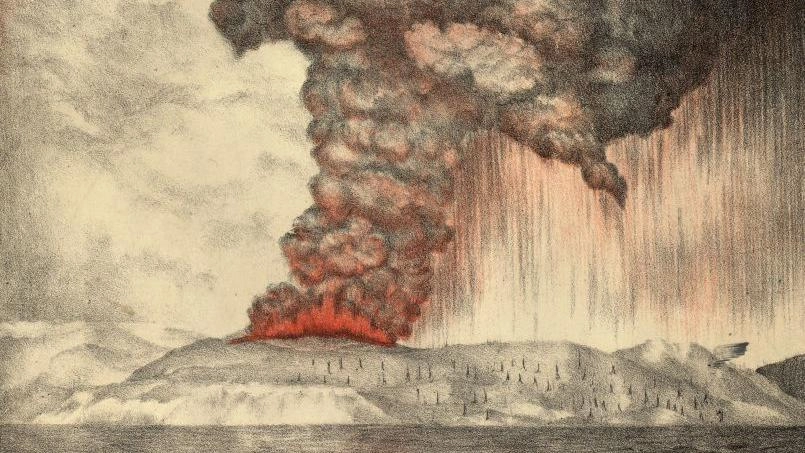

According to local media, a volcanic island in Indonesia erupted this week, sending up columns of ash up to 250 meters high.
According to reports, citing the country's geological agency, Anak Krakatau erupted once on Tuesday and twice on Wednesday, although a group monitoring volcanic activity in the area said there was no immediate threat to nearby communities.
Krakatoa was formed in 1927 from a large underwater crater, known as a caldera, left after the eruption of the Krakatoa volcano, the second deadliest eruption in history.
In fact, Anak Krakatau translates as “Son of Krakatoa.”
The 1883 eruption killed more than 36,000 people and devastated 165 villages, all in less than 48 hours.
It also produced what is considered the loudest sound ever recorded, which could be heard thousands of miles away, and generated so much ash that it caused temperatures to drop around the world for years.
The BBC reviews one of the worst natural disasters in history.
“You couldn't even see a hand in front of your face.”
According to the United States National Centers for Environmental Information (NCEI), it was in May 1883 when the first signs of the coming disaster were observed.
The captain of a German warship was passing by when he saw clouds of ash and dust rising from Krakatoa.
Until then, the volcanic island had remained dormant for about 200 years.
Over the following months, merchant ships and other vessels made similar sightings.
On August 26, catastrophic eruptions began.
Krakatoa's first colossal eruption produced a series of flows of lava, pumice and ash that rushed into the sea and caused a tidal wave that headed north and killed thousands of people.
Within an hour, the column of ash reached 48 kilometers high and spread in all directions.
At its peak, the column would extend 80 kilometers into the sky, covering 778,000 square kilometers and plunging the area into darkness for more than two days, according to the NCEI.
Sidney Baker witnessed the eruption as a child, from his father's boat, and remembered the moment toward the end of his life.
“The air seemed to be full of dust, so much so that we feared suffocation,” he told the BBC in 1946.
"It got so black you couldn't even see a hand in front of your face. Ash started falling around the boat, on it and into the water, and there was maybe six or seven inches of ash all over the boat."
He described the noise of the explosions as “unbelievable.”
“Adjectives are not enough to describe the commotion and confusion,” he said.
Simon Winchester, author of the book Krakatoa: The Day the World Exploded, said that on August 27, several explosive noises were heard before a “titanic explosion” at 10:02 in the morning. According to the NCEI, the noise was heard even in Australia and Mauritius, more than 4,600 kilometers away.
“The entire island, six cubic miles of rock, was essentially vaporized in an explosion that sent pumice and ash 17 or 18 miles into the air, and the island was gone,” he told the BBC's Witness History podcast in 2010.
“For a few seconds, it left a huge hole in the sea, which then refilled with billions of tons of water which, due to the intense heat down there, instantly evaporated and turned into steam, causing a series of huge tsunamis.”
Deadly disaster
Those tsunamis were the deadliest part of the disaster, causing 34,000 of the 36,000 deaths attributed to it. Baker recalled how he and his father headed to Anjer, on the west coast of Banten, a province of Indonesia.
“This city was completely submerged,” he said.
“I heard my father say that the hotel he had stayed in was so flooded that he could sail the boat over it and drop anchor down the chimney.”
Some people managed to survive the tsunamis and flee to the mountains.
But while they were safe from the water there, they were not completely protected from the pyroclastic flows—fast, ground-level avalanches of hot volcanic gases, ash, and rock fragments—that came later.
There was no respite from the effects of Krakatoa during those 48 hours. The ash spread around the world, creating a halo around the Moon and Sun, and acting as a radiation filter. It lowered global temperatures by up to 0.5°C, a change that took five years to normalize, according to the NCEI.
Particles in the atmosphere also caused red sunrises and sunsets around the world, as they scattered light differently than we are used to; a phenomenon that can be seen in paintings of the time.
Some even believe that the red sky in Edvard Munch's “The Scream” was inspired by this event.
Lessons
Despite all the destruction it caused, the eruption taught us something fundamental about our planet.
Before the eruption, no one knew about jet streams: invisible air currents in the upper layers of the atmosphere that play a fundamental role in our climate. Seeing the magnitude of Krakatoa's atmospheric effects changed that.
“It was the first event that scientifically conscious humanity realized affected the entire world,” Winchester said.
"And so began the understanding that the entire world was an interconnected entity, and things that we now take for granted, like the perception of global warming and sea level rise... all of these had their origin in the understanding that the world is an interconnected place. That was born with the Krakatoa eruption."
This article was originally written in English and we used an artificial intelligence tool to translate it. A BBC journalist reviewed the text before publication. Learn more about how we use AI.