

Why Venezuela is so prone to destructive earthquakes
Many wonder how it was possible for a natural disaster of this magnitude to hit the South American country with such dire consequences.
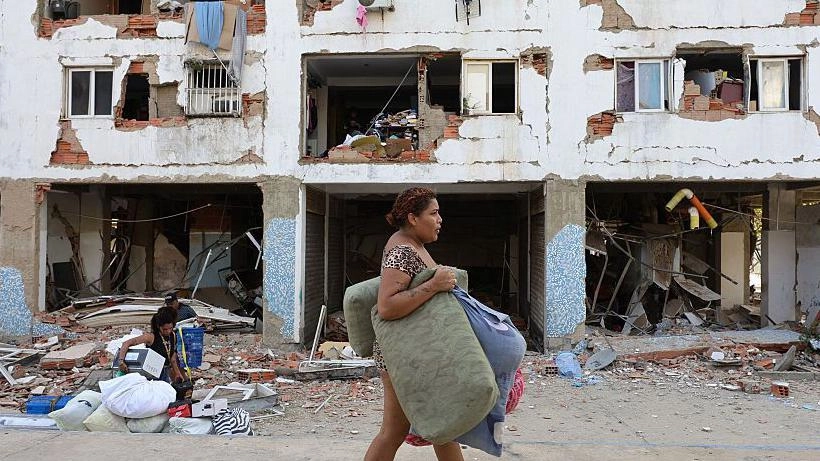

The two earthquakes that hit northern Venezuela this Wednesday and left hundreds dead and thousands injured have once again highlighted the country's propensity to suffer seismic movements and their catastrophic effects.
The two successive earthquakes on Wednesday had magnitudes of 7.2 and 7.5 and caused hundreds of buildings to collapse, trapping numerous people under the rubble.
The disaster has caused the country to face a serious emergency aggravated by the precarious living conditions of a large part of its population for years.
While citizens and rescue teams work to search for survivors, many wonder how it was possible for a natural disaster of this magnitude to hit the South American country with such dire consequences.
The answer lies in the geology and history of Venezuela.
The plates and faults of Venezuela
It is not the first time that Venezuela has suffered earthquakes of great magnitude and catastrophic consequences.
This is because the country is located near the boundary of two tectonic plates, the Caribbean plate and the South American plate.
According to BBC Science journalist Esme Stallard, “both tectonic plates try to pass over each other and sometimes they get stuck and energy accumulates.”
“When they finally start moving again, enormous amounts of energy are released, making Venezuela prone to earthquakes,” notes Stallard.
The movement of the Caribbean plate to the east of the South American plate, at a rate of 2 centimeters per year, according to scientists' estimates, explains the telluric movements in the country.
The movement of plates over millennia has generated a system of faults whose confluence in northern Venezuela increases the probability of large earthquakes.
These are the Boconó faults, which go from Táchira to the Caribbean; that of El Pilar, which mainly crosses the northeastern state of Sucre; and that of San Sebastián, which runs along the sea near the Venezuelan Coastal Mountain Range.
Although its route is completely underwater, the San Sebastián fault runs almost parallel to it a few kilometers from the central coast of Venezuela. Its distance from Caracas is only 30 kilometers, which makes tremors common in the Venezuelan capital.
The high concentration of faults contributes to the high seismicity of the Venezuelan territory, especially in the north.
In the Andean region of Mérida, for example, the Venezuelan Foundation for Seismological Research (Funvisis) detects dozens of small earthquakes every day.
This entity attached to the Venezuelan government counts up to 131 major seismic episodes between 1530 and 2004, but the figure is presumably higher since until the beginning of this century the network of measurement stations was much smaller than the current one.
According to Funvisis, this year 1,274 tremors had been recorded until June 25, some of them in eastern Colombia.
The country has suffered major earthquakes throughout its history.
One of the most remembered was the one that shook Caracas and the central coast of Venezuela on July 29, 1967 and that, according to Funvisis, left at least 245 dead and thousands injured. Its ravages forced a rethinking of building rules in a capital then in the midst of uncontrolled growth.
Decades before, on January 17, 1929, a 6.9 magnitude earthquake caused a tsunami and destroyed the city of Cumaná, in the state of Sucre. It is estimated that about 800 people died.
And on October 29, 1900, the well-known San Narciso earthquake took place, due to the holiday celebrated on that date by the Catholic Church, also well remembered.
The earthquake hit the central coast, affecting Caracas, Naiguatá, Guatire and other towns. According to Funvisis, there were 21 deaths and hundreds of buildings destroyed.
Why this week's earthquakes were so devastating
With hundreds of dead and thousands injured, and material damage yet to be quantified, the double seismic episode last Wednesday has been particularly deadly and damaging.
Jan Egeland, secretary general of the Norwegian Refugee Council, told the BBC from Venezuela that humanitarian teams on the ground are seeing “atrocious damage.”
Egeland affirmed that Venezuela is poorly prepared and vulnerable in an emergency situation, since it has an “infrastructure in ruins” after decades of lack of investment.
Science journalist Esme Stallard explains why movements like this week's can be so destructive in a country like Venezuela.
"These events were very shallow, less than 21 kilometers from the surface; and the shallower the seismic movements, the greater their potential damage."
There is another factor is the distribution of the population in Venezuela.
Funvisis estimates that about 80% of Venezuelans live in areas of high seismic risk.
Indeed, the main cities of the country, such as Caracas, Valencia, Maracay, Mérida or San Cristóbal, are built on or near the faults that cross the country, which increases the risk of loss of life when there are earthquakes.
The reasons are again historical.
Venezuelan cities were founded in colonial times by the Spanish, who preferred to establish their settlements in the valleys formed by tectonic movements because they offered water courses, more fertile soils, a milder climate and natural protection against potential enemies.