

Why Venezuela lacks electricity despite its oil wealth
Venezuela has the largest crude oil reserves in the world and enormous hydroelectric potential, but it has serious problems with electrical service
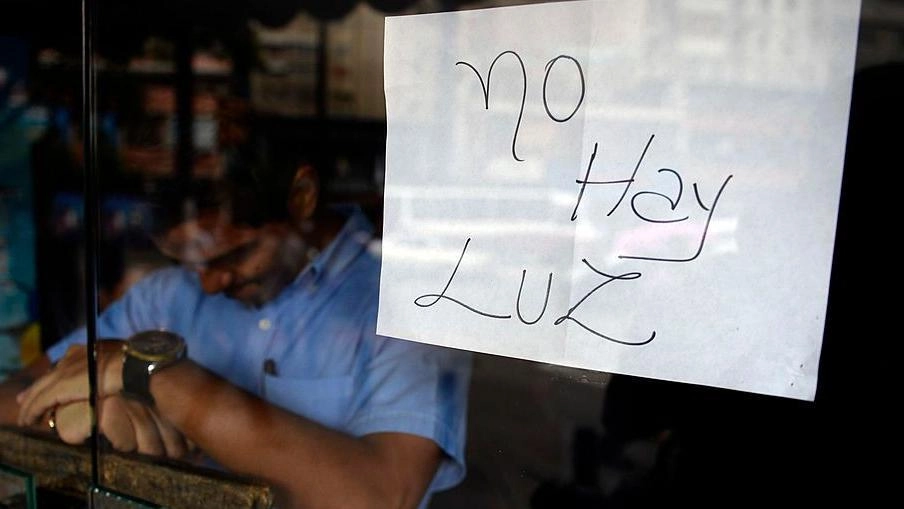

Maria was hoping that on her birthday the only candle she would need was the one she would place on top of the cake.
But on May 5, when I called her to congratulate her, the electrical service to her house in Maracaibo, the second most populated city in Venezuela, located in the west of that country, was interrupted.
“I believed that today they were not going to cut off our electricity because they had already taken it away from us yesterday and the previous weeks the blackouts had been interday,” she told me resignedly.
The outage extended from 8 p.m. until midnight, so when it was time to sing “Oh, what a beautiful night”—the long traditional Venezuelan birthday song—they still had no light.
Luckily, they didn't need many more candles than the one on the cake because, after years of constant electrical service failures, María bought some battery-powered lamps. He also bought fans, which help him deal with the stifling heat of his city, whose average annual temperature is around 30 ° C.
The problem of lack of electricity is not exclusive to Maracaibo. According to the most recent edition of the Living Conditions Survey (Encovi), published in 2025 by the Andrés Bello Catholic University of Caracas, 9 out of 10 households in Venezuela reported suffering interruptions in electrical service and 4 out of 10 stated that these cuts were daily and lasted for several hours.
It's not a new problem either. At least since 2009, during the presidency of Hugo Chávez, the Venezuelan government began to apply measures to ration electricity consumption and, shortly after, in 2010, declared the so-called “electrical emergency” to supposedly facilitate the investments required by this sector.
More than 15 years later, Venezuelans continue to suffer from electricity problems and, in fact, outages appear to have increased in 2026.
Growth without energy?
During the first quarter of 2026, there were 36 protests in Venezuela due to electricity failures. Of those, 24 occurred in March, according to the Venezuelan Observatory of Social Conflict, which attributed the demonstrations to frequent electrical outages without scheduled announcements "that affect domestic, commercial and service activities, in addition to generating economic losses and damage to equipment."
The government of interim president Delcy Rodríguez attributes these electricity problems to the increase in temperatures and the increase in economic activity in the country.
"We are seeing the opening and economic development that the country is experiencing in recent months and this opening brings with it an increase in consumption. Venezuelans have higher incomes and that allows them to buy more household appliances. As there is more equipment connected to the network, demand increases," said the Minister for Electric Energy, Rolando Alcalá, in an interview with the state television station VTV at the beginning of May.
Alcalá said that electricity demand had increased to reach 15,579 megawatts, and attributed this to the reactivation of the industrial and commercial sector.
“From an industrial and commercial point of view, those companies and businesses that were working at 50% have increased their activities, and that increases electricity consumption,” he said.
Miguel Lara, an engineer who for three decades—until 2004—worked in the office responsible for coordinating the operation and planning of the Venezuelan electricity system, points out that a demand of 15,579 megawatts represents just an increase of just over 5% in relation to the demand in 2025, which was about 14,724 megawatts.
If such a small increase in demand is causing these recurring outages, which in some cities extend for up to eight hours a day, how can Venezuela make progress in the promised economic and oil recovery promised by both Rodríguez and US President Donald Trump?
No power, no transmission
Miguel Lara, who headed the technical team that advised María Corina Machado's program in the electrical area, points out that Venezuela theoretically has an installed capacity to generate about 36,000 megawatts, but that the actually available capacity is between 13,000 or 13,500 megawatts.
"The electrical system is in a critical phase, perhaps it is already in continuous deficit. It has reached its limit. It no longer supports the incorporation of any new electricity supply requirements, neither in power nor in energy," he points out.
Although Venezuela has the largest proven oil reserves in the world, the bulk of its electrical energy comes from hydroelectric sources.
Lara explains that, currently, renewable sources—basically hydroelectric—generate about 17,000 megawatts, but only a maximum of 10,000 megawatts can be used, since the transmission system is not capable of transmitting more.
The other 3,000 megawatts available come from thermoelectric plants that, according to figures cited by the Reuters agency, operate at around 13% of their capacity.
Thus, the real availability of electricity is far below the installed capacity that the country theoretically has.
"How are you going to reactivate a country that doesn't have electricity? You can't. The productive apparatus is not capable of being reactivated right now because you don't have the megawatts, nor can you have them in the short term. There is no way," says Lara.
This limitation also affects Venezuela's ability to increase its oil production, apparently the main objective of the intervention carried out by the Trump government since it captured the then president of Venezuela, Nicolás Maduro, on January 3.
Trump has advocated making investments of US$100 billion to recover the Venezuelan oil industry, but without electricity there is no oil.
“Without electricity there is no way for the drills to work, which is the fundamental piece to start production,” Miguel Lara tells BBC News Mundo.
“Refineries and all processes from exploitation to marketing, moving gas pipelines and driving all of that need engines,” he adds.
The expert assures that to have electricity in the oil fields, foreign companies that want to invest in Venezuela will have to import their own power plants and even their own fuel.
According to him, the fuel that PDVSA can offer them is of very poor quality, so the power plants that use it require more frequent and expensive maintenance.
Susana Brugada, Chevron's corporate affairs manager in Venezuela, explained that the oil fields they operate are directly connected to the electrical grid, so production is affected when a failure occurs.
“Every time there is one of the power outages that causes all of our refrigerators to start to suffer and our computers to crash, imagine what that does to the oil wells,” he said.
"Each flicker of light can knock down 40 wells in a single blink, but [later] it's not like the light came back on and the 40 wells went back up. We took out the calculator of what it can produce and we're talking about how that really is a decrease in national production," he added in statements reported on May 21 by the Televen television station.
Brugada highlighted that while there are wells that have independent power plants, most of the Venezuelan crude oil is produced in the Orinoco Oil Belt, which depends on the Venezuelan electrical grid.
The lack of energy could become an even bigger problem if some of the eight million Venezuelans who have emigrated return to the South American country.
"The country does not have electricity for all the people who now live here. Imagine that half of those who left return. That is 4 million, equivalent to the population of Caracas. Now you do not have enough to supply electricity to more people," says Miguel Lara.
Medium and long term solutions
Power outages are already having a negative impact on the Venezuelan economy.
Ernesto Abbass Sosa, president of the Valencia Chamber of Commerce, points out that in that city—the third most populated in Venezuela—power outages last between 5 and 8 hours a day.
"It is a complicated situation, it is a challenge that all of us in the commercial sector of the city have. Although commercial or service establishments are not operational during those hours, they still have to pay rent, fiscal taxes, parafiscal taxes, electricity, water, cleaning services, they have to pay payroll, everything that is part of the fixed expense," says Abbas in conversation with BBC News Mundo.
Abbass indicates that the situation also has an impact on citizens who do not have a business due to the frustration and exhaustion it generates.
“The physical and mental exhaustion of that person as a production factor, as a social factor, as a family factor, is detrimental to the development of a country,” he points out.
And he adds that, from the Valencia Chamber of Commerce, they have proposed to the national Executive that it establish a mechanism to provide credits to businesses so that they can acquire basic equipment - power plants, solar panels, etc. - to be able to operate, even if the electricity has gone out.
Meanwhile, he indicates, many businesses are notifying potential customers via social networks when they have or lack electricity service and are lengthening their hours of operation to partially compensate for closing hours.
But what are the options that Venezuela has to once again have a reliable electrical system that is capable of boosting economic recovery?
Time, money and planning
Miguel Lara estimates that to have an electrical system with these characteristics, it is necessary to have a professional management team with execution capacity that has “a well-structured plan, with all the subprojects, with all the possibilities, all the actions that must be taken from the legal and technical point of view, in all aspects.”
In addition, money from multilateral organizations and the private sector would be needed.
And how much money and time would it take? The expert estimates that about US$45,000 million and about six years to have an electrical system capable of supporting a 15% growth in interannual demand and an increase in GDP of 10 points per year.
Lara points out that the first two or three years may be enough to stabilize the system and recover part of the installed capacity that exists in the country, but is not operational at this time.
The expert considers, however, that the first step on this path implies a political change in the country, since he believes that the state of deterioration in which the electrical service has fallen in Venezuela is not due to a lack of resources but to a management model.
“Positive political change is the first element, although not sufficient, to change this authoritarian model, without knowledge, without merit, without maintenance, with a system of opacity in which you do not know the figures, where there is waste, where there is impunity,” he says.
He assures that the deterioration is not due to a lack of resources and explains that the entire electrical system that was installed in Venezuela during the second half of the 20th century cost about US$48.25 billion (at 1998 prices) between public and private investment, while Chavismo invested between 1999 and 2025 about US$117.04 billion.
Despite this, 80% of the current supply continues to be generated through what existed before Chávez came to power.
“Money has been left over and they have wasted it on inconvenient works,” he says.
Lara says, for example, that Venezuela bought some power plants during the Chávez government that Cuba resold to it and that had the potential for about 1,800 megawatts, but that none of those plants are working anymore.
He assures that the plants were inadequate for a country like Venezuela and that, in practice, the operation served as a money transfer to Havana.
“Then they began to incorporate barges and machines in places where there was no fuel, machines that did not have a transmission system and stowed machines that have been lost,” he says.
In hydroelectric matters, he points out that Chavismo allocated US$9,000 million to the Tocoma plant — “three times more than what he claims the Caruachi plant cost, which is an identical development in civil and electromechanical works” —. This was supposed to be ready by 2010, but 16 years later it is still not working.
In any case, with or without political change, what seems clear is that María will continue to need her battery-powered lamps and fans to ensure that she does not spend her next birthdays by candlelight.