

If we die, let it be in the house of the Lord: Christians do not want to abandon the churches of Gaza
The Christian community in Gaza City said it will not comply with the Israeli armys order to move
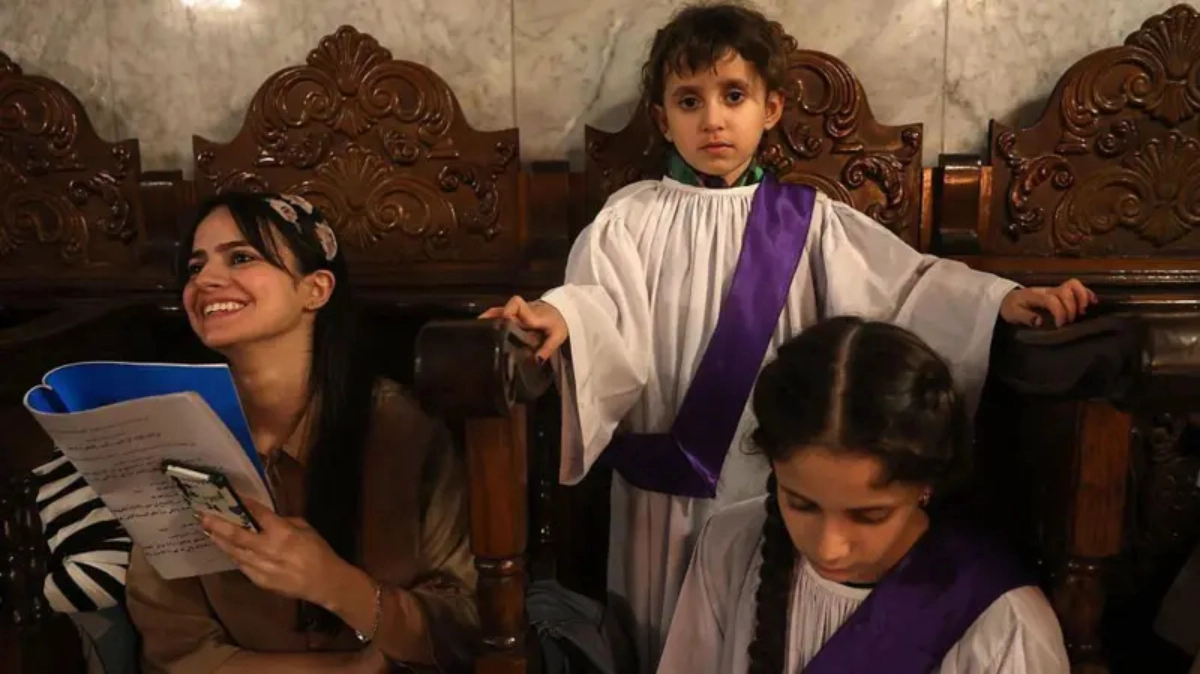

Ramez Al-Souri lives in the St. Porphyrius Orthodox Church in Gaza City.
He lost 12 members of his family, including three of his children, in the same place on October 19, 2023, following an Israeli airstrike that targeted the third oldest church in use, after the Church of the Nativity in Bethlehem and the Church of the Holy Sepulchre in Jerusalem.
However, the grieving father insists on staying and not being displaced, despite the evacuation orders recently issued by the Israeli military to the city's residents.
“We are here, among family, friends, and loved ones. Together, we have faced all the acts of violence to which we have been exposed since the beginning of the war. Churches were directly attacked, resulting in the martyrdom of many of my relatives and children,” he told the BBC radio program “Middle East Diaries.”
“I am speaking to you despite my illness, my pain, and the loss of my children, because the unprecedented scenes of destruction in the Sabra and Zeitoun neighborhoods do not bode well,” he said.
“Certainly, all of us, as Christians and displaced people in the Church, fear that it will be attacked again. However, we will abide by the decision made by the Supreme Council of the Church for Christians in Jerusalem not to be displaced from Gaza City.”
Al-Souri emphasized that the Church is the one who makes the right decisions for Christians, and that all members of the Christian community are committed to the most important church decisions made by the Greek Orthodox Patriarchate and the Latin Patriarchate in Jerusalem.
The Israeli military on Wednesday ordered the evacuation of the St. Porphyrius Greek Orthodox Church and its compound in Gaza City, according to the Israeli newspaper The Times of Israel.
These developments come as the Israeli military prepares to carry out a large-scale evacuation of civilians from Gaza City in preparation for a broader military offensive aimed at capturing the Strip’s largest city.
“We fight with the word of God.”
For his part, Father Issa Musleh, official spokesman for the Greek Orthodox Patriarchate of Jerusalem, stated that the determination not to displace was a direct decision of Patriarch Theophilos III, Patriarch of Jerusalem, All Palestine and Jordan, and the Latin Patriarch of Jerusalem.
Father Musleh emphasized that the press release issued by both patriarchates aims to “prevent the displacement of Christians in particular, and Palestinians in general, from Gaza,” in order to thwart what he called “Israeli attempts to seize the land and empty it of its inhabitants.”
The Greek Orthodox and Latin Patriarchates Jerusalemites said in a joint statement released last Tuesday: “Leaving Gaza City and attempting to flee south would be tantamount to a death sentence for them.” For this reason, the religious have decided to stay and continue caring for all those who remain in the two compounds.
Father Musleh noted in his speech that, “Despite the Israeli army’s decision to expel the Christians from the Monastery of Saint Porphyrios and the Church of Saint Porchinia, the Orthodox clergy, along with the Christian masses, categorically refused to leave, insisting that it was their duty to care for the Palestinian people, as these monasteries and churches host displaced Palestinians, both Muslims and Christians.”
The Orthodox clergy unanimously decided to remain in the monasteries and churches to “thwart the displacement plan and preserve the precious heritage they inherited from their parents and grandparents.”
Father Musleh described the attempt to expel them from their places of worship as an “atrocious crime against humanity,” according to his statements.
And he concluded his speech by saying: “We are closely following the situation because we are truly concerned about the situation in Gaza City, but no matter how difficult the circumstances, we will not abandon them. This is our final decision.”
Christian Pastors
For his part, Father Abdullah July stated: “Christians in Palestine and the Arab East in general are not sects, but an integral part of the Palestinian Arab people and the Arab peoples of the region. From this perspective, we, as pastors, must help Christians survive, because survival and perseverance are resistance against the objective that the Israeli army seeks to impose, which is to take over the land without its people.”
Father July warned that without the Christian Arabs in this region, the churches and monasteries would become mere museums and shrines for a displaced people to mourn in the ruins.
Elias Al-Jilda, a displaced church member and member of the Council of Representatives of the Arab Orthodox Church in Gaza, noted: “Staying is a reality. The reality is that there are hundreds of displaced people in this place who cannot be abandoned, in addition to several children with disabilities who cannot be relocated if the displacement decision is implemented.”
According to Al-Jilda, the majority of those in the Christian churches in Gaza City are women, the elderly, and children with disabilities who were displaced from their homes about two years ago and sought refuge in these churches after their homes were destroyed.
“The church decided that we would not leave because it is impossible for them to leave and abandon people, especially people with disabilities and the elderly. It is not even religious nor humane to leave them alone to face the unknown. This is tantamount to a death sentence,” he added.
As a Palestinian Christian, Al-Jilda said he would never consider leaving, because moving south would mean departing into the unknown and a world of unbearable loss. “We were born in Gaza City and are used to living there. We know no home but Gaza City.”
“If death is inevitable, let it be within the church. We do not choose between life and death, but between death and death.”
This Christian steadfastness in Gaza is not simply a rejection of displacement. It sends a clear message to the world that the Christian presence in the Holy Land is an integral part of the Palestinian social fabric, and that churches are not mere buildings but refuges and symbols of humanity.