

No contract, no coffee: Starbucks employees on strike
More than 1,000 unionized baristas continue their indefinite strike; they denounce low wages and unfair labor practices
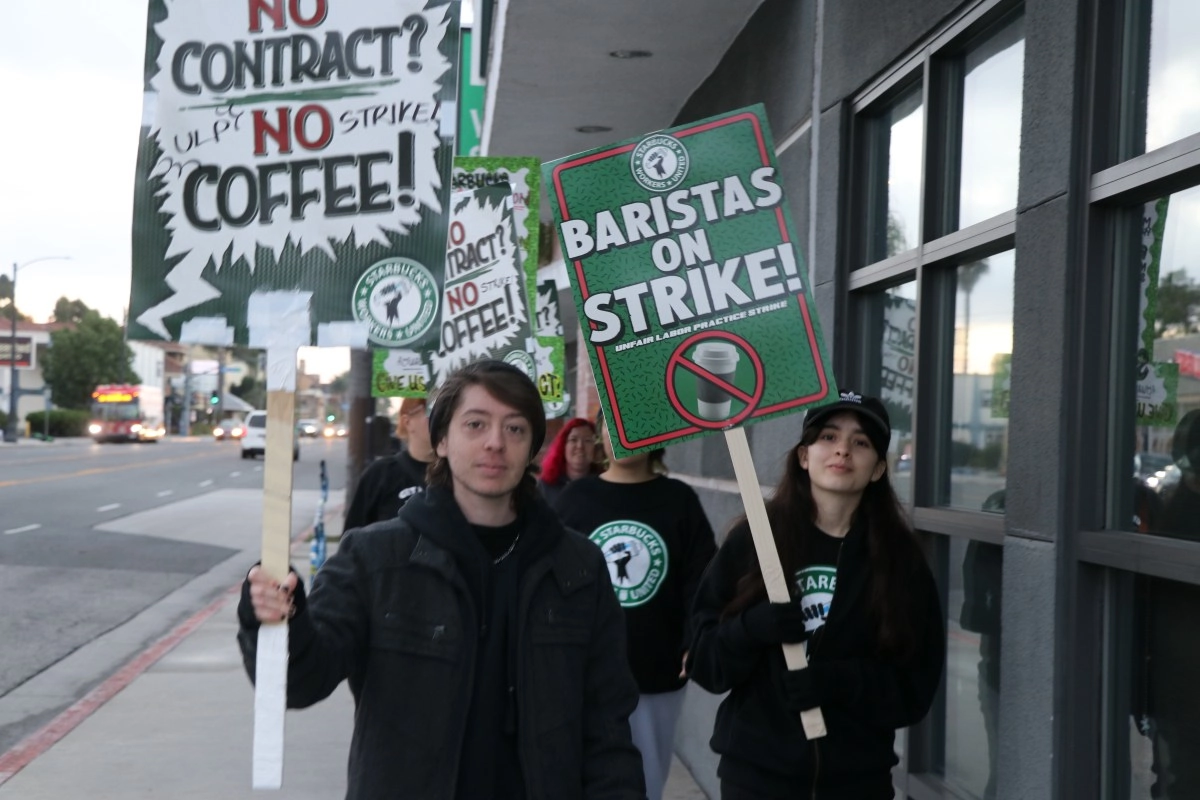

In the early hours of Friday morning, a dozen Starbucks employees protested what they consider unfair labor practices at 65 stores in more than 40 cities across the United States, including Long Beach, and continued their indefinite strike.
The labor dispute at Starbucks—from California to Colorado, and from Illinois to Georgia and Missouri, and from Oregon to Pennsylvania and Texas—has intensified since April, when unionized employees lost their contracts, and the strike that began on November 13.
“Starbucks calls us employees 'partners.' However, I don't feel they've earned the right to call us that,” declared Arvon Nicholson, who has been with the multi-billion-dollar company for three years. “We fight for a living wage.”
In front of the store located at 5760 Seventh Street in Long Beach, the workers—mostly young—express their frustration with issues such as the lack of contracts, staff shortages, low wages, the resolution of unfair labor practices, and the proper allocation of hours for workers. The average salary for a barista is $16,000 or $31,683 annually.
“If we don't get it, shut it down!” “What's disgusting?” Union busting” (“If we don’t get it, we’ll stop it!” “What’s disgusting? Union repression!” the strikers shouted.
Dubbed the “Red Cup Rebellion” in protest of Starbucks’ long-standing anti-union practices and its refusal to agree to a fair collective bargaining agreement, the strike came 18 months after the start of national contract negotiations, with the company failing to present any new proposals to address workers’ demands.
“The contract they offered us wasn’t made in good faith,” Nicholson said. “We walked away because, essentially, it was an insult. That’s why we’re saying now, ‘No contract, no coffee.’”
Jaci Anderson, a Starbucks spokeswoman, stated that, given the workers’ demands, the company needs the union back at the negotiating table.“Workers United abandoned negotiations and has not returned since April, despite the company’s efforts to resume them,” she told La Opinion. “As we have already stated, 99% of our 17,000 U.S. stores remain open and serving customers, including many that the union publicly announced would go on strike, but which never closed or have even reopened,” the spokesperson revealed. She added that, regardless of the union’s plans, “we do not anticipate any significant disruption. When the union is ready to return to the negotiating table, so are we.” Anderson also emphasized that “the facts are clear: Starbucks offers the best jobs in the retail sector, with pay and benefits averaging $30 per hour for hourly employees.” “People choose to work here and stay: our employee turnover is less than half the industry average, and we receive more than one million job applications each year,” she stated. Background: Workers United reported that last week, Workers United announced 64 strikes, but only 49 Starbucks cafes experienced any disruption, and 29 of those have already reopened. “In fact, 13 cafes included on their strike list never closed,” said a Starbucks spokesperson. Starbucks Workers United is comprised of 11,000 baristas in more than 550 active Starbucks stores. Affiliated with Starbucks Workers United, the baristas authorized and launched an indefinite unfair labor practices (ULP) strike, protesting more than 700 unresolved LLP complaints and demanding a fair first collective bargaining agreement. They emphasized that Brian Niccol's tenure as CEO has coincided with a worrying resurgence of widespread anti-union practices, which had significantly decreased during the previously agreed-upon bargaining period. According to Yahoo Finance, Niccol, who assumed the chairmanship and CEO position at Starbucks employees in September 2024 have a base salary of $1.6 million annually. They also receive annual bonuses with a target value of $23 million, and a signing bonus of $10 million. Unionized baristas said they are prepared to make the strike the largest and longest in the company's history, right during the crucial holiday season. “Yes, we are in a very difficult situation,” Nicholson said. “The holidays are coming up. People not only have stories to tell, but also their families. We have to provide for our children: put food on the table, clothes to wear, and a roof over our heads.” However, he added that with all of that in mind,They are finding it difficult to find the willpower to continue the strike.
“When we go on strike and refuse to work, we are obviously turning down money. However, resisting and doing so is honoring something much more important than earning a paycheck each day,” the Starbucks employee stated. “Because what we sacrifice is in the hope of a better future. Nobody wants to be in this situation, unable to work, [but] with the sacrifices we make, we hope for a better future.”
Kayla Bennett, a new Starbucks employee of six months, also expressed her dissatisfaction with the company.
Bennett highlighted problems such as irregular schedules, the lack of guaranteed hours, and the difficulty in finding a second job due to the unpredictability of shifts.
“I know this company generates billions of dollars in profit, and I think they should treat their associates better, especially union members,” she said. “They’ve been dragging out the contract negotiations, and we deserve a fair contract.” She criticized the company’s CEO, Brian Niccol, for earning $57,000 an hour while she can’t even pay her bills. “I struggle to pay $1,800 a month in rent.” In December 2024, the Starbucks Workers United union filed a national Unfair Labor Practices (ULP) complaint. alleging that Starbucks had not negotiated in good faith and was undermining the union's representativeness after the company reneged on the previous agreement and failed to present any serious economic proposals following nine months of negotiations. This complaint by PLD was amended and expanded in April 2025 after Starbucks illegally implemented new policies, as components of the “Back to Starbucks” program—a strategy to return to the company's core identity by improving the in-store experience, focusing on craft beverages, increasing efficiency through new technologies, a simplified menu, and establishing a new restrictive dress code—without negotiating with the union.The lack of guaranteed hours and the difficulty in getting a second job due to unpredictable shifts.
“I know this company makes billions of dollars in profit, and I think they should treat their associates better, especially union members,” she said. “They’ve been dragging their feet on contract negotiations, and we deserve a fair contract.”
She criticized the company’s CEO, Brian Niccol, for earning $57,000 an hour while she can’t even pay her bills.
“I struggle to pay $1,800 a month in rent.”
In December 2024, the Starbucks Workers United union filed a national Unfair Labor Practices (ULP) complaint. alleging that Starbucks had not negotiated in good faith and was undermining the union's representativeness after the company reneged on the previous agreement and failed to present any serious economic proposals following nine months of negotiations. This complaint by PLD was amended and expanded in April 2025 after Starbucks illegally implemented new policies, as components of the “Back to Starbucks” program—a strategy to return to the company's core identity by improving the in-store experience, focusing on craft beverages, increasing efficiency through new technologies, a simplified menu, and establishing a new restrictive dress code—without negotiating with the union.The lack of guaranteed hours and the difficulty in getting a second job due to unpredictable shifts.
“I know this company makes billions of dollars in profit, and I think they should treat their associates better, especially union members,” she said. “They’ve been dragging their feet on contract negotiations, and we deserve a fair contract.”
She criticized the company’s CEO, Brian Niccol, for earning $57,000 an hour while she can’t even pay her bills.
“I struggle to pay $1,800 a month in rent.”
In December 2024, the Starbucks Workers United union filed a national Unfair Labor Practices (ULP) complaint. alleging that Starbucks had not negotiated in good faith and was undermining the union's representativeness after the company reneged on the previous agreement and failed to present any serious economic proposals following nine months of negotiations. This complaint by PLD was amended and expanded in April 2025 after Starbucks illegally implemented new policies, as components of the “Back to Starbucks” program—a strategy to return to the company's core identity by improving the in-store experience, focusing on craft beverages, increasing efficiency through new technologies, a simplified menu, and establishing a new restrictive dress code—without negotiating with the union.a simplified menu and establishing a new, restrictive dress code, without negotiating with the union.