

3 keys that explain why Keiko Fujimori won in Peru this time after three previous defeats
The right-wing party won the fourth ballot that it disputes, after a series of changes in the country and in its own electoral campaign
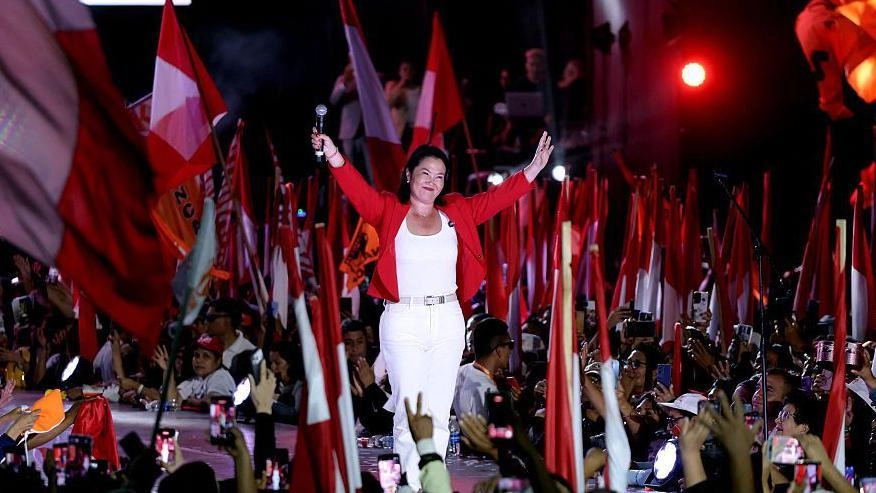

Keiko Fujimori has managed to win the presidential elections in Peru, according to the final result of the scrutiny published this Monday by the National Office of Electoral Processes (ONPE).
The ONPE completed the recount of the electoral records 100% after more than three weeks since the runoff on June 7.
Fujimori, Fuerza Popular candidate, obtained 50.135% of the valid votes, equivalent to 9,223,396 votes, compared to 49.865% and 9,173,755 votes for the leftist candidate Roberto Sánchez, of Together for Peru, according to ONPE.
The difference between the two was 49,641 votes, one of the narrowest margins recorded in a Peruvian presidential election in recent decades.
In this way, in the absence of official proclamation, Fujimori will access a position that he had been seeking for 15 years but that had eluded him for various reasons.
Overcoming, even by that minimal difference, half of the valid votes was a difficult challenge for the daughter of former President Alberto Fujimori: this was the fourth presidential runoff she contested.
There are three keys that explain why Fujimori managed to overcome that barrier now, at 51 years old:
1. Anti-Fujimorism gives way
Fujimori had been defeated in the last three elections, even by narrow margins, by a political movement that lacked an organic structure: anti-Fujimorism.
This is the name given to the rejection that the idea of a Fujimori governing Peru generates in voters of various profiles, from liberals to leftists and centrists.
This is largely due to the memory of when Fujimori Sr. presided over the country between 1990 and 2000, carried out a self-coup d'état and was responsible for acts of corruption and human rights violations for which he would later receive a 25-year prison sentence.
In the 2016 runoff, for example, many leftists supported a former Wall Street banker like Pedro Pablo Kuczynski to defeat Keiko Fujimori, who had 49.88% of the votes.
And, in the 2021 second round, liberal and centrist voters backed a Marxist party candidate like Pedro Castillo to defeat Fujimori, who received an almost identical percentage of support.
However, after the death of former President Fujimori in 2024, that motley coalition appears to have given in slightly but decisively in these elections.
“Anti-Fujimorism has weakened, so it no longer generates the traction it used to,” says political scientist José Incio, professor of social sciences at the Pontifical Catholic University of Peru, to BBC Mundo.
This weakening is due in part to the discontent generated by the Castillo government, who was involved in several scandals, tried to dissolve Congress in 2022 like Fujimori three decades earlier, but failed and was sentenced to 11 years in prison for rebellion and conspiracy.
That Sánchez was Castillo's minister and considered himself his political heir in this runoff led many anti-Fujimoristas to avoid closing ranks behind him.
That paved the way to power for Fujimori, who in the campaign vindicated several aspects of his father's government although he promised to avoid corruption and human rights violations such as those that led his father to prison.
2. Fatigue with instability
Peru's political instability is so great that the country has seen eight people serve as president in the last decade. Fujimori will be the ninth, starting July 28.
Experts attribute this phenomenon to a loss of balance between the powers of the State since Congress forced Kuczynski's fall in 2018, by initiating a process to remove him for “moral incapacity.”
This constitutional mechanism was activated by Fujimori's party, which had an absolute majority in the Legislature, and since then it began to be used frequently to pressure the Executive and remove other presidents.
Congressmen have also taken advantage of their increased power to approve a series of expenses that could put macroeconomic balance at risk.
And such confusion also seems to have weighed on the ballot boxes.
“There is a kind of accumulated fatigue in people, because this campaign and the previous political crisis have been very intense,” explains Ricardo Cuenca, a social psychologist and principal researcher at the Institute of Peruvian Studies.
In these elections, Fujimori sought to present himself as a guarantee of stability, with his slogan “order returns” and promises to direct the economy as his father's government did.
Unlike what could happen if Sánchez won, the president-elect will have a level of support in Congress that, according to analysts, would prevent her from being removed, even if she lacks her own majorities.
"What there is is a bit of exhaustion and Keiko Fujimori wins because she became 'the lesser evil', something that had not happened in the three previous elections," Cuenca tells BBC Mundo.
3. The appeal of the “strong hand”
Fujimori also placed the issue of security at the center of his campaign, with promises to firmly combat crimes.
“All our energy will be focused on what we know how to do: being tough on crime,” she said as a candidate.
Their proposals included involving the military in security tasks, allowing anonymous magistrates to try suspected criminals, building mega-prisons like Nayib Bukele's in El Salvador, forcing prisoners to work for food, and expelling irregular immigrants who commit crimes.
Fujimori also promised to “pacify Peru” and appealed to the memory of his father as a president who faced and defeated two left-wing armed insurgencies.
All of this seduced voters in a country where insecurity is a priority concern after an increase in extortion and homicides, which reached 10.7 per 100,000 inhabitants last year.
“It is a tendency of the populist right in general in Latin America to work with people's fear due to an insecurity that exists,” says Cuenca.
He adds that, in addition to crime, the problem is linked to the uncertainty that poor State management generates in society.
“Therefore, whoever offers me a more direct path to the solutions of those problems (and) commits to being ‘tough’ with this, ultimately ends up in a position that is attractive to many,” explains the social psychologist.