

Earthquakes in Venezuela have left at least 1,400 dead and more than 3,200 injured
The number of dead and injured is increasing as the hours go by and as rescue teams reach some of the most affected areas.
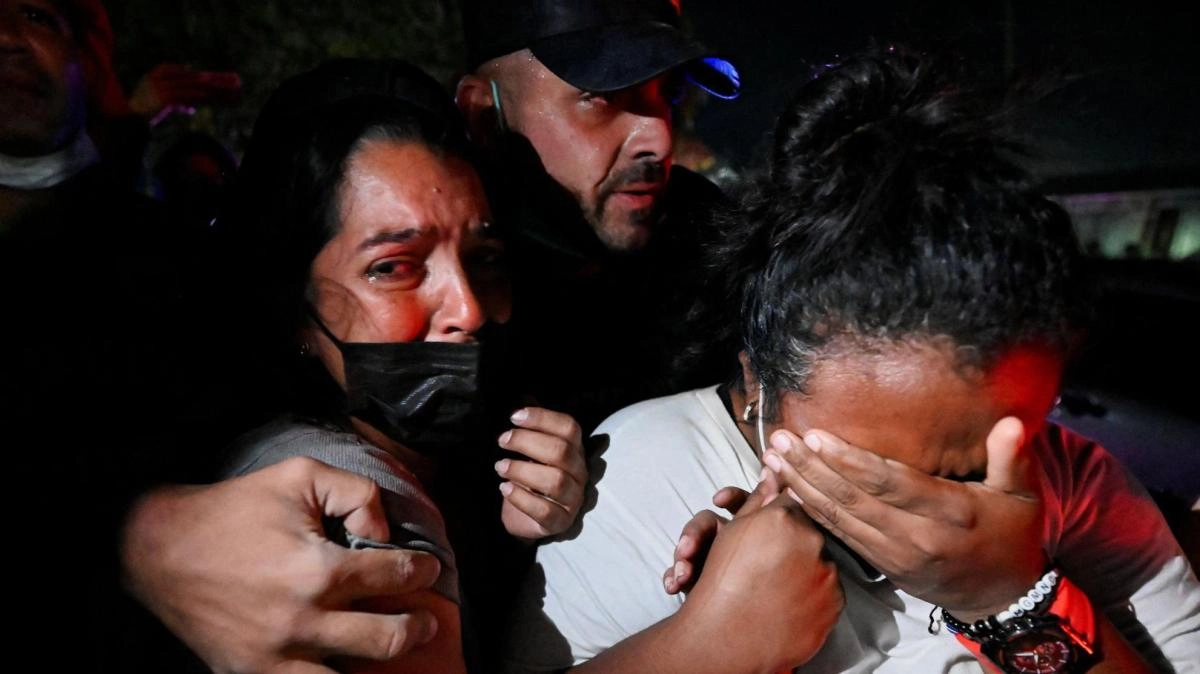

First responders continue to work around the clock in the search for tens of thousands of missing people in Venezuela, more than three days after back-to-back devastating earthquakes that shook the country.
More than 1,400 people have died and more than 3,200 have been injured, according to preliminary data provided by authorities.
On Saturday night, acting president Delcy Rodríguez reported that 24 countries had sent assistance and 2,741 first responders to help in the search operations.
The crucial 72 hours have already passed, after which the probability of finding survivors decreases.
However, there have been some successful rescues, such as that of an 11-year-old boy who was pulled alive from the ruins of a building on Saturday by a specialized unit from Colombia, after a five-hour operation.
The minor was found conscious and with a fracture in his arm, after spending three days under the rubble. Early Friday morning a newborn baby and his mother had been rescued from a collapsed building.
This Sunday, speaking from the window of the Apostolic Palace in the Vatican, Pope Leo XIV expressed “gratitude and encouragement” to those who collaborate in rescues and assistance, and sent a message to Venezuelans.
“I wish to express my closeness to the Venezuelan sisters and brothers affected by the recent earthquakes that caused numerous victims and injuries, as well as enormous material damage,” the Supreme Pontiff said in Spanish.
Two strong earthquakes shook Venezuela just a few seconds apart. The second earthquake, with a magnitude of 7.5, was one of the most intense recorded in the country in the last century.
The president of the National Assembly of Venezuela, Jorge Rodríguez, reported this Saturday in a televised appearance that more than 430 aftershocks have been recorded since the initial earthquakes and that more than 3,100 families are in shelters.
When the tremors hit, dozens of buildings collapsed and residents of Caracas and the neighboring state of La Guaira, the worst affected areas, took to the streets seeking shelter.
The UN estimates that there are about 50,000 missing.
A state of emergency has been declared and airport, rail and transport services have been suspended.
The injured are being treated in makeshift medical facilities and a senior Venezuelan government official reported that hundreds of international rescuers have arrived in the country and more are on the way.
The medical centers that remain in operation are overwhelmed; Health staff told the BBC that, even before the disaster, it was already difficult to care for patients.
The earthquakes occurred while Venezuela was celebrating a holiday, meaning there were more people at home than there would be on a typical weekday.
Venezuelan Interior Minister Diosdado Cabello reported on Friday that traffic to and from La Guaira would be restricted starting Friday night, amid concerns about congestion, chaos and public health.
The latest information from the authorities
The president of the National Assembly of Venezuela and key man of the Chavista leadership, Jorge Rodríguez, said this Saturday that the two earthquakes were “the most fateful event that this Republic has suffered in the last 123 years.”
Rodríguez, brother of the acting president Delcy Rodríguez, addressed the population on state television and updated the official death toll from the disaster, which now stands at 1,430.
The government has recorded 3,238 injuries.
In the state of La Guaira, one of the most affected areas, there is “tremendous destruction,” said Rodríguez, who asked Venezuelans to avoid traveling there so as not to collapse the roads and allow emergency machinery and equipment to work.
Access to La Guaira remained restricted this Saturday, according to Reuters. Authorities maintained checkpoints on the main highway connecting to Caracas as traffic slowed emergency vehicles, and civilians who were not part of official rescue teams needed credentials to pass checkpoints.
Residents of the area have been lamenting since Wednesday that no one has come to their aid and they lack the heavy machinery necessary to rescue survivors from the rubble of the destroyed buildings.
According to Rodríguez, 3,142 families are now in shelters after their homes were affected by the earthquakes.
The leader also pointed out that after the double seismic movement on Wednesday, 430 aftershocks have occurred.
“That speaks of the devastating and lethal power that this earthquake, these two earthquakes and their aftershocks have also had,” Rodríguez added.
These are the details he offered about the earthquakes:
The death toll is increasing
The number of dead and injured is increasing as the hours go by and as rescue teams reach some of the most affected areas.
So far dozens of people have been rescued alive.
Citizens have pulled people out of collapsed buildings with their bare hands, as disruption to communications, damage to roads, and lack of resources made initial emergency response difficult.
Many people are feared still trapped under the rubble and the death toll is likely to rise further as rescue efforts continue.
In the hours after the earthquakes, the US Geological Survey (USGS) said there was a 44% chance there could be up to 10,000 fatalities and a 30% chance the number could reach 100,000.
However, these figures were calculated based on previous earthquakes with similar characteristics and other factors, such as the size and depth of each earthquake, so they are not exact predictions.
Other factors influence potential injuries and deaths, including the quality of buildings and the time of day the earthquakes struck.
The area where the earthquakes occurred is particularly vulnerable, the USGS said.
He indicated that many buildings there are built with unreinforced brick masonry and adobe blocks, and that the intensity of the earthquake implied a high probability of destruction of structures and fatalities.
Population frustration grows
According to the BBC's special envoy to La Guaira, Will Grant, the situation in that coastal area is critical.
It is believed that most of the approximately 50,000 missing people are found there, an unknown number of them buried under the rubble.
Grant assisted in the recovery of three bodies among the concrete and twisted rebar of a collapsed building.
Nearby, in another destroyed apartment block, there was better news: two people were rescued alive.
However, Grant notes, tension is rising due to the slowness and lack of coordination of the government's response.
While the magnitude of this tragedy would represent a challenge for any country, many residents have complained about what they see as a hesitant and poorly managed reaction.
They affirm that it has been the population itself that has united in this emergency.
Services and supplies cut
The fuel supply has been partially interrupted in parts of the country and cuts in internet and electricity service have also been reported.
Venezuela's main international airfield, Simón Bolívar International Airport in Maiquetía, located just outside Caracas, has also been closed due to earthquake damage.
Metro and train services have also been suspended across the country, and school classes are also on pause.
Delcy Rodríguez's declaration of a state of emergency allows additional resources and personnel to be used for recovery efforts.
Many Venezuelans have spent the last few nights on the streets. The country's Interior Ministry called on people to leave damaged houses for fear of unstable buildings and the possibility of gas lines being affected.
The international response
More international search and rescue teams have arrived in Venezuela in recent hours to collaborate in the efforts to locate survivors, just when the crucial 72-hour window has passed.
Experts point out that, after this period, the chances of finding someone alive decrease drastically.
The arrivals area at Valencia airport—located about two and a half hours' drive from Caracas—was bustling with activity with dozens of rescue teams from numerous countries rushing to collect their bulky luggage and equipment.
Upon landing, the airport staff greeted the rescuers with thanks while they remained on the tarmac, under the scorching heat. There were also cheers and expressions of gratitude from the local population present in the arrivals area.
For families waiting desperately by the piles of rubble, the intervention of these well-equipped international teams could represent their best chance of recovering their loved ones.
At least 20 international search and rescue groups have been sent to Venezuela, according to the UN Global Disaster Alert and Coordination System.
This includes nine teams classified as “heavy”, eight as “medium” and three as “light”.
Countries that have sent teams include Switzerland, the United States, the Netherlands, France, Qatar, the Czech Republic, Jordan, the United Kingdom, Spain, Chile, Colombia, Ecuador, Germany, Turkey, Italy and Lithuania.
Another 32 teams are currently mobilizing, according to the UN, bringing the total to 52 teams and more than 2,265 rescuers.
He also adds that the total number of rescue dogs being sent is around 150.
What were the earthquakes like?
The two earthquakes occurred around 6:04 p.m. local time on Wednesday.
The first had a magnitude of 7.2 and had its epicenter in the state of Yaracuy, west of Caracas, at a depth of 22 km, according to the United States Geological Survey (USGS).
Less than a minute later, a stronger earthquake, magnitude 7.5, shook a nearby area, at a depth of about 10 km.
Although both epicenters were located outside the Venezuelan capital, they were strongly felt throughout the city, causing buildings to sway and some to collapse completely.
The causes of earthquakes
Venezuela is located on the boundary between the Caribbean and South American tectonic plates, which move over each other.
The USGS says the sudden release of friction between these two plates likely caused the earthquakes.
The second magnitude 7.5 earthquake was the strongest to hit Venezuela since 1900, according to the USGS.
But another crucial factor is how far below the Earth's surface it occurred.
Earthquakes that occur closer to the surface typically cause stronger, more concentrated shaking.
Wednesday's two earthquakes occurred less than 25 kilometers underground. “Shallow” earthquakes are defined as those that occur at a depth of 70 kilometers or less.
The combination of such a large magnitude with its shallow depth explains to some extent why the damage has been so extensive.
According to the USGS, the earthquakes occurred in a “doublet” sequence, a phenomenon that occurs when two earthquakes of similar magnitude strike shortly after each other and in a similar location.
This suggests that the first earthquake helped trigger the second, unlike a typical sequence in which a larger earthquake is followed by aftershocks of much smaller magnitude.
That two earthquakes of such magnitude occur with such a short difference in time is something particularly unusual, although not unprecedented in this part of the world.
Northern Venezuela suffered a seismic doublet in September 2025, although the tremors were much weaker, with magnitudes of 6.2 and 6.3.
The Turkey and Syria earthquakes of February 2023, which killed more than 50,000 people, also constituted a doublet sequence.