

How Bukele's megaprisons became a model for the radical right
Nayib Bukele's “iron fist” policy, based on mass arrests and megaprisons, is gaining popularity among right-wing leaders in Latin America and Europe
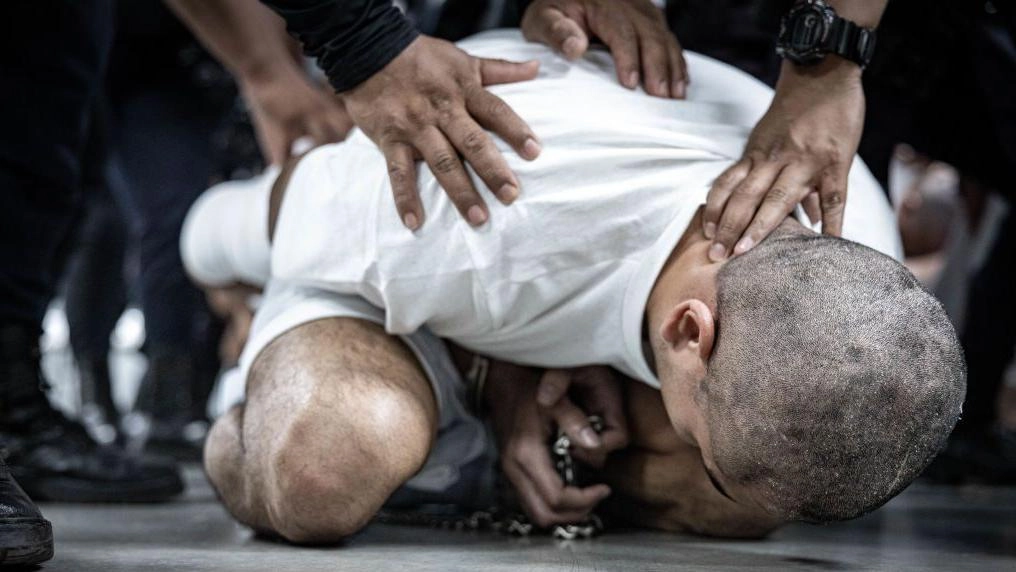

In recent electoral campaigns in Latin America, the president of El Salvador, Nayib Bukele, and his “iron fist” policy against crime—including his controversial megaprisons—have become a recurring reference point in the political debate.
In Colombia, the right-wing Abelardo de la Espriella, winner of the presidential elections according to preliminary data from the pre-count of votes, has openly expressed his admiration for Bukele. During his campaign, he promised the construction of seven megaprisons inspired by the Salvadoran model.
In neighboring Peru, Keiko Fujimori also put the idea at the center of his security proposal. The right-wing leader assured that, if she came to power, she would promote the construction of four prisons and a mega-prison for highly dangerous prisoners, “like Cecot in El Salvador,” in reference to the Terrorism Confinement Center, an establishment that has received numerous complaints of human rights abuses.
The appeal of Bukele's megaprisons is not limited to Latin America. His model has also begun to resonate with the European radical right.
Last week, Jordan Bardella, president of the far-right French party Rassemblement National, referred to the Salvadoran prison system when addressing the problem of overcrowding in his country's prisons.
“In a country of 6 million inhabitants, Mr. Bukele built 40,000 prison spaces in eight months,” he stated in an interview with the BFMTV network.
Although this approach is attractive to some political leaders, critics warn that it is often presented without mentioning the allegations of human rights violations documented under these policies.
“You have to be careful when talking about the ‘Bukele model’, because it is not really a model, but Bukele is interested in being called that and in spreading it to other countries,” Sonja Wolf, a researcher at the Faculty of Government and Economics at the Universidad Panamericana in Mexico City, tells BBC Mundo.
Wolf, who is also the author of “Mano Dura,” a book that examines the politics of gang control in El Salvador, states that part of the international appeal of this approach is due to the fact that the political context in which it has developed in El Salvador is not always known.
"Many do not understand the political regime that Bukele has been consolidating. It is what can be described as an electoral autocracy, in which, to remain in power, he needs to demonstrate that he has the support of the 'people,'" he explains.
In that sense, the emergency regime — which has allowed mass arrests — fulfills a double function: combating crime and reinforcing its political legitimacy.
"Apart from the elections, for Bukele it is essential to maintain high levels of popularity. The exceptional regime, despite the costs it has had for the detained people and for democracy in El Salvador, has popular support, and that helps him sustain his political project," he points out.
Wolf adds that the international projection of these policies also plays a key role.
“The promotion of the emergency regime abroad, as well as the visits of political leaders to places like Cecot, contribute to reinforcing their image and legitimizing their permanence in power,” he concludes.
In February 2024, after having been re-elected as president with more than 80% of the votes, Bukele highlighted the security results of his government and congratulated himself for having achieved them "with a Salvadoran recipe", attacking his critics.
"We went from being the most insecure country in the world to being the safest country in the entire American continent. And what did they say? That it is violating human rights," he said in front of his followers in reference to international complaints about his heavy-handed policy.
"Whose human rights? Not honest people. Maybe we prioritized the rights of honest people over the rights of criminals, that's the only thing we've done and that's what you call violating human rights," the president said.
Why it is attractive to the radical right
The appeal of Bukele's “iron fist” policy for sectors of the radical right in Latin America and the world responds to several factors.
On the one hand, it offers a quick and visible response to one of the main concerns of voters: insecurity, in the case of Latin America, to which is added irregular immigration in the US and Europe.
The images of thousands of prisoners in megaprisons, along with the drastic drop in homicides in El Salvador, project the idea that the strategy has been effective. The country has gone from being one of the most violent in the world to being among the safest in the region, which reinforces that perception.
However, this policy has come at a high cost.
According to the Salvadoran organization Cristosal, the emergency regime in force since March 2022 has normalized the mass detention of people with limited judicial control, leaving thousands of detainees without sufficient evidence against them.
For its part, Human Rights Watch has documented cases of torture, ill-treatment, arbitrary detentions and forced disappearances. He has also denounced the weakening of democratic institutions and the lack of judicial guarantees under the government of Nayib Bukele.
United Nations experts have warned that prolonged detention without access to legal assistance or judicial review may constitute a serious violation of international law.
In a joint report with Cristosal on the Salvadoran prison system, Human Rights Watch concludes: “The cases of torture and ill-treatment at Cecot were not isolated incidents, but rather systematic violations that were repeated throughout the detention.”
But the appeal of the so-called “Bukele model” lies not only in its security strategy, but also in its political dimension, analysts explain.
Many leaders see the Salvadoran president's high levels of popularity as a sign that these types of “iron fist” policies and rhetoric can translate into electoral support.
“When studies are carried out on political culture in Latin America, at first people tend to express support for democracy, but then, when they are asked more specific questions, what is observed is that many prefer leaders who solve their problems,” says Wolf.
“People, in practice, are not as democratic as one might think,” he adds.
For politicians, this model based on strong leadership and few institutional counterweights is especially attractive.
In other countries
However, several analysts warn that this appeal can be misleading. The model is difficult to export and depends largely on specific conditions in El Salvador, as well as political decisions that would not always be viable or legal in other countries.
Ecuador is one of the countries that has tried to apply this approach.
Since 2023, under the presidency of Daniel Noboa, it has tried to replicate elements of the model by declaring an “internal armed conflict”, accompanied by the militarization of security, mass arrests and the announcement of new maximum security prisons.
However, the measures have not produced the expected results. Levels of violence have remained high. The homicide rate in the country went from around 8 per 100,000 inhabitants in 2020 to around 45 in 2023, and in 2025 it reached 51 per 100,000, making that year the most violent in the country's recent history, according to data from the National Institute of Statistics and Censuses (INEC), the United Nations Office on Drugs and Crime, and estimates collected by the specialized media InSight Crime.
The government of Xiomara Castro in Honduras has also adopted “iron fist” measures inspired by El Salvador, including states of exception from 2022 and the militarization of security.
However, there has not been a sustained reduction in violence comparable to that in El Salvador.
Honduras remains one of the most violent countries in the region with a homicide rate of around 23 per 100,000 inhabitants in 2025, according to an annual security report by InSight Crime.
These figures have led several experts to question the effectiveness of the approach.
“There is a reason why Bukele's security model has not worked in countries that have tried to replicate parts of it, such as Honduras or Ecuador,” Juanita Goebertus, director for the Americas of Human Rights Watch, tells BBC Mundo.
“The so-called ‘Bukele model’ is not based solely on mass incarceration: it also implies a concentration of power, a weakening of judicial supervision, tens of thousands of people detained without due process and even covert agreements with gangs,” he continues.
"That is not a sustainable public security strategy. Although homicides have decreased [in El Salvador], it has been at the cost of weakening the institutions necessary to guarantee lasting security."