

The flight recorder of the Air India plane that crashed reveals mysterious conversation of the pilots
Preliminary report reveals fuel cut-off switches were activated seconds after takeoff in Air India crash
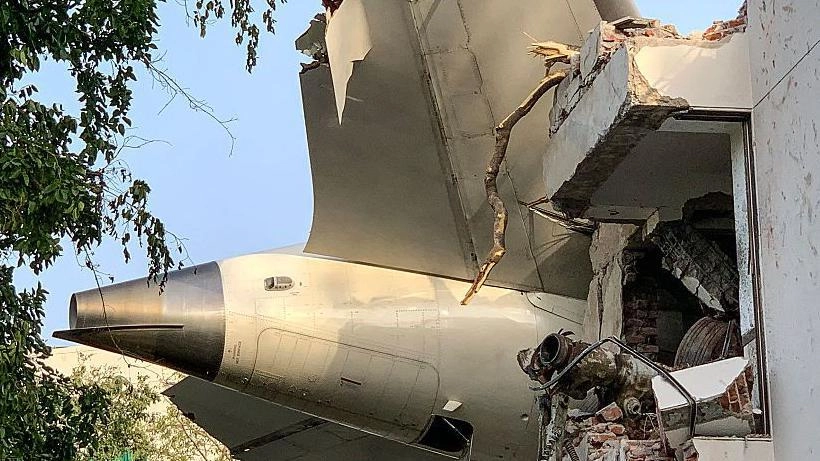

Investigators have made a chilling discovery in the preliminary report of India's Air Accident Investigation Bureau into the crash of Air India Flight 171 that killed 260 people in June.
Just seconds after takeoff, the two fuel cut-off switches The fuel control valves on the 12-year-old Boeing 787 Dreamliner abruptly moved to the “cutoff” position, resulting in a fuel starvation of the engines and a total loss of power.
Switching to “cutoff” is an action normally performed only after landing.
The cockpit voice recording captures one pilot asking another why he “cut off,” to which the other responds that he didn’t. The recording does not clarify who said what. At the time of takeoff, the first officer was steering the aircraft while the captain was supervising.
The switches returned to their normal positions during the flight, triggering the automatic engine restart. At the time of the crash, one engine was regaining thrust, while the other had reignited but had not yet regained power.
Air India Flight 171 was in the air for less than 40 seconds before crashing into a crowded neighborhood in the western Indian city of Ahmedabad, marking one of the country's most baffling aviation disasters.
They are examining the plane's wreckage and cockpit recorders to understand what went wrong just after takeoff.
The Air India flight climbed to 190 meters (620 feet) in good weather before losing location data 50 seconds in, according to Flightradar24. The 15-page report released Saturday offers preliminary information.
The investigation, led by Indian authorities with experts from Boeing, General Electric, Air India, Indian regulators, and participants from the United States and Britain, raises several questions.
Researchers say the locking-lever fuel switches are designed to prevent accidental activation: They must be lifted to unlock before being actuated, a safety measure that dates back to the 1950s. Manufactured to exacting standards, they are highly reliable. Protective brackets further protect them from accidental bumps.
“It would be almost impossible to operate both switches with a single motion of one hand, and this makes accidental deployment unlikely,” a Canada-based air crash investigator, who asked to remain anonymous, told the BBC.
This is what makes the Air India case stand out.
If one of the pilots was responsible for turning off the switches, intentionally or not, “it begs the question: why… put the switches in the off position?” said Shawn Pruchnicki, a former air crash investigator and aviation expert at Ohio State University.
“Was this intentional or the result of confusion? It seems unlikely, as the pilots reported nothing unusual. In many cockpit emergencies, pilots may press the wrong buttons or make incorrect selections, but there was no indication of such a situation in this case, nor any discussion to suggest that the fuel switches were selected by mistake. This kind of error doesn’t usually happen without an obvious problem,” Pruchnicki told the BBC.
The key to the puzzle
Peter Goelz, former executive director of the US National Transportation Safety Board (NTSB), expressed a similar sentiment: “The finding is very disturbing – that a pilot turned off the fuel switch just seconds into the flight.”
“The cockpit voice recorder likely contains much more information than has been shared. A simple comment like ‘why did you cut the switches?’ “is not enough,” he said.
“The new details suggest someone in the cockpit closed those valves. The question is who and why. Both switches were turned off and reset within seconds. The voice recorder will reveal more: Was the pilot flying trying to restart the engines, or the one in control?” he added.
Investigators believe the cockpit voice recorder, with audio from the pilot’s microphones, radio calls, and ambient cockpit sounds, holds the key to this puzzle.
They haven’t yet identified the voices, which is crucial. Typically, when the voice recorder is reviewed, people familiar with the pilots are present to help cross-check the voices. So far, we still don’t know which pilot turned the switches off and on, Goelz said.
In short,Investigators say what's needed is clear voice identification, a full cockpit transcript with tagged speakers, and a thorough review of all communications from the time the plane was pushed from the door to the time it crashed.
They also say this underscores the need for cockpit video recorders, as recommended by the NTSB. An over-the-shoulder view would show who pulled the kill switch.
An earlier report
Before boarding Flight 171, both the pilots and crew passed a breathalyzer test and were declared fit to fly, the report says. The pilots, based in Mumbai, had arrived in Ahmedabad the day before the flight and had gotten enough rest.
But investigators are also focusing on what they describe as an interesting point in the report.
It says that in December 2018, the U.S. Federal Aviation Administration (FAA) issued a Special Airworthiness Information Bulletin (SAIB) highlighting that some Boeing 737 fuel control switches were installed with the lockout feature disabled.
While the problem was noted, it was not considered an unsafe condition requiring an Airworthiness Directive (AD) — a legally enforceable regulation to correct unsafe conditions on a product.
The same switch design is used on Boeing 787-8 jets, including the Air India VT-ANB that crashed. Since the SAIB was a recommendation, Air India did not perform the recommended inspections.
Pruchnicki said he wonders if there was a problem with the fuel control switches.
“What exactly does this [part of the report] mean? Does it mean that simply flipping the switch could kill the engine and cut off the fuel supply? When the lock is disengaged, what exactly happens? Could the switch simply flip and kill the engine? If so, that is a very serious problem. If not, that also needs to be explained,” he said.
Others, however, are not convinced this is a key issue.
“I haven’t heard about this, which appears to be a quiet decision by the FAA. I also haven’t heard any complaints [about fuel switches] from pilots, who are typically quick to speak up. It’s worth looking into since it’s mentioned, but it could just be a distraction,” Goelz said.
Captain Kishore Chinta, a former investigator with India's Aircraft Accident Investigation Bureau (AAIB), wonders if the switches were activated due to a problem with the plane's electronic control unit.
“Is it possible that the aircraft’s electronic control unit could electronically activate the fuel cut-off switches without any pilot intervention? If the fuel cut-off switches were activated electronically, that would be a cause for concern,” he told the BBC.
“No time to think.”
The report said fuel samples from the refueling tanks were “satisfactory.” Experts had previously suggested fuel contamination as a possible cause of the twin engine failures. It is worth noting that no alert has been issued for the Boeing 787 or its GE GEnx-1B engines, with a mechanical failure being ruled out for now pending further investigation.
It also states that the aircraft’s Ram Air Turbine (RAT) was deployed, a clear sign of a major systems failure, and that the landing gear was either in the “down position” (the normal landing or descent position) or not retracted.
The RAT, a small propeller that extends from the underside of the Boeing 787 Dreamliner, acts as an emergency generator. It automatically deploys during flight when both engines lose power or if all three hydraulic systems experience critically low pressure, supplying limited power to keep essential flight systems operational.
“The deployment of the Ram Air Turbine (RAT) strongly supports the conclusion that both engines had failed,” Pruchnicki said.
A Boeing 787 pilot explained why he thought the landing gear hadn’t retracted.
“Today, every time I take off on a 787, I closely watch the landing gear retraction process. By the time the gear lever is pulled back, we’re already at about 200 feet (60.9 meters), and the entire gear retraction process is complete at 400 feet (120 meters), about eight seconds total, thanks to the airplane’s high-pressure hydraulic system.”
This pilot believes whoever was piloting the plane didn’t have time to think.
“When both engines fail and the airplane begins to descend, The reaction goes beyond shock: you freeze. At that point, you're not focused on the landing gear. Your mind is on one thing: the flight path. Where can I land the plane safely? And in this case, there wasn't enough altitude to navigate." Investigators say the crew tried to recover, but it happened too quickly. "The engines shut down and then came back on. The pilots realized they were losing thrust; they probably restarted the left engine first, followed by the right," Pruchnicki said.
“But the right engine didn’t have time to recover and the thrust was insufficient. Both eventually started, but because the left one died first and the right one took too long to recover, it was too late.”
Click here to read more stories from BBC News Mundo.
Subscribe here to our new newsletter to receive a selection of our best content of the week every Friday.
You can also follow us on YouTube, Instagram, TikTok, X, Facebook and on our WhatsApp channel.
And remember that you can receive notifications in our app. Download the latest version and activate them.