

Why Trump is paying special attention to South America (and what he has achieved so far with it)
The US president is focusing on the region with controversial decisions regarding Venezuela, Colombia, Brazil, and Argentina. What is he after?
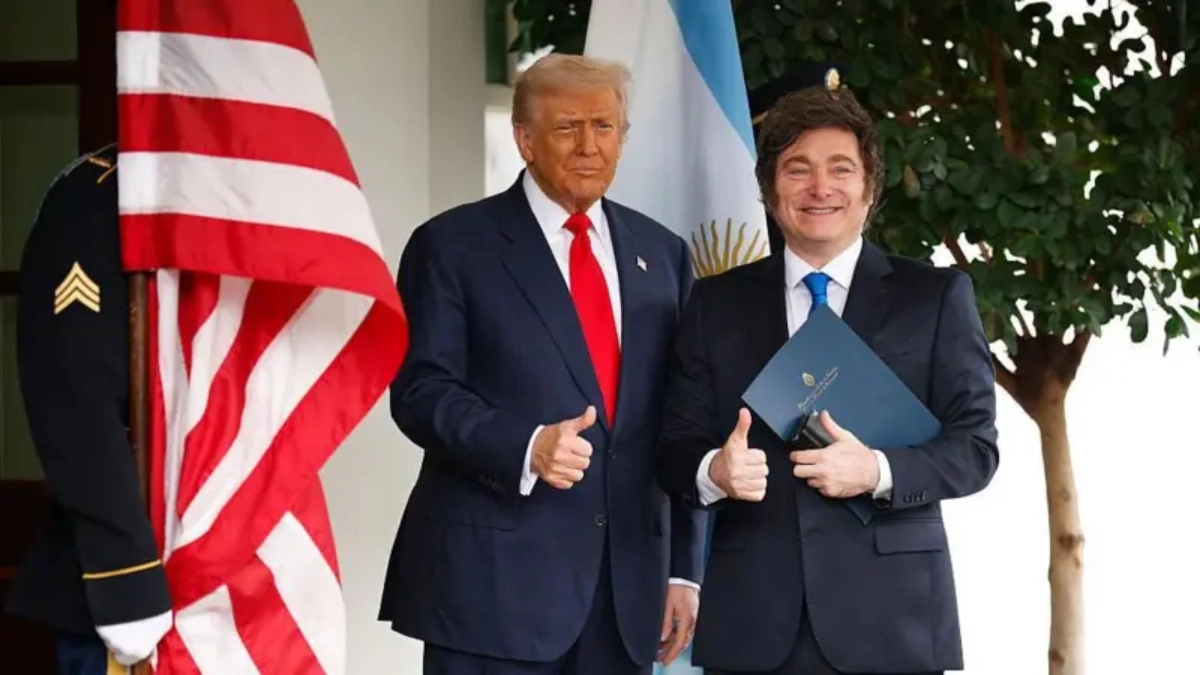

Donald Trump has shown in various ways that he has begun to give special attention to South America in his second term as president of the United States.
He did so, for example, by ordering an unprecedented military deployment in the southern Caribbean and a series of bombings off the coast of Venezuela and Colombia against ships it claims are carrying drugs, without presenting evidence.
Trump also opened a political-commercial standoff with Brazil, imposing 50% tariffs to try to prevent his ally, former president Jair Bolsonaro, from being tried for attempted coup.
And then he made clear his interest in Argentina, granting an unusual $20 billion bailout to the government of Javier Milei before last Sunday's legislative elections.
“We are very focused on South America and we are getting a strong grip on South America in many ways,” Trump declared on Monday, publicly congratulating his ally Milei on his electoral victory.
All this contrasts with the relative disinterest in the region shown by previous US administrations this century, including much of Trump's first term between 2017 and 2021, analysts point out.
Whether due to the “war With President George W. Bush's "war on terror" between 2001 and 2009, his successor Barack Obama's "pivot to Asia," and the wars in Ukraine and Gaza that occupied Joe Biden before he handed the reins to Trump, South America was far from Washington's priorities. However, things seem to have changed in the nine months since the Republican's return to the White House. "South America has once again become an important region for the US, as it hasn't been for many years," Monica de Bolle, a senior fellow at the Peterson Institute for International Economics in Washington, told BBC Mundo.
“Very difficult”
Trump has hinted that he seeks to align South American countries with his administration, based on a policy of punishments or aid.
When receiving the ultraliberal Milei at the White House this month, before the legislative elections in Argentina, Trump maintained that aid to this country “isn’t going to make a big difference” for the U.S.
“But it will for South America. If Argentina does well, others will follow,” he added. “There are many other countries that are following in our footsteps.”
As an example, he mentioned Bolivia, where centrist Rodrigo Paz was elected president this month and plans to reopen his country's relations with the U.S., suspended since 2008 under the Movement for Socialism governments.
Some experts argue that Washington seeks to expand its access to various resources in South America, from critical minerals to rare earth elements, and establish key supply chains in the region for its own economic security.
But they also observe that, with his displays of force and influence in South America, Trump seeks to distance China from the region.
When receiving Milei at the White House, Trump drew a kind of red line when a journalist asked him if Argentina should close a currency swap line it has with China and a Chinese space base in Patagonia.
“You can do some trade, but you shouldn't go any further. You certainly shouldn't do anything that has to do with "The military aspect with China. And if that's what's happening, it would bother me a lot," he said. In this century, China expanded its ties with South America to become the region's largest trading partner, surpassing the U.S., and forging strategic links with a dozen countries. "South America in general has become a Chinese sphere of influence in recent years, and I think (Trump) is trying to reverse that so that South America becomes a U.S. sphere of influence again," de Bolle points out. However, he warns that "it's very difficult to reverse that situation." A sign of such complexity emerged after Trump's financial assistance to Milei: there were complaints from the U.S. agricultural sector, which understood that this contributed to Argentina exporting to China the soybeans that the Asian country stopped buying from the United States due to the mutual trade war. Margaret Myers, director of the Asia and Latin America program The Inter-American Dialogue, a Washington-based think tank, states that “the modus operandi (of the U.S. in the region) is clearly transactional and geographically limited, and lacks an integrated hemispheric policy or strategy.” In their view, the tension with China influences the U.S. perspective.toward the southern hemisphere, “especially from the perspective of competition for resources and concerns about maritime security.”
“This approach has achieved some short-term benefits, as it increased unease in the region about agreements with China,” Myers tells BBC Mundo.
But he adds that Beijing “remains committed to the region, (where) the importance of trade relations with China weighs heavily on decision-makers.”
The ideological factor
The Trump administration has also shown signs of viewing South America from an ideological perspective.
The president said, for example, that he paid attention to Milei even before he was elected president, when “he came across as very conservative.”
“He is an unconditional supporter of MAGA,” he stated, using the acronym for his political movement Make America Great Again, before changing America to Argentina.
On the other hand, the US maintains that the shipment of The deployment of warships, fighter jets, bombers, marines, and its largest aircraft carrier to the Caribbean is part of an offensive against drug trafficking. At least 57 people have died since the beginning of September in US attacks against vessels accused of loading drugs in Caribbean and Pacific waters, the legality of which is questioned by experts. Many believe that one of Trump's objectives with this military deployment is to intimidate and overthrow Venezuela's leftist president, Nicolas Maduro, whom he accuses of leading a drug cartel, something he denies. Marco Rubio, Trump's Secretary of State and National Security Advisor, is considered an architect of the strategy toward Venezuela, which includes covert operations by the US intelligence agency, the CIA. Born in Miami to Cuban immigrant parents, Rubio, since his time as a senator, has called for a hardening of US policy toward Venezuela, Cuba, and Nicaragua, and has warned against China's presence in Latin America.
The region could take center stage in the national security and defense strategies that the Trump administration plans to release soon, according to reports.
The U.S. also recently sanctioned Colombia's leftist president, Gustavo Petro, who has called military attacks on civilian ships murders and whom Trump accuses of encouraging drug production.
This has heightened tensions between Washington and Bogota, one of its closest historical allies in Latin America. Some warn that the situation could complicate the long-standing counternarcotics cooperation between the two.
Last month, Rubio was questioned about the possibility of U.S. forces“unilaterally execute traffickers” from allied countries like Ecuador or Mexico, and seemed to rule it out.
“In many cases it is not necessary to do it with friendly governments, because friendly governments will help us,” Rubio said during a visit to Ecuador. “They can do it themselves, and we’ll help them.”
While Trump is maintaining the tariffs on Brazil that pitted him against leftist President Luiz Inacio Lula da Silva, the two met this week on the sidelines of a summit in Malaysia, and relations appeared to ease.
Some see all of Trump’s actions in South America as an attempt to reinterpret the Monroe Doctrine, presented by a U.S. president in 1823 against European colonialism on the continent, under the slogan “America for the Americans.”
Alan McPherson, an expert on U.S.-Latin American relations who directs the Center for the Study of Force and Diplomacy at Temple University (Philadelphia, USA), notes a “general tendency by President Trump to expand the U.S. presence and act like a bully.”
But he denies seeing the Monroe Doctrine behind Trump’s motivations in South America.
“What connects all these motivations,” he concludes, “is that Latin America, unlike China or Russia, doesn't have the same capacity to counter US power, making it an easier target.”