

The program with which the USA wanted to replace migrant farmers with students for 60 years
The plan resonates as a cautionary tale in a context where deportations decrease the labor force in the fields

Randy Carter was a sophomore in high school at San Diego University High when those gentlemen came to offer them what sounded like “a great adventure.”
It was 1965, just a year after the so-called Bracero Program—which supplied the United States with agricultural workers—was launched Mexicans for more than two decades—had come to an end and the harvest was rotting in the American fields with no one to pick it.
Faced with this, the administration of then-President Lyndon B. Johnson devised an initiative to attract students to replace the migrant labor force.
The marketing strategy involved naming it A-TEAM, like the “A Team” but actually an acronym for Athletes in Temporary Employment as Agricultural Workers, and promoting it with ads and pamphlets, with talks at sports clubs and high schools.
“They told us about team spirit and a good summer job,” recalls Carter, who would eventually become a prolific assistant director in Hollywood.
“And we, being 16 or 17 years old, thought: 'We'll be away from home, maybe we'll meet some girls, maybe some rancher will buy us beer'; that kind of thing that often cross teenagers' minds,” he tells BBC Mundo.
The reality that he and about twenty companions encountered in Blythe, an oasis created by the Colorado River in the Californian part of the Sonoran Desert where they spent the summer picking melons under a scorching sun, could not have been more different.
Nor was it that of the other 3,000 young people who finally enrolled in the program, although the objective had been to recruit 20,000.
The project lasted six weeks, which the most kind describes as “an attempt at a solution to a crucial problem” and the most critical call a disaster, a fiasco or, directly, an “embarrassing episode.”
And despite its fleeting life,Today it resonates as a sort of cautionary tale in a context where deportations threaten to decimate the agricultural workforce in the US
The countryside without migrants
The Mexican Farm Labor Program was conceived in 1942, through a binational agreement with Mexico, to compensate for the labor shortage in the US during World War II.
Better known as the Bracero Program, it was intended to be a temporary measure but ended up being extended until 1964.
And during the 22 years it was in effect, it allowed some 4.5 million young Mexicans to work on US crops and farms, most with contracts that lasted only a few months.
“To register, you had to show up with your papers and that was it. They gave you a blood test and then fumigated you with all your clothes on, before letting you cross the border,” one of them, Lorenzo Cano, told researchers at the University of Texas at El Paso as part of a project called the Bracero History Archive, to which the BBC had access.
What this bracero from Durango told wasn't the only controversial part of the program. The conditions faced by many of the seasonal workers, as well as workplace accidents and deaths, were also controversial.
Furthermore, not everyone welcomed them with open arms.
The idea that they were taking jobs from Americans while draining public aid and resources was spreading rapidly in the US; Meanwhile, on the other side of the border, some representatives in Congress were complaining that Mexico was sending its best workers to enrich a foreign country.
Some former braceros continue today, decades later, fighting for deferred payments and compensation.
“It was a time of growing xenophobia,” Lori A. Flores, associate professor of history at Columbia University, who has extensively researched the initiative and its consequences, tells BBC Mundo.
“Part of the American public was aware of how dangerous and poorly regulated the program was, especially towards the end,” she explains.
Peasant leader Cesar Chavez, who in 1962 would found the National Farmworkers Association with Dolores Huerta, and other civil rights activists had been denouncing it for some time.
“But if you had asked the average citizen, they most likely would not have known of its magnitude, that it was a systemic problem and that It was happening all over the country simply because there weren't enough inspectors to make sure braceros were being treated well," Flores explains.
In that context, the US Congress let the program die, hoping that domestic farm workers would fill the vacancies.
And a year later, in 1965, A-TEAMS was born.
“Farm Work Makes a Man Out of You”
On Cinco de Mayo—the day Mexico commemorates the victory at the Battle of Puebla but which abroad has evolved into a celebration of Latino roots and resilience—newspapers across the country reported that Secretary of Labor Willard Wirtz wanted to recruit 20,000 high school students to replace migrant seasonal workers.
But he didn't want just any students. He wanted athletes.
“They can do it. We have to give them a chance,” Wirtz said when announcing the initiative at a press conference, flanked by Stan Musial and Warren Spahn, who would later join the Baseball Hall of Fame, and Jim Brown, a future member of the Pro Football Hall of Fame. So wrote Gustavo Arellano for NPR in 2018, the first journalist to rescue this episode from near obscurity.
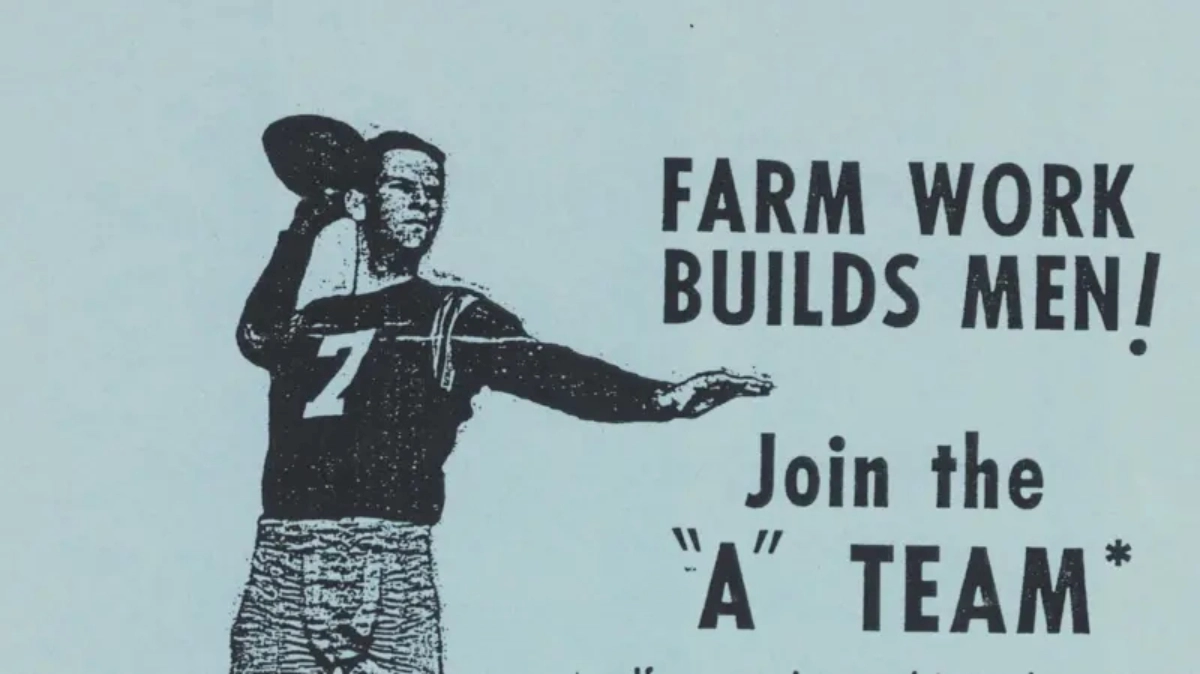
In the following weeks, the Departments of Labor, Agriculture, and the President's Council on Physical Fitness paid for advertising space in the press. “Farm work makes you a man!” read one of the ads, alongside an illustration of football player John Huarte about to throw a ball.
“It could have been seen as a genuine attempt to reach young people capable of working and in need of summer employment,” says historian Flores, one of the first to investigate the program.
But she also offers a view she describes as “more cynical,” one that points to a combination of interests that ultimately led to the initiative's downfall.
On one side was Secretary Wirtz, fed up with the “diplomatic and public relations nightmare” that the Bracero Program had become.
“It could have been a way of telling agricultural employers that, given the tragedy of labor and human rights and Mexico's increasingly noticeable annoyance at the number of fatalities and injuries and the lack of compensation, they were not going to accept any more temporary workers,” explains historian Flores.
And On the other hand, there was the lobby of agricultural businessmen who disagreed with the end of the migrant labor program, "who might want to save the harvest that year, yes, but perhaps more to show the federal government that negotiations with Mexico could perhaps continue if they could demonstrate that A-TEAM did not work."
"If we analyze it cynically, it could have been a plan intentionally doomed to fail," Flores emphasizes.
"This is crazy"
Although now he is also considering both options, Then-high school student Randy Carter only thought he needed a new surfboard that his parents weren't willing to buy him.
“But there's another important aspect of context to keep in mind,” he tells BBC Mundo before adding another component to the equation. “This was the 60s,"'This is crazy,' we thought. We had to pick cantaloupes in a place where at 9 in the morning it's already 11,819 degrees,” he exclaims exaggeratedly.
They had to work six days a week, earning minimum wage; $1.40 an hour at the time.
They slept in what he describes as “plywood sheds with a roof,” with no air conditioning, where it never got cool. And they showered with “brown” water.
“But we told ourselves we wouldn't give up. We weren't going to be kicked out either. "They fed them food unfit for human consumption," Rep. Teno Roncalio, D-Wyo., said in a June. 29, 1965, hearing about what the A-TEAM team found in California's agricultural Salinas Valley, The Washington Post reports.
“I'm delighted to hear the gentleman from Wyoming deliver this report to the House, because the conditions he described are ones that I and others have been describing and lamenting for many years in relation to other workers,” exclaimed Jeffery Cohelan, D-Calif.
Historian Flores chronicles the House debate in her book, “Grounds for Living."
“A thoughtless, shameful experiment”
Experts and researchers agree to describe the initiative as a fiasco or a disaster. Historian Flores prefers to call it a “shameful episode in the history of farmworkers in the US”
“It wasn't well conceived, although on the other hand, I think many of our farmworker programs are not well thought out. And that remains the case today,” she acknowledges.
“We're a nation that's become so accustomed to a steady stream of foreign labor that it's become the way we undermine any attempt at unionization, at organizing workers to be political and articulate what they need,” he says.
“There's been an incredible amount of intentional disregard for these kinds of workers in the country. And A-TEAM is just another thoughtless, shameful experiment that, thankfully, didn't last long," he concludes.
The episode left its mark on Carter and partly shaped his current views. So much so that in 1990 he directed a sort of autobiographical fiction based on his experience in Blythe,titled Boy Wonders.
Today he is convinced that he created a timeless story.
“I wanted a script that my grandson could read and that would still be relevant. And, in fact, it is. No one improved the working conditions in the fields. The entire A-TEAM story resonates today,” he concludes.
It resonates perhaps more than ever within the framework of the immigration policies of the Trump administration, who is trying to fulfill the now president's campaign promise to carry out “the largest deportation in the history of the country.”
The agricultural sector, in which 40% of workers are undocumented according to 2022 estimates by the Department of Agriculture, has not been spared from the raids.
Faced with claims from business owners in the sector who assure that with a reduced workforce part of the harvest will be lost, the Agriculture Secretary Brooke Rollins suggested tapping into “able-bodied adult Medicaid beneficiaries,” a government program that provides health coverage to low-income Americans.
“Mass deportations are continuing, but strategically, and we will push the workforce toward automation and 100 percent American participation,” she said at an event at USDA headquarters in August.
“With 34 million able-bodied adults on Medicaid, we should be able to do it fairly quickly,” she concluded.
Meanwhile, a bill for a new Bracero Program has been introduced in Congress.
It was introduced by Republican Monica de la Cruz, who represents a Texas district bordering Mexico in the House of Representatives, with the goal of “stabilizing the agricultural workforce and discouraging illegal border crossings.”
“I am leading the effort to revive the Bracero spirit by reforming the H-2A visas. This will provide desperately needed solutions for the immigrant workers. With labor shortages challenging our communities, the Bracero 2.0 Program will bring stability and certainty to South Texas,” he stated when presenting the proposal.
Perhaps it's a good opportunity to look back and learn from the 1965 incident when an attempt was made to replace seasonal migrant workers with American high school students.