

The testimonies of people rescued from Everest after a fierce snow storm
At least one trekker has died while hundreds more remain trapped by snow on the eastern slope of the world's highest mountain.
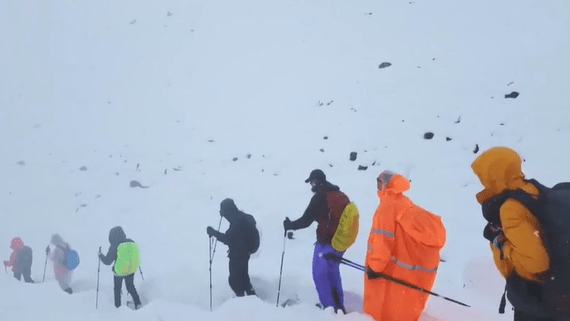

Trekkers trapped by a sudden snowstorm near Mount Everest have reported suffering from hypothermia as they faced relentless snowfall, while rescue teams continue to evacuate dozens of people.
At least one trekker has died and more than 200 are still trapped in the eastern slopes in Tibet, a popular area for climbers and hikers, according to Chinese state media.
The heavy snowfall began Friday night. Hundreds of local villagers and rescue teams have been deployed to clear the snow blocking access to the area, located at more than 4,900 meters above sea level.
About 350 people have been rescued and guided to safety to the small township of Qudang. Authorities are in contact with all the trekkers who remain stranded.
Nature photographer Dong Shuchang was among hundreds of tourists who flocked to the area during China's so-called Golden Week holiday.
He was eager to capture the wonder of the Himalayas from the Tibetan slopes when the blizzard hit just hours after he began his trek on Saturday.
“The lightning and thunderstorms [on Saturday] were non-stop. The snowfall was so intense that I could hardly sleep,” Dong said.
His group had reached an altitude of 4,600 meters when they decided to turn back.
“Our jackets and raincoats weren't enough for the snow. We were all soaked,” said Dong, who added that several people in his group of 20 were showing signs of hypothermia.
The 27-year-old had been to the Himalayas more than 10 times, but said he had “never I had never experienced weather like this.”
Dong's escape from the trail happened amid wet snow and falling hail.
“We were all moving slowly. The route was very slippery. I was constantly falling through the ice.”
His group spent the previous night in a hotel room in Qudang, where they relied on a generator for electricity.
When they left the hotel this morning, the blizzard had finally abated.
“We are very relieved to receive help and support,” he said.
Chen Geshuang,who was part of Dong's hiking group, said the snow was about 1 meter deep when the group began their retreat on Sunday.
“We are all experienced hikers,” Chen said. "But even so, this storm was extremely difficult to face. I was lucky to be able to get out."
“The snow this year was exceptional,” added Chen, a 29-year-old outdoor enthusiast.
Another woman told the BBC that her husband, who had been trapped by the storm, was slowly making his way down the mountain, but thick snow was complicating his rescue.
“Even for the rescuers, it's not easy; they need to clear the snow to make way,” said the woman, who did not want to be identified.
“I hope my husband reaches [the rescue team] safely.”
Her husband had told her he had barely been able to sleep in their tent for fear of being buried in snow, she added.
Another hiker, Eric Wen, told Reuters that three people in his group suffered from hypothermia despite being properly protected. dressed.
They barely slept because it was snowing so heavily that their group had to clear snow every 10 minutes.
“Otherwise, our tents would have collapsed.”
Golden Week
China is in the midst of celebrating a national holiday known as Golden Week, a peak season for local tourism.
October typically offers clear skies and pleasant temperatures, making it one of the months favorite for trekking. in the Mount Everest region.
Many trekkers have headed to Karma Valley, a lesser-known but more scenic route that leads to Everest's base and also offers a panorama of the world's highest peak.
Although some people attempt to reach the summit each year, it is considered an incredibly dangerous climb.
In recent years, Mount Everest has been hit by the overcrowding, environmental impact, and a series of climbing attempts that ended in fatal accidents.
The region is currently facing extreme weather conditions.
Neighboring Nepal has been hit by torrential rains and flash floods that have killed at least 47 people, blocked roads, and washed away bridges.
Across China, Typhoon Matmo made landfall on the country's east coast, forcing the evacuation of some 150,000 people.