

Who are the main candidates to preside over Colombia and succeed Petro?
A dozen candidates will compete in the first round in Colombia. Polls elevate three favorites
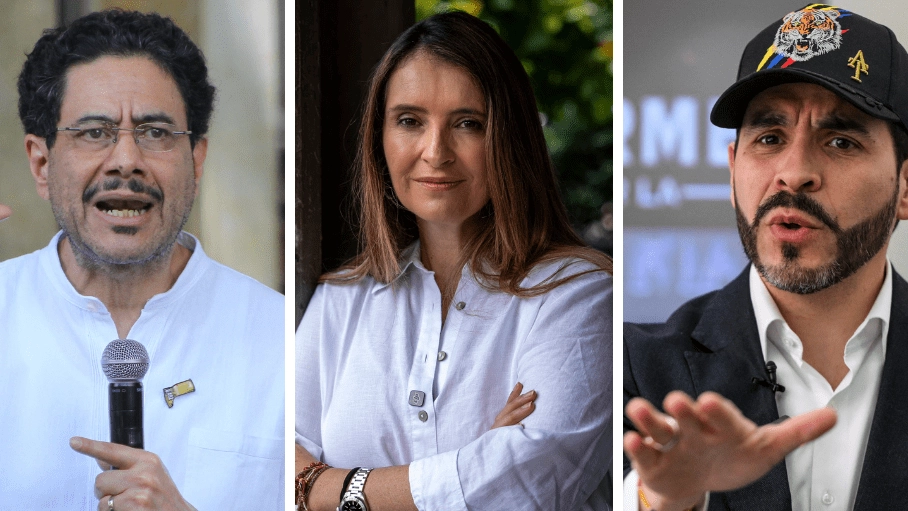

The race to succeed Gustavo Petro in Colombia is on and polls show three clear favorites for the first electoral round this May 31.
Iván Cepeda (left and center-left), Abelardo de la Espriella (radical right) and Paloma Valencia (right and center-right) head a list that includes a dozen candidates.
Cepeda, of the Historical Pact, is the candidate for Petrism and the call to continue the progressive path started by the current president in 2022.
Valencia belongs to the Democratic Center of former President Álvaro Uribe and seeks to return Uribismo, a very influential right-wing current in Colombia, to power. The candidate has also sought to seduce centrist voters in her campaign.
The lawyer and businessman De la Espriella presents himself as an 'outsider' and with a recipe for a strong hand, conservative morality and economic growth that is reminiscent of the manuals of Nayib Bukele in El Salvador, Javier Milei in Argentina or Donald Trump in the US.
Well-known politicians such as the former governor of Antioquia, Sergio Fajardo, and Claudia López, former mayor of Bogotá, will also participate in the race.
Both represent a political center that has been left far away in polls and reviled by an average voter who leans towards more equidistant options.
Cepeda, the successor of Petrism
Since he launched his candidacy in October 2025, Iván Cepeda, 63, has led most polls to be the most voted in the first round.
He is the son of the communist leader Manuel Cepeda Vargas, murdered in 1994 by paramilitaries in collusion with state agents.
He lived in exile several times due to death threats against his family and studied philosophy in Bulgaria in the 80s. There he absorbed modern socialist and reformist ideas, far from the communist and authoritarian orthodoxy that marked the Soviet bloc for many years.
A well-known congressman since 2010, he has dedicated his career to working for the memory of the victims of the conflict, negotiating with armed groups to achieve peace and investigating paramilitarism.
The latter led him to a long judicial battle as a victim and witness against Uribe, in a case of bribery in criminal proceedings and procedural fraud that continues despite the fact that the former president was acquitted in the second instance.
He was a facilitator of the peace talks between the State and the FARC in 2016 and is an active part of Petro's "total peace", a policy questioned for not yielding the promised results.
His manual of proposals includes continuing with the social reforms of the current president, increasing the role of the State in the economy, fighting corruption, reducing inequality, reforming institutions and achieving peace without giving up dialogue.
The first generates concern among economists who observe the country's delicate fiscal situation.
The latter provokes rejection among those who do not want negotiations with armed groups.
De la Espriella, the “outsider” with an “iron fist”
With his Defenders of the Homeland movement, lawyer De la Espriella (47 years old) burst into politics with a hard-line right-wing speech.
He presents himself as an 'outsider', a successful businessman and independent of the political and economic elite, although in recent weeks some names from those same sectors that he says he rejects have publicly supported him.
He is a media lawyer, with a list of defendants that includes cases of paramilitarism, corruption, victims of gender violence and celebrities.
Among his clients was Álex Saab, the alleged front man for Nicolás Maduro in Venezuela who was recently extradited to the US to face criminal charges.
De la Espriella focuses his speech on security and the fight against corruption and is a defender of free enterprise, God and the family as the central nucleus of society.
His social media strategy, especially on X and Instagram, has been prolific and intense, attracting voters thirsty for radical changes.
In his campaign he has insisted that the country is experiencing an “existential moment” and has accused Petro of wanting to remain in power, despite the fact that re-election is not allowed in Colombia and that the president, to date, has not activated any legal or institutional mechanism that invites us to think about it.
A declared admirer of conservative leaders like Bukele, Trump and Milei, De la Espriella says that his movement is not about ideologies or political spectrums, but about “extreme coherence.”
Polls place him as Cepeda's most likely rival in a hypothetical second round.
Valencia, the “moderate” option
48 years old, Valencia entered the presidential race strongly by obtaining 3.2 million votes in a consultation of right-wing and center-right parties held in March.
With a strategy in which she sought to get closer to the political center, this prominent senator would contest the center-right and right-wing ticket in the runoff against De la Espriella.
Valencia belongs to a well-known family dynasty in Colombia, which includes former conservative president Guillermo León Valencia, the candidate's grandfather.
Graduated in law and economics, the senator has been a firm critic of Petro in this legislature, standing out for her partisan and rebellious speech in Congress.
He promoted the No vote in the plebiscite for peace in 2016 and since then he has questioned the implementation of the agreement between the State and the FARC.
Their proposals are framed in what political analysts in Colombia call “institutional right.”
In security, he proposes a hardened line: increase defense spending and reinforce the Public Force. Like De la Espriella, he has spoken out against Petro's “total peace” policy.
In addition, it proposes reducing the size of the State, lowering taxes on companies and assets and supporting enterprises with credits.
Political scientists consulted by BBC Mundo believe that his “more moderate” strategy gave way to De la Espriella's radical right and that he lost steam, as surveys indicate.
The center, with few voting intentions
The former mayor of Bogotá, Claudia López (56 years old), will compete for the political center with Sergio Fajardo, former mayor of Medellín and former governor of Antioquia who is launching the presidential race for the third time at 69 years old.
Both appear far from the three favorites in the polls.
Names such as former ministers Daniel Palacios and Mauricio Lizcano, businessman Santiago Botero, lawyer Sondra Macollins and former ambassador to the United Kingdom, Roy Barreras, also intend to compete in the event.
The former ministers of the Petro government, Interior Minister Juan Fernando Cristo and Foreign Minister Luis Gilberto Murillo, registered their candidacy, but in recent weeks they gave their support to Cepeda.
A limited power
The priority of any president will be to build political alliances.
In the Congressional elections on March 8, Cepeda's Historical Pact repeated and reinforced its position as the most voted force for the second consecutive legislative election, obtaining 23% of votes for the Senate, although once again it will lack dominant majorities.
It is followed by the Democratic Center, which garnered 16% of the votes and improved its result in 2022 in the Upper House. Its candidate Valencia, on the other hand, has been the candidate who has obtained the most prior support from other benches.
Other prominent forces were the Green Alliance, with 10 seats; and the traditional Liberals and Conservatives, with 13 and 10 seats respectively.
De la Espriella is the only one of the presidential favorites who would not have direct representation in Congress, although he would have the four seats of the National Salvation Movement, an allied party aligned with his ideals.
Analysts consulted by BBC Mundo point out that the Congress that will accompany the next president will remain fragmented, similar to the current one and without absolute benches.
This suggests that the power of Petro's successor will be limited.
“No matter who wins, they will face a polarized Congress with difficult governance,” Alejandro Chala, political scientist at the National University of Colombia and researcher at the Pares Foundation, analyzes for BBC Mundo.
Of the three candidates who emerge as favorites, Cepeda and Valencia would have the greatest direct representation in Congress, but transactions with other parties will be crucial for any government.
The parliamentary opposition was the main thorn in the side of Petro, who promised ambitious reforms and stumbled again and again over the lack of legislative consensus.
During his mandate he has managed to get a tax reform, another pension reform and another labor reform approved. These last two after extensive debates, tensions and constant tugs of war between the benches and the government.
It doesn't seem like that dynamic is going to change in the next four years.