

Who is Abelardo de la Espriella, the businessman who promises to govern Colombia with an “iron fist” inspired by Bukele
De la Espriella, who represents a hard and populist right, according to experts, will face Iván Cepeda, candidate of the Petrista left
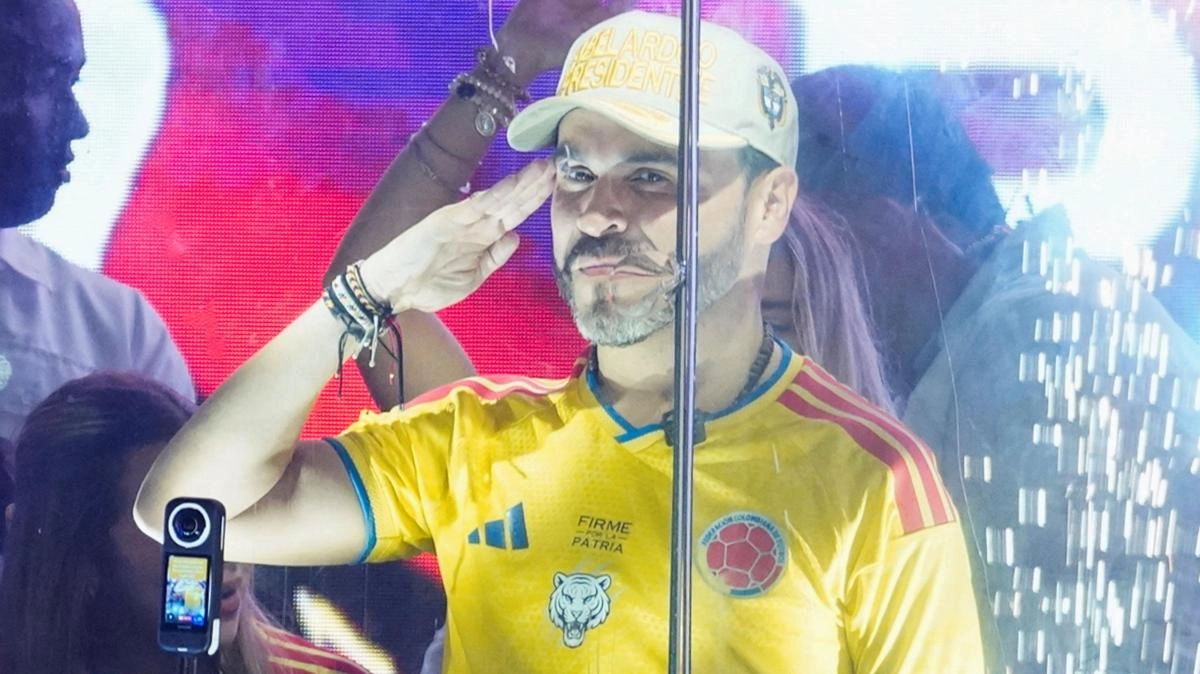

With the yellow jersey of the Colombian national team and behind an armored glass, the "Tiger" celebrated on Sunday having been the most voted candidate in the first round of the elections with a record of more than ten million votes.
Lawyer and businessman Abelardo de la Espriella shook the board of Colombian politics this Sunday.
De la Espriella (Bogotá, 1978) won with 43% of the votes and will contest the presidency in the second round with the left-wing leader Iván Cepeda, who wants to give continuity to the policies of President Gustavo Petro.
De la Espriella will thus be the candidate of the right in the South American country. Many of his opponents classify him as extreme right-wing, but his team says he is of "extreme coherence".
He promises an "iron fist" against crime, illegality, drug trafficking and corruption, the main problems he identifies in Colombia.
As other candidates and politicians in the country have denounced, De la Espriella's campaign says he receives death threats frequently; that is why he is accompanied by at least 35 escorts in each act plus police deployments.
Without political experience, he presents himself as an "outsider", a successful and independent entrepreneur.
Admire the efforts of Presidents Nayib Bukele in El Salvador, Javier Milei in Argentina and Donald Trump in the US.
He refuses to govern "with the usual", a common phrase to refer to the elite that until the arrival of Gustavo Petro in 2022 had governed the country.
With his movement, Defensores de la Patria, he aspires to channel the discomfort of Colombians who see in the old political guard the origin of many challenges.
On June 21, it will be defined if he reaches the presidency in a duel with Cepeda, located in his ideological antipodes.
The Early Entrepreneur
Senator Enrique Gómez Martínez is key to De la Espriella's campaign. He belongs to the National Salvation Movement, a party that allied with the candidate and won four seats in Congress in last March's legislative elections.
He says that behind the image of the strong and transgressive man of the applicant is someone "jovial, patient, punctual, energetic and who sleeps little".
He already showed some of these characteristics when he emerged very young as a businessman and before becoming a media lawyer with clients such as Álex Saab, the alleged figurehead of Nicolás Maduro who was extradited from Venezuela to the US to face criminal charges.
Colombian journalist Gerardo Reyes inquired about the candidate while writing a biography about Saab.
“De la Espriella's biographer, the journalist Ángel Becassino, tries to present him as a child prodigy. He learned by heart the speeches of Luis Carlos Galán, whom his father admired, and recited them on a stool," says Reyes.
Galán was a presidential candidate assassinated in 1989 by drug-trafficking hitmen in collusion with state agents.
De la Espriella ended up being a defense lawyer for Alberto Santofimio Botero, the former Minister of Justice who in 2007 was found guilty as the instigator of Galán's murder.
Going back to his childhood, Reyes mentions that the candidate set up a business selling food in a neighborhood of Montería, a city where he grew up in northern Colombia.
He later graduated as a lawyer from the Sergio Arboleda University of Bogotá.
"There he also did business; selling clothes, whiskey and emeralds in the US," adds the journalist.
Today the businessman claims to manage dozens of companies in various sectors: real estate, food, beverage and clothing trade, livestock and his law firm, De la Espriella Lawyers.
With the benefits of these companies and personal loans, he says he finances his campaign.
The media lawyer
In addition to Saab, from whom the lawyer says he disassociated himself in 2021, he has defended multiple cases including artists, victims of violence and environmental disasters, and individuals linked to paramilitarism.
The latter has aroused criticism in currents of opinion, although his team frames him within the usual exercise of a criminalist and the right to a legitimate defense.
"It reaches the paramilitary world from the hand of an anthropologist from Montería who taught geopolitics, good manners and history to Carlos Castaño, the paramilitary leader of the United Self-Defense Forces of Colombia," says Reyes.
He also represented David Murcia Guzmán, founder of the firm DMG. This company was intervened by the State in a massive and illegal money collection scandal.
In addition to these cases, the lawyer has defended communities affected by the environmental impacts of the Cerro Matoso nickel mine, victims of gender violence and the late leftist congresswoman Piedad Córdoba, who was once accused of illicit enrichment.
The safety flag
De la Espriella announced his intentions to seek the presidency in July 2025, a month after pre-candidate Miguel Uribe Turbay was shot in public in Bogotá.
By then the entrepreneur had created a prolific brand on social media.
"He understood the country's digital moment long before the war. With many videos and different accounts, he generated conversation before launching the candidacy," political strategist Catalina Suárez analyzes for BBC Mundo.
A central theme of that conversation was safety.
After four years of Petro's rule and his questioned "total peace" policy, the country has experienced an expansion of armed groups in number and territory.
Along with the tragedy of Uribe Turbay, who died two months after the shooting, Colombia also accuses security crises linked to drug trafficking and other illicit income.
Although several analysts point out that the deterioration in security is not the sole consequence of "total peace", the message that much of it is, defended by De la Espriella, permeates certain voters.
“It's going to wipe out all the crime. You can see that he is the one who will bring this country to the surface," a working-class supporter of his tells me, who prefers not to give her name.
"No one has raised the flag of security like De la Espriella. His nickname of the Tiger became a symbol for the discontented. With the vest, the armored lectern and its security scheme, it shows that it is not intimidated. With this issue, he has created a strong polarization," says Suárez.
De la Espriella promises to dismantle Petro's peace policy and is a firm critic of the Special Jurisdiction for Peace, a transitional and restorative justice body created within the framework of the peace agreement between the government and the FARC guerrillas in 2016.
He has called the left “enemies of the republic.”
Like Bukele in El Salvador, he says he intends to build mega-prisons. It also plans to "eliminate" drug traffickers, guerrilla dissidents and other armed groups.
He has announced that he wants to fumigate hectares of coca, bomb "narco-terrorist" camps and take down any plane or boat with drugs that leaves Colombia.
He says he will ask for help from the United States, Europe and Israel.
De la Espriella combines his strongman stance while enhancing the value of the traditional family and Christianity, after converting to the faith after losing a loved one six years ago.
His wife, Ana Lucía Pineda, graduated as an administrator and director of companies, frequently accompanies him in his acts. They have four children.
It also promises to improve the health system, be relentless against corruption and incentivize the growth of the economy with the exploitation of hydrocarbons and mining, tax freedoms, fiscal adjustments and severe state cuts.
For the latter, he has said that he will use "the chainsaw" as Milei in Argentina.
Transgressive (and controversial) speech
De la Espriella says he rejects political correctness. It somehow fits into the transgressive discourse with which it is presented to the electorate.
"With this photo I earned some very good votes from the female electorate," De la Espriella said in an interview on Piso8, a streaming channel, at the beginning of May.
He then asked the interviewers, including a woman, to zoom in on the photo, following comments on the show about the candidate's private parts and an alleged silicone implant.
His stance was criticized as macho among political opponents and other social media users.
"If a woman feels uncomfortable, a gentleman has a moral obligation to apologize (...) It all happened in a humorous context," the lawyer excused himself.
In another interview, De la Espriella seemed to imitate the voice of the openly homosexual politician Juan Daniel Oviedo, adding that there were "pods" of him "that he did not like" and that "had no arrangement".
The comment was interpreted as homophobic by voices in politics. The lawyer said it was a joke taken out of context.
As an "outsider" and "successful entrepreneur", as defined, De la Espriella claims to have the independence of "the same as always" to take the measures required by the country.
Rodrigo Lara Restrepo, politician and son of Justice Minister Rodrigo Lara Bonilla, murdered during the reign of the Medellín cartel, made public his support for the lawyer for this reason.
“I'm excited about their independence and freedom from traditional politics and the business elite. It is something unique in the history of Colombia," he tells BBC Mundo.
Despite this, in recent weeks the candidate has received support from former members of governments such as former presidents Álvaro Uribe and Juan Manuel Santos.
His vice-presidential formula, José Manuel Restrepo, was Minister of Finance and Commerce with former President Iván Duque. He also comes from a political caste that includes Francisco de Paula Santander, a hero of Colombian independence.
And Casa Char, a powerful political and economic clan in Barranquilla, announced its support for the candidate at the beginning of May.
Five analysts from different universities and think tanks consulted by BBC Mundo consider that these supports come from the traditional political class that the candidate claims to reject.
In short, they agree, "it is difficult to govern Colombia without these guarantees and politicians who are experts in the functioning of the State."
"Extreme consistency"
De la Espriella's heavy-handed discourse, together with his confrontational, anti-elite and conservative style, has led some media, political opponents and analysts to call him an "extreme right-winger and representative of the extreme right".
It's a label they ignore in their campaign.
"We mock the categorization of extreme by talking about extreme coherence," explains Gómez Martínez, an ally of the candidate.
"We do not believe that this is a matter of ideologies, but of founding principles and values. We believe that the Colombian people are not in the debate of ideologies. The elites do, because it allows labels to be generated," adds the newly elected senator, grandson of former President Laureano Gómez and nephew of Álvaro Gómez Hurtado, an influential politician assassinated in 1995.
The founding principles and values to which Gómez Martínez refers revolve around the challenges of the Colombian State in security, productivity, justice, corruption, education and values.
Asked what values they put forward, Gómez alluded to "Christian, Judeo-Christian morality, which is what builds this society".
According to recent surveys by the National Administrative Department of Statistics, the population that identifies as Catholic is estimated at 80% of the total of 52 million Colombians. Other Christian groups are around 10%.
Patricia Muñoz Yi, a political scientist at the Pontifical Javeriana University, says she does not see De la Espriella as "so extreme right-wing", but acknowledges that "he has tried to be more radical than the right-wing referent of the Democratic Center".
Democratic Center is the party founded by former President Álvaro Uribe and was represented in this first round by Senator Paloma Valencia, who finished third without going to the runoff and below what the polls gave her.
Laura Bonilla, political analyst and deputy director of the Pares Foundation, considers the lawyer movement to be a "populist right".
Beyond labels, the final fight for the next presidency is served among the options seen as more extreme by many Colombians: De la Espriella vs Cepeda.