

BRICS avoid a frontal clash with Trump and support Putin in the face of attacks in Ukraine
The summit of leaders of the BRICS group of major emerging economies began in Brazil, but with the notable absence of China
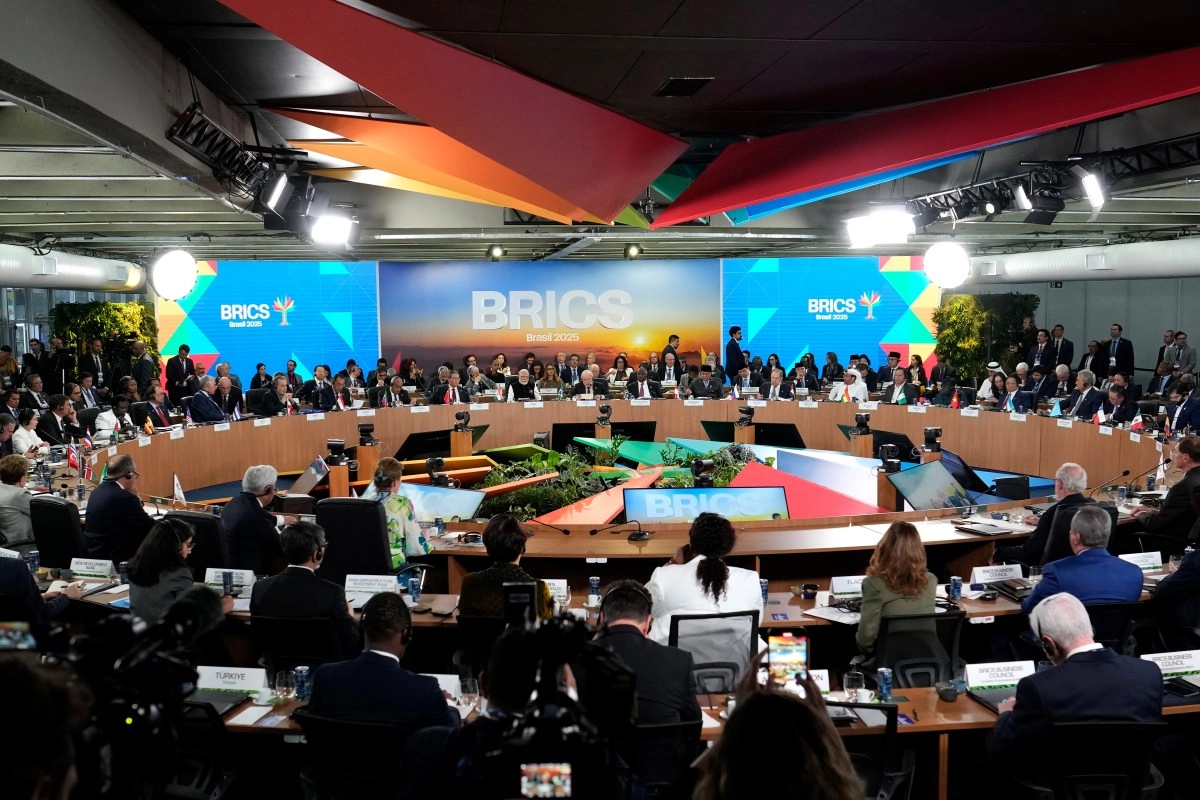

The BRICS leaders expressed their “grave concern” about the war in Gaza, strongly rejected the protectionist measures that affect global trade, with implicit criticism of the US, but without a direct message naming Donald Trump.
In this way, despite the call to urgently reform the institutions international financial leaders, the BRICS, meeting in Rio de Janeiro, avoided a direct clash with Trump and supported Vladimir Putin in the face of Ukraine's attacks on Russia.
The forum, made up of eleven countries from the Global South and led by China and Russia, held its 17th meeting of heads of state and government at the Museum of Modern Art in Rio, under heavy security and marked by the absence of Chinese leader Xi Jinping and Putin, who participated remotely.
The first of the two days of the summit closed with a final declaration of 126 articles that addresses the trade war of United States President Donald Trump, the escalation of violence in the Middle East and the "urgent" reform of the UN, the World Bank and the International Monetary Fund.
Lula criticizes NATO
In his opening speech, Brazilian President Luiz Inácio Lula da Silva, host of the meeting, declared the "unparalleled collapse of multilateralism” and stated that progress in areas such as climate and trade “is under threat.”
Lula also criticized the increase in military spending agreed upon by the countries of the North Atlantic Treaty Organization (NATO), at the instigation of Trump.
Putin, absent in Rio due to the arrest warrant against him for alleged war crimes in Ukraine, assured that the liberal globalization model “has become obsolete.”
In the same vein, the Indian Prime Minister, Narendra Modi, said that “the world today needs a new multipolar order,” while his Chinese counterpart, Li Qiang, warned that the effectiveness of multilateral institutions “is fading.”
The arrows seemed to point to Trump,who since returning to the White House on January 20 has withdrawn the US from the Paris Climate Agreement, the World Health Organization (WHO) and has unleashed a tariff war against the world.
In fact, this July 9th the truce granted by the president to make the “reciprocal tariffs” effective expires, after having closed agreements with the United Kingdom, China and Vietnam, while negotiating with more than a dozen partners, including India.
The same thing happened in today's final declaration of the BRICS: no direct mention of Trump or the US on the thorniest issues.
"We express serious concerns about the increase in unilateral tariff and non-tariff measures that distort trade," the document stated.
The same strategy was used to refer to the bombings by Israel and the US on Iran, a BRICS partner since 2024 and which failed in its attempts to raise the tone of the group.
“We condemn the military attacks against the Islamic Republic of Iran from June 13, 2025, which constitute a violation of international law and the United Nations Charter,” the statement said.
India and the United Arab Emirates, allies of the North American power, imposed their position.
Professor Paulo Borba, coordinator of the BRICS Study Group at the University of São Paulo (USP), told EFE that “it is convenient to avoid a direct confrontation with Trump,” who has already threatened the group with 100% tariffs if it dared to challenge the dollar’s ??hegemony.
For the moment, the BRICS continue with their idea of ????only promoting trade in local currencies.
Nod to Putin
Borba was struck by “the criticism of Ukraine for defending itself against Russian aggression.”
In the Point 35 of the declaration, between paragraphs on terrorism, the BRICS condemned “in the strongest terms the attacks against bridges and railway infrastructure that deliberately targeted civilians” in the Russian regions of Bryansk, Kursk and Voronezh, on May 31 and June 1 and 5, “and which caused several civilian casualties, including girls and boys.” The three explosive attacks, attributed to Ukraine, resulted in the derailment of two trains, one of them a passenger train, resulting in seven dead and more than one hundred injured. The BRICS condemnation does not mention Ukraine, although elsewhere in the document it does refer to the conflict triggered by the Russian invasion in February 2022. Another point reflects the positions of each of the member countries in relation to the “conflict in Ukraine,” although it does not name Russia as the aggressor country at any point.as is customary in the bloc's statements since the war began.