

“Guardians of the Space”: the unit of the U.S. army that can track missiles from anywhere in the world
From their base in Colorado, U.S. Space Force units track missiles fired from anywhere in the world.

A short, clear shout is heard: “Launch Yemen!” The men and women in uniform, sitting in front of their computers, respond in unison: "Copy, launch Yemen!"
In the United States Space Force, they don't call their members soldiers, but Guardians. Staring into their screens at a base outside Denver, Colorado, they can track a missile launch from anywhere in the world and follow it from its launch site to its likely point of impact.
We are the first international journalists allowed inside the U.S. Space Force's missile warning and tracking operations room at Buckley Space Force Base, a nerve center where Guardians are on alert 24/7.
They are surrounded by giant monitors displaying maps and data beamed back from a constellation of military satellites in space.
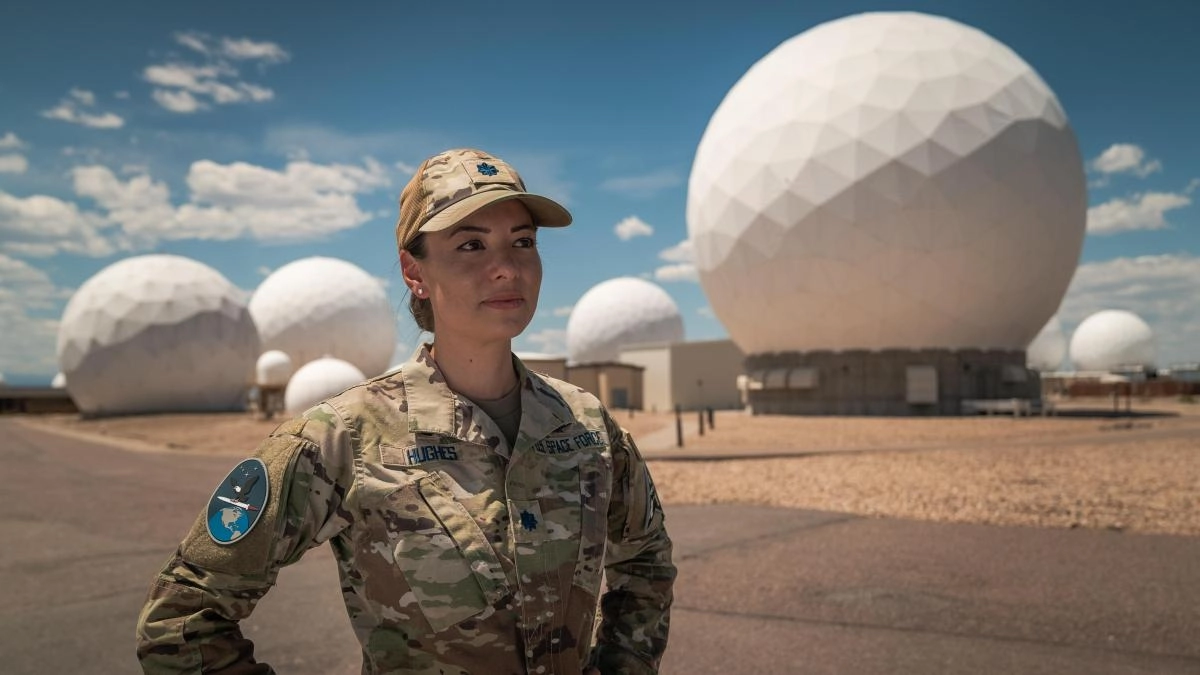
These Guardians are the first to detect the infrared heat signature when a missile is launched. Moments later, another shout is heard: "Iran launch!" followed by a chorus of "Copy, Iran launch!" This time it's a drill. But last month they did it for real: Iran fired a salvo of missiles at the U.S. military base at al-Udeid in Qatar, in response to U.S. and Israeli attacks on Iran. Lt. Col. Ann Hughes describes the atmosphere that day as "heavy." Unlike most launches, the base had been warned in advance. It was possible to track the Iranian missiles and then send that information back to air defense batteries on the ground.
“In the end, we saved the entire facility and the personnel that were there,” says a relieved Hughes.
Hughes says they have been exceptionally busy in recent years, with wars in both the Middle East and Europe.
When I ask if they have given warnings to Ukraine,Lt. Col. Hughes responds: "We provide strategic and tactical missile warnings to all U.S. and allied forces." The U.S. has not publicly confirmed this, but it seems likely that Kyiv was also warned when it was about to come under Russian attack. Buckley Space Force will be a key part of President Donald Trump's plans for a U.S. missile defense system, known as Golden Dome. The administration has allocated $175 billion for the ambitious program, modeled after Israel's Iron Dome air defense system. Many believe it will cost much more. But the groundwork has already been laid at Buckley. At the base, the horizon is dominated by enormous "radomes," circular covers that protect powerful satellite dishes inside. They look like giant golf balls. These satellite arrays have detected radio frequency waves from a supernova 11,000 light-years away. Lieutenant General David Miller, commander of the U.S. Space Operations Command, says the development of the Gold Dome, still in its early stages, recognizes the growing threats to the United States. He specifically mentions China and Russia. Both countries have developed hypersonic missiles that can travel at more than five times the speed of sound. They have also tested Fractional Orbital Bombardment Systems, which are harder to track.
“The speed and physics associated with intercepting these missiles require consideration of space-based interceptors,” says General Miller. He prefers to speak of “capabilities” to defend U.S. interests, rather than space-based weapons.
The creation of the U.S. Space Force five years ago demonstrates that space has become a battlefield. President Trump launched the force during his first term, describing space as “the world’s new battlefield.” Both China and Russia have tested anti-satellite missiles, as well as methods to jam their communications. General Miller says Russia has demonstrated the capability to launch a nuclear payload into space. He says space is already a highly contested area, adding that we must also be prepared for space conflicts. Colonel Phoenix Hauser oversees the Space Force’s Intelligence, Surveillance, and Reconnaissance unit, known as Delta 7. Her job is to figure out what’s happening in space. At their base near Colorado Spring, teams monitor screens showing thousands of tiny dots around the globe.There are already around 12,000 satellites in space. By the end of the decade, that number could rise to 60,000.
Colonel Hauser says her main focus is China. “It’s the approaching threat,” she says. China already has around 1,000 satellites, half of them military. Over the next decade, Hauser adds, China will have tens of thousands more satellites in low-Earth orbit. Space is increasingly congested and contested.
“There are already antagonisms in space,” she says. “We see unprofessional and unsafe actions by our adversaries.” This includes satellites equipped with electronic jammers, lasers, and even nets and grappling arms, which could be used to knock another satellite off course.
Some have suggested that “dogfights” in space are already taking place.
“I don’t know if we’re at a Top Gun-like stage yet,” says Colonel Hauser. “But it’s definitely something we need to be prepared for.”
The U.S. Space Force is preparing for the possibility of conflict in space.
Colonel Hauser says that a year ago, “they couldn’t talk about offensive space capabilities.” Now, he says his goal “is to generate options for the president so that we can achieve and maintain space superiority through offensive and defensive space control.”
Lt. Gen. Miller says the only way to prevent conflict is “with strength, and we must have our own capabilities to defend our assets.” He doesn’t elaborate on what exactly that means.
But recent U.S. strikes against Iran’s nuclear program, Operation Midnight Hammer, offer a glimpse of what the U.S. Space Force is already capable of. These B-2 bomber strikes also underscore why continued dominance in space remains crucial for the U.S. military.
“You have to understand the extent to which the U.S. military embraces the advantage we gain from space,” General Miller says. This includes the ability to navigate and communicate across the horizon, and to launch precision strikes using GPS.
The BBC has obtained the first details of the US Space Force Guardians' involvement in the operation.
"One of the measures we took was to leverage our electromagnetic warfare capability to ensure dominance throughout the operation," says Lt. Gen. Miller. The electromagnetic spectrum includes radio waves, microwaves, infrared light, and visible light.
"We knew there was going to be interference," he added. The US Space Forcemade sure to block that interference so the B-2 bombers could reach their target and deliver their GPS-guided massive ordnance bombs with precision.
Electronic warfare specialists from the U.S. Space Force's Delta 3 were already operating on the ground in the region.
Their commander, Colonel Angelo Fernandez, shows me the rows of satellite dishes and command pods they can send anywhere in the world.
The dishes, he explains, can be used to intercept and then silence the communications of enemy forces, "by emitting noise at a higher intensity."
"They were able to protect U.S. assets while also opening a flight corridor," he says.
Before, during, and after the mission, the U.S. Space Force Delta 7 Guardians were overseeing the operation.
Colonel Phoenix Hauser says they were able to monitor the electromagnetic spectrum “to understand if Iran knew what was going on, if they had any tactical warning that attacks might occur.”
The Guardians helped preserve the element of surprise and allowed the aircrews to complete the mission undetected.
The U.S. Space Force may be the nation’s youngest military service, but it’s crucial to its military might. Lt. Gen. Miller says the entire U.S. military “depends on space superiority.”
He wants to make sure it stays that way. And he has a warning for any adversary: "When the US military focuses on something, God help you!"