

“We spent 17 years looking for the truth”: the fight of 3 brothers to discover who murdered their mother
Jean Hanlon's three children refused to accept that her death was an accident. They spent 17 years fighting until the culprit was found
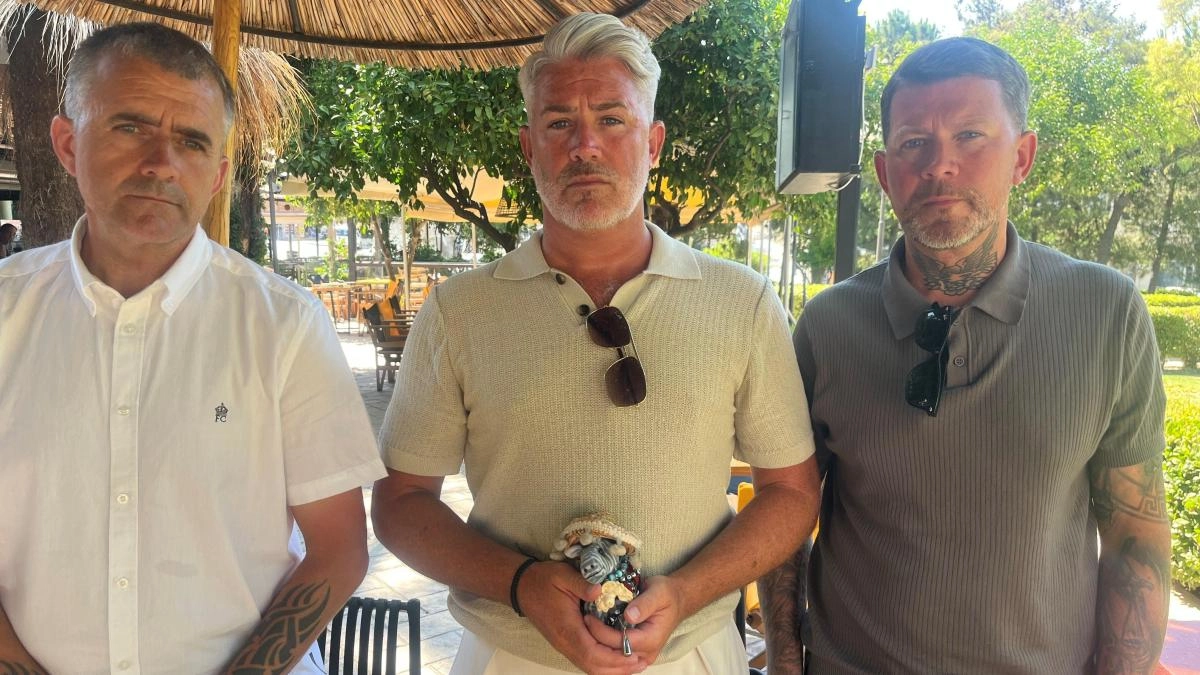

It all started with a call from Interpol in 2009.
Authorities had contacted Jean Hanlon's parents to inform them that their 53-year-old daughter had disappeared in Crete.
Michael Porter, Jean's youngest son, received a call from his older brother, Robert, to tell him the news: “I thought, 'What does she mean?'”
The lives of three brothers were about to change in ways they could never have imagined.
“I automatically thought the worst, even though I didn't know exactly what the worst was,” Michael said.
Jean Hanlon was supposed to look after a child with learning difficulties in Crete and, when he didn't show up, alarm bells went off.
"One of our mother's great virtues was her loyalty. She always gave everything for others and kept her word," Michael recalled.
At that time, Michael lived in a different city from his two brothers. The three took a plane to Crete.
"I wouldn't say we're especially sentimental people, but that was an intense, emotional moment in which we didn't say anything. We just hugged each other and cried; it was the quietest plane ride in history, because what could we say?"
They had been informed that in Heraklion, capital of the island of Crete, the body of a woman in her thirties had been recovered from the water. Their mother was in her fifties, so although they felt sorry for another family, they still held out some hope.
Even so, they were taken to see if the body was Jean's. Michael saw his mother's clothes in a pile and said they were instantly recognizable.
His brothers Robert and David had experience working in hospitals and tried to prepare him for what he was about to see: “As much as I appreciated the gesture, if that body was my mother's, that was going to be the last time I saw her.”
Suspicious injuries
Nothing could have prepared the three brothers for what they saw: “It was impossible to touch her, hug her or anything like that, and I think that was the hardest thing.”
The brothers were immediately suspicious. There were reports that her mother had been seen with a man in a nearby café in Heraklion on the night she disappeared, and her injuries – including a blow to the back of the head – were not believed to have been the result of an accident.
Greek authorities initially ruled his death accidental, but they insisted that the autopsy report be reviewed again. The process took time, but after two years, it revealed injuries consistent with a struggle.
“It makes me sick to think that if we hadn't kept pushing, we would never have found out about all those other injuries,” Michael said.
The brothers' fight for justice had begun.
Jean had worked for the NHS in Scotland, but her first holiday abroad – to Crete, aged 40 – convinced her to try something different.
He worked for a time in the tourism sector before moving to Greece, where he worked in restaurants. It was “his place”: he adored Crete and its inhabitants. Something that made his violent death there even more shocking.
“It is the duty of the living to speak out for the dead,” Michael said. It's a phrase he has repeated in hundreds of media interviews since 2009.
In the following years, Greek authorities closed and reopened the case four times. Two men were falsely accused of being involved in the death of Jean Hanlon.
The case appeared on the Greek show equivalent of “Crimewatch,” but every time the investigation seemed to gain momentum, it hit a wall.
A new perspective
In 2019, Michael and Rebecca – Robert's daughter – traveled to Crete again to raise awareness of Jean's case and raise public awareness. Several British and Greek journalists covered the trip, but no conclusive developments were made as a result.
Michael described the struggle as endless: “You can't describe what that does to you… my daily motivation was to think of something new to keep [his mother's] story alive, get people's attention, and come up with new ways to raise funds.”
The turning point came at the end of 2023, when the brothers decided to hire a private investigator named Haris Veramon, who worked alongside his colleague Nikos Arkoulis.
Veramon approached the case with a renewed perspective and turned his attention to Jean Hanlon's diary. In it, she mentioned a man she had dated briefly in early 2009, but with whom she had ended the relationship.
Investigators said Jean's diary, along with other evidence, led them to believe the suspect was a "rejected stalker" who did not accept the breakup and mistakenly believed she was in a relationship with another man.
Veramon spoke with witnesses and reviewed old statements. One of the key issues in the case was who Jean Hanlon had been with at the Café Marina on the night she disappeared.
There was no security camera footage or DNA evidence, but the private investigator's report concluded that she had dated the suspect.
Veramon's report was enough to take the case to trial.
Seventeen years after identifying their mother's body, Michael, Robert and David returned to Crete to confront the man accused of murdering her.
All three gave statements at the beginning of the trial. They believed that their mother had broken things off with the suspect, but that he continued to harass her.
A contradictory testimony
A decisive moment occurred on the second day of the trial, when the suspect's sister testified.
She claimed that her brother had been diagnosed with mental health problems and that if he did not take his medication, he would become aggressive.
The prosecution's thesis was that he had not been taking medication during the time he was with Jean Hanlon.
The suspect's testimony was contradictory. At one point, he claimed that they had only been together four or five days, even though Jean's diary suggested the period had been longer.
Some of the most difficult evidence for Michael, Robert and David to hear was that of a forensic pathologist.
He told the trial that the most likely cause of death was a blow to the back of the head and that in his opinion Jean Hanlon was still alive when she was thrown into the water.
In the end, it took about three hours for a mixed jury of judges and members of the public to unanimously convict the suspect in Jean Hanlon's murder, although the court recognized that his responsibility had been diminished due to mental illness.
Michael, Robert and David were crying, and it was not the first time they had done so during the trial. After 17 years, a man had finally been convicted of the murder of his mother.
He was sentenced to 10 years in prison, but will not go to prison until his appeal is resolved.
Under Greek law, the identity of a convicted person is generally not revealed until the judicial process is concluded, which includes the appeal phase.
Upon leaving the court, the brothers spoke with journalists.
Michael expressed his joy and relief at feeling that his mother was finally free: “We have all fought hard to get to this day.”
However, the three brothers were concerned that the convicted man had not been sent directly to prison: "It is disappointing that he remains free until the appeal is resolved. Everyone has rights, but for us it is sad and worrying," Michael added.
“My mother's voice was heard”
Robert Porter, Jean's eldest son, stated, “I am so grateful that a group of strangers heard my mother's voice and made the right decision… in the end it is a victory, and I am grateful that her voice was heard.”
David Porter, Jean's middle son, commented: “I'm very glad this is coming to an end, although I would have preferred the person to be in prison.”
Their lawyer, Apostolos Xiritakis, who has worked with the family since 2012, said: "This is the case I have worked on the longest throughout my career. It is a great victory because the family now feels, after 17 years, that justice has been done."
“We could say that there is a bittersweet feeling: on the one hand, a conviction has been achieved, but the accused was not imprisoned because it was recognized that he suffers from a mental illness.”
Throughout these 17 years, the brothers have learned to expect the unexpected. They have endured countless ups and downs and know that an appeal process is still pending.
However, for now, after years of suffering, they finally feel that justice has been served for their mother.