

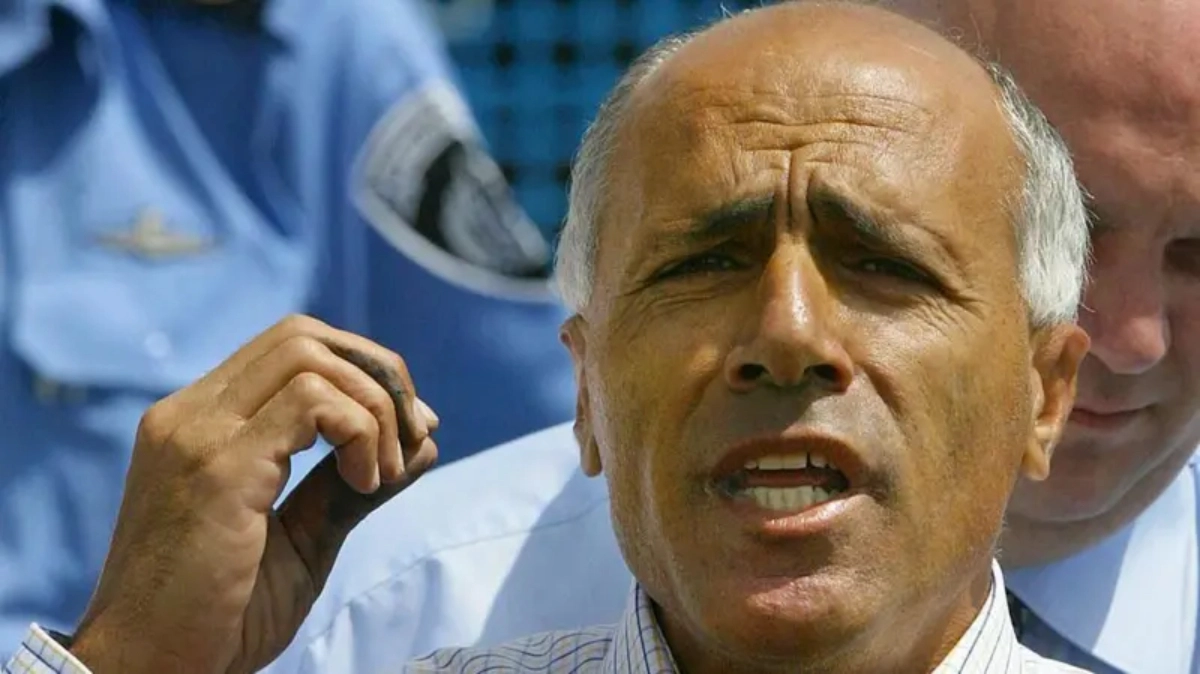
Mordechai Vanunu, the man who denounced Israel secret nuclear program three decades ago and ended up kidnapped by the Mo
Israel nuclear capability remains a mystery, although thanks to Vanunu revelations, some details are now known

We struck a blow at the heart of Iran's weapons program, said Israeli Prime Minister Benjamin Netanyahu after the preemptive strikes Israel launched last week, leaving little doubt about the war that his country started.
Iran insists its nuclear program is peaceful, but Israel has long accused it of covertly trying to produce nuclear weapons.
Meanwhile, Israel neither confirms nor denies having a nuclear arsenal, although it is widely believed around the world that it does.
This is thanks to one man and the revelations he made, exposing the clandestine operations Israel carried out to become a nuclear power.
It cost him his freedom for two decades.
“Secrets of the Arsenal”
Vanunu was a former employee of the Dimona nuclear reactor who spent 9 years working there, until 1985.
But before leaving his post, he took two rolls of photographs of the facility clandestinely.
The photos showed the equipment for extracting radioactive material for weapons production and the thermonuclear device model laboratory.
In 1986, he joined an anti-nuclear group in Sydney, Australia, and it was there that he contacted a Colombian freelance journalist, oscar Guerrero, who convinced him to publish the photos.
He then contacted journalist Peter Hounam of the British newspaper The Sunday Times.
In October 1986, the Sunday Times published an article, widely acclaimed as one of the best pieces of British journalism, entitled “Revealed: The secrets of Israel’s nuclear arsenal.”
The source was Israeli nuclear technician Mordechai Vanunu, and his revelation confirmed suspicions about his country’s nuclear capabilities, showing a larger and more advanced weapons program than anyone had previously thought.
Vanunu had worked at the top-secret Dimona nuclear research center in the Negev Desert, about 150 kilometers south of Jerusalem by road.
The newspaper concluded that Israel had become the world’s sixth nuclear power and possessed as many as 200 atomic weapons.
“We were tense, we were exhausted, most of the people there had never worked on a story as big as this,” the newspaper’s investigative journalist, Peter Hounam, told the BBC.
But on the day The Sunday Times broke the story – October 5 – his key source disappeared.
Traitor or informer?
Hounam first met Vanunu in Sydney, Australia, in August 1986 and was struck by the Vanunu’s appearance and behavior. whistleblower.
“When I saw Vanunu sitting there – a small, puffing man, lacking self-confidence, dressed very casually – he certainly didn’t look like a nuclear scientist to me,” Hounam recalled.
“But I was convinced by his decision to tell the world what he saw in Dimona,” he added.
In late 1985, Vanunu decided to quit his job and embark on a trip around Asia, disillusioned by Israel’s treatment of the Palestinians and its development of nuclear weapons.
Before retiring, he took photos of the nuclear plant, including equipment for extracting radioactive material for weapons production and laboratory models of thermonuclear devices.
It was a decision that took him first to London and the Sunday Times, and then to Rome, where he was kidnapped by the Israeli intelligence service Mossad, which brought him back to Israel, where he served a long prison sentence.
“He began to outline the story of how he had smuggled a camera without film into the headquarters, and then smuggled the film in his socks and started secretly taking pictures late at night and early in the morning,” Hounam said.
The editors of the Sunday Times asked Hounam to bring Vanunu back to London to further corroborate his testimony.
Despite his fears, Vanunu agreed to fly to the UK. The Sunday Times put him up in a discreet country house hotel outside London.
But he grew agitated and was transferred to a London hotel where things took an unexpected turn.
“That weekend, he met a woman while walking down the street. He saw her a couple of times and went to the cinema with her. And I asked him, ‘Are you sure this woman is genuine?’” Hounam recalled.
During his stay in London,Hounam grew increasingly concerned for Vanunu's safety and began checking on him periodically. He recalled their last conversation.
“He said, 'I'm just going to the north of England for a few days. I'll be fine.' And I said, 'Look, whatever you do, call me twice a day just to make sure you're safe.'”
A month later, the Israeli government revealed that Vanunu had been detained. He had been the victim of a classic seduction trap in Rome and had been smuggled, unconscious, back to Israel by boat.
Chronicle of a Kidnapping
While being transported from a prison in Israel, Vanunu wrote some details of his kidnapping on the palm of his hand, which he held up to the van window so that journalists could get the information.
He said that in London, an American-born Mossad agent, Cheryl Bentov, who had been posing as a tourist, had befriended him.
She lured him to Rome on September 30 to spend a few days together. Once there, he was kidnapped and drugged.
Vanunu was tried in March 1987 for treason and espionage, and was later sentenced to 18 years in prison. More than half of those years were spent in solitary confinement.
“I wanted to tell the world what was happening… this is not treason, it is informing the world, in contrast to Israel’s policies,” Vanunu said in a recorded interview in prison.
He was released on April 21, 2004, and has since been denied permission to leave Israel.
He has been imprisoned several times for violating the conditions of his parole.
Before his arrest in 2009, Vanunu shouted, “You have achieved nothing from me in 18 years; you will achieve nothing in three months! Shame on you, Israel!”
Secret Agreement
Until Vanunu’s revelations, little was known about Israel’s nuclear capabilities, even among its closest allies.
Israel is believed to have begun its nuclear program shortly after the state’s founding in 1948.
Greatly outnumbered by his enemies, Israeli Prime Minister David Ben-Gurion recognized the value of nuclear deterrence, but did not want to upset Israel's allies by introducing unconventional weapons into an unstable region.
So Israel reached a secret agreement with France to build the Dimona plant, which is believed to have gone into production to make nuclear weapons ingredients in the 1960s. For years, Israel maintained that it was a textile factory.
US inspectors visited the site several times in the 1960s, but were reported towere unaware of the existence of the underground floors, as the elevator shafts and entrances had been bricked up and plastered over.
Israel currently possesses an estimated 90 nuclear warheads, according to the Center for Arms Control and Nonproliferation.
However, it maintains an official policy of ambiguity surrounding its nuclear capability, and Israeli leaders have frequently repeated over the years that “Israel will not be the first country to introduce nuclear weapons to the Middle East.”
Since 1970, 191 states have joined the Treaty on the Non-Proliferation of Nuclear Weapons (NPT), an agreement that aims to prevent the proliferation of nuclear weapons and promote disarmament.
Five countries (the US, Russia, the UK, France, and China) are permitted to possess the weapons because they built and tested a nuclear explosive device before the treaty came into force on 1 January 1967.
Israel is not a signatory to the treaty.
Vanunu is considered a traitor in Israel, but his supporters celebrated his release in 2004, calling him a “hero of peace.”
In his first interview after being released, he told the BBC that he had no regrets.
“What I did was inform the world of what is happening in secret. I did not come to say: 'We must destroy Israel, we must destroy Dimona.' I said: 'Look at what you have and judge for yourselves.'”
Click here to read more stories from BBC News Mundo.
Subscribe here to our new newsletter to receive a selection of our best content of the week every Friday.
You can also follow us on YouTube, Instagram, TikTok, X, Facebook and on our new WhatsApp channel.
And remember that you can receive Notifications in our app. Download the latest version and activate them.