

What is the origin of the conflict between China and Tibet and how the succession of the Dalai Lama revives tensions
Tibet claims to be an autonomous territory, but China rejects any approach by its inhabitants to possible independence from Beijing

For almost 40 years, Tibet enjoyed de facto independence, but the victory of the communists in China in 1949 put an end to this parenthesis in the history of this troubled Himalayan region.
On October 7, 1950, thousands of troops sent by Mao Zedong entered Tibet, cornered its authorities, and finally took the border town of Chamdo on October 19.
Under pressure from China, the Dalai Lama, the Tibetan leader, signed the controversial 17-Point Agreement after eight months of occupation by the Chinese army, a document that formalized the annexation of the territory.
But according to the spiritual leader of the Tibetan people and Nobel Peace Prize winner, the treaty is invalid because it was “forced on a helpless government that did not want to do it.” The Dalai Lama was barely 15 years old when he signed it.
Beijing refers to this episode in Tibetan history as a “peaceful liberation,” while exiled Tibetans call it an invasion.
In any case, this marked the beginning of the most recent phase of a historic conflict, and tensions were rekindled this week following the Dalai Lama’s announcement that he will have a successor and that only the institution he heads not Beijing will be able to name him.
The fact is that the Tibet Autonomous Region located in the northern Himalayas is a remote territory of 1.2 million km2 with a turbulent history.
Its annexation by China, signed on May 23, 1951, is seen by most Tibetans as a tragic date that left many open wounds and widespread popular discontent.
With The Chinese occupation began tensions in Tibet, which gradually intensified in 1956, until on March 10, 1959, the first major rebellion of the Tibetan people began against Chinese rule, a popular uprising that left tens of thousands dead.
After the intervention of the Chinese People's Liberation Army (PLA) and almost two weeks of violent clashes, the Chinese victory - whose army was much larger - forced the Dalai Lama to flee the country and go into exile in India.
The Chinese treasury
After the capture of Chamdo in October 1950 by the then newly formed communist government, the city has been considered by Beijing as the "front line" of combat in the "political struggle against separatism", explains independent specialist Kate Saunders, an expert on Tibet and China.
"By 1949, communist forces had already entered areas in eastern (Kham) and northeastern (Amdo) Tibet, which were under military occupation by regimes supported by the Kuomintang nationalists. The late British radio operator Robert Ford, who was captured and imprisoned by Chinese forces, wrote that the Tibetan defense forces fought to the end, but were annihilated,” Saunders explained to BBC Mundo in 2020, when the 70th anniversary of the occupation was marked.
The British journalist said that the conquest of Tibet was one of Mao’s objectives since he assumed power, as it is a region with a strategic location and is considered the “southwest border of the motherland.”
“Known as the ‘treasury’ in Chinese, Tibet is rich in natural resources and minerals, such as lithium, uranium and another particularly important one: water,” she added.
Tibet is also the highest and largest plateau in the world and the source of most of the main rivers in Asia, so it would be crucial for China in the event of a water shortage.
How did this conflict originate?
Tibet was part of the Mongol Empire since the 13th century and since its conquest almost always enjoyed considerable autonomy.
In the 1850s, Russian and British rivalry for control of Central Asia led the Tibetan government to ban all foreigners and close the borders, but in 1865 Great Britain began to discreetly map the territory.
In 1904, the Dalai Lama fled from a British military expedition led by Colonel Francis Younghusband. Britain subsequently forced Tibet to sign a trade agreement to forestall any further Russian overtures.
Two years later, with the signing of the Convention Between Great Britain and China, the British promised not to annex or interfere in Tibet in exchange for compensation from the Chinese government.
The treaty reaffirmed Chinese control of the territory.
Between 1908 and 1909, China restored the Dalai Lama, but he fled to India when Beijing sent an army to seize control of his government.
Finally, In April 1912, after the fall of the monarchy and the declaration of the Republic of China, the Chinese garrison surrendered to the Tibetan authorities. Then the 13th Dalai Lama returned from India, and the Chinese troops left.
The government in exile claims that China recognized the region’s de facto independence in 1913, while China says it always had sovereignty over Tibet but was temporarily unable to exercise it.
The Destruction of Local Culture
While not a nation-state in the modern sense, Tibet has maintained a unique culture, written and spoken language, religion, and political system for centuries.
“It signed international treaties and maintained diplomatic relations with neighboring countries. In 1912, the 13th Dalai Lama issued a proclamation reaffirming Tibet’s independence, and the country retained its own national flag, the snow lion, currency, stamps, passports, and army,” Saunders recalls.
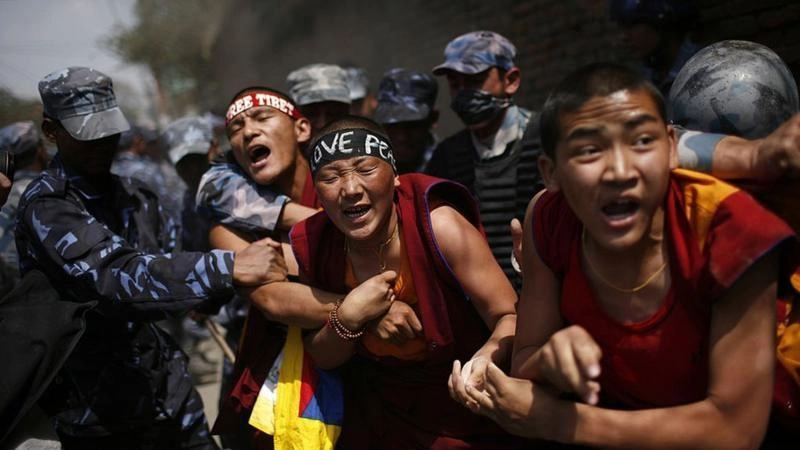
Over the years, any form of protest in the Tibet's protests against Beijing have been severely repressed. The Dalai Lama claims that nearly 1.2 million people have died in the region during Chinese rule. But Chinese authorities deny this. Several independent assessments cast doubt on this high death toll, but still place the figure between 200,000 and 800,000. In recent decades, there have been protests within Tibet against the destruction of local culture and the treatment of the Tibetan people by the Chinese authorities. During China’s Cultural Revolution in the 1960s and 1970s, most local monasteries were destroyed.
China has acknowledged abuses during the Cultural Revolution and says the Communist Party has been leading a cultural revival in Tibet since 1980 by restoring damaged monasteries.
The government-in-exile says the move is aimed solely at boosting tourism.
Similarly, many Tibetans have been detained, and Amnesty International has reported numerous cases of torture and killings.
And a 2020 report by the Jamestown Foundation said China is forcing hundreds of thousands of people in Tibet into military-style training centers that experts say are similar to labor camps.
“Before the mass internment of Uighurs (Muslims) in Xinjiang, Tibet was used as a laboratory to test dystopian measures of total surveillance, a system of accelerated cultural assimilation to create citizens and subjects obedient to the party,” says Tibet expert Kate Saunders.
Succession Issues
This week, the current Dalai Lama decided to address a very sensitive issue: his succession.
By confirming that he will have a successor, the Tibetan spiritual leader, who has been in exile in India since 1959, put an end to speculation that the 600-year-old institution he heads would disappear after his death.
In a video released Thursday, he stated that only the organization he founded could name a successor and that “no one else has the authority to interfere in this matter.”
According to Tibetan tradition, the Dalai Lamas are “reincarnated” after their death.
Of course, this prompted a response from China, which rejected the statement, stating that the Dalai Lama’s successor would come from China and must be approved by the government.
A spokesman for China’s Foreign Ministry stated that the The reincarnation of the Dalai Lama must comply with Chinese regulations and laws, as well as “religious considerations,” in order to receive Beijing’s approval.
This highlights once again how the Tibet issue pits a people’s right to self-determination against the legitimacy of a multi-ethnic state, like China, to maintain what it views as its territorial integrity.
Currently, in exile, the Dalai Lama advocates for finding a middle ground with Beijing, saying he would settle for substantial autonomy within China.
But younger generations of nationalists in Tibet, and especially abroad, are pushing for full independence, a scenario that seems increasingly distant.
*This story was originally published in October 2020 and was updated to mark the Dalai Lama’s 90th birthday.