

Famine is spreading in Gaza while Israel prepares the assault on its major city
An expert report confirms how famine is spreading in Gaza and calls for immediate action. Israel rejects its conclusions.
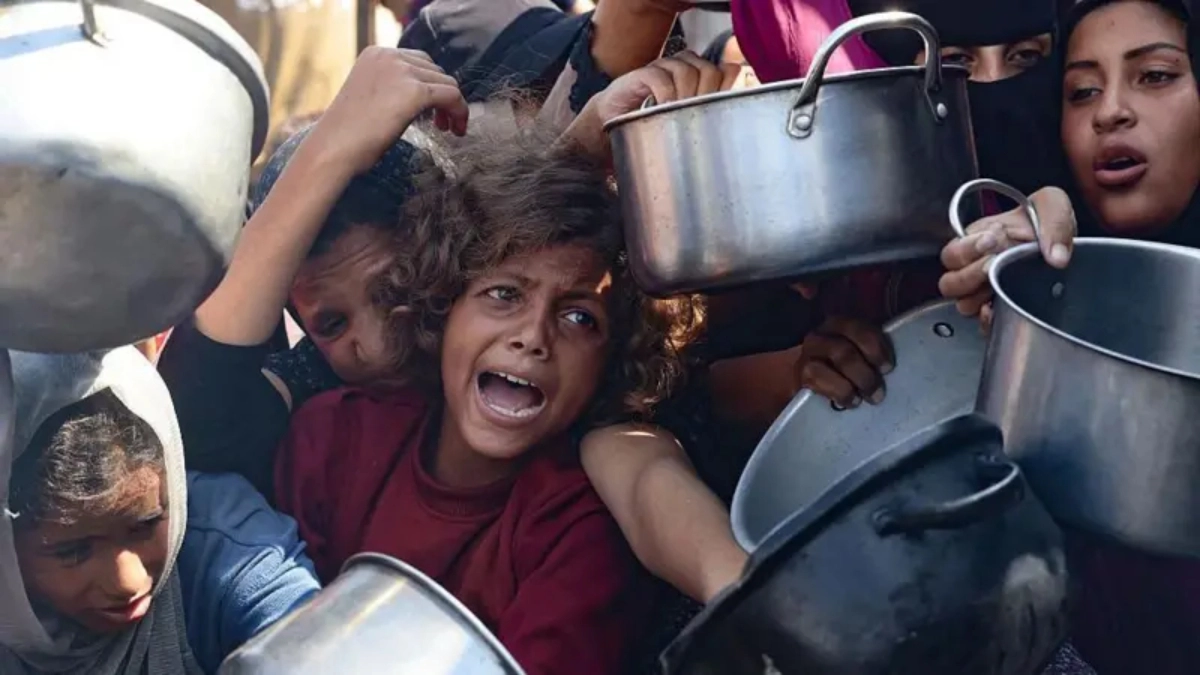

Half a million people in Gaza already face famine.
For the first time, famine in Gaza City and its surrounding areas was officially confirmed on Friday by a UN-backed food security agency, after almost two years of war between Israel and Hamas.
The Integrated Food Security Phase Classification (IPC) system reported that more than 500,000 Palestinians in the Gaza Strip—almost a quarter of the population—face starvation, destitution, and death and warned that “catastrophic conditions” will spread to other areas by September.
UN Secretary-General Antonio Guterres said the crisis is a “failure of humanity itself” and called for unrestricted humanitarian access to Gaza.
However, Israeli Prime Minister Benjamin Netanyahu called the report a “blatant lie.”
In a statement released by his office, Netanyahu said: “Israel does not have a famine policy. Its policy is to prevent famine.”
Here is a summary of what the report concluded:
The report predicts that if measures are not taken between mid-August and the end of September, famine will spread across the Strip as far as Deir al-Balah and Khan Younis.
And it projects that by June next year, malnutrition will threaten the lives of 132,000 children under the age of five.
“Children are paying the price”
Yousra Abu Sharekh, Gaza program coordinator for the US-based International Aid, Relief and Assistance Network, lives in Gaza City with her two children, ages 12 and 7.
Speaking on the BBC World Service’s Newshour program, she said people have not had access to “nutritious food” like meat, eggs, and fruit for five months.
“Children are paying the biggest price in this conflict,” she said, adding that her youngest child shows clear signs of malnutrition.
“I can’t survive on bread alone, I can’t survive on pasta alone,” she told the BBC. “This is killing me.”
Shaima al-Obaidi, media director for the international charity Save the Children, recalled that humanitarian aid was suddenly cut off starting in March.
“Within days, there was no protein or meat available. Within weeks, there was no fresh fruit or vegetables, and within a month, there was no flour, and if flour was available, it was three times the usual price,” she told the BBC. “People ate grass, they ate leaves.”
Al-Obaidi said children told him they “wish they could die so they could go to heaven and eat.”
Currently, Israel does not allow international news organizations, including the BBC, into Gaza to report on what is happening there.
“Hamas steals aid”
Rejecting the food experts’ report, Israeli Prime Minister Benjamin Netanyahu said that since October 2023, Israel has “allowed two million tons of aid into the Gaza Strip, more than one ton of aid per person.”
He added that food prices in Gaza have plummeted due to increased Israeli humanitarian aid.
The report “ignores Israel’s humanitarian efforts and the systematic theft by Hamas, which steals aid to fund its propaganda machine.” war,” Netanyahu said in a statement.
Israeli military aid agency Cogat says approximately 300 trucks of aid are entering the area daily.
The UN says 600 truckloads of supplies are needed daily to address the emergency.
Last month, the Israeli military claimed to have airdropped humanitarian aid into Gaza, a move that was criticized at the time by aid agencies as a “diversion.”
Since then, Israel has carried out further aid drops, although on some occasions safety warnings have been issued about approaching such food distribution areas.
Earlier this week, BBC Verify identified 10 separate instances where humanitarian aid was dropped into an area the Israeli military had explicitly warned the public not to enter.
The IPC report comes as Israel prepares to launch a new military offensive aimed at occupying Gaza City.
The military Israeli launched a campaign in Gaza in response to the Hamas-led attack on southern Israel on October 7, 2023, in which some 1,200 people were killed and another 251 taken hostage.
Since then, nearly 60,000 people have died in Gaza, according to the territory's Health Ministry.
Most of Gaza's population has also been displaced multiple times. More than 90% of homes are estimated to be damaged or destroyed, and healthcare, water, sanitation, and hygiene systems have collapsed.