

The controversy in Serbia per the construction of a Trump Hotel in a place bombed by NATO in 1999
Donald Trump son-in-law, Jared Kushner, is seeking to convert the former Yugoslav Defense Ministry building into a luxury resort
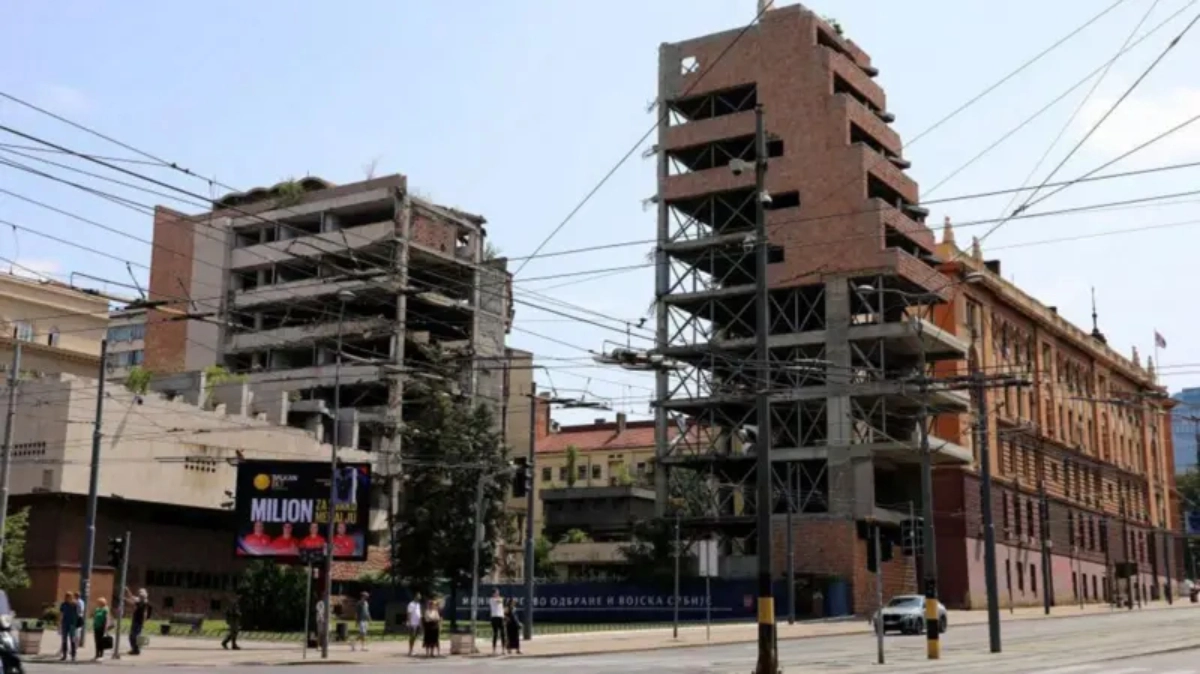

One of the first images that those who arrive in the center of Belgrade, the capital of Serbia, see are public buildings in an advanced state of ruin. NATO planes bombed these buildings in 1999, and they have remained in the same state ever since.
The message they might convey to visitors is: “Welcome to Serbia. Our recent history has been turbulent and complicated, and we are still processing it.”
Like a smile with a row of broken teeth, the Ministry of Defense buildings are still standing. But it’s clear they were dealt a major blow when NATO intervened to halt Serbia’s military campaign in Kosovo.
The United States was involved in the bombing as a member of this military alliance.
Given that history, it came as a surprise to Serbs when the government announced last year that it had reached an agreement with the company Affinity Global to convert the buildings into a $500 million luxury hotel and apartment tower complex.
Not only because the company is American, but because its driving force is Jared Kushner, best known as the son-in-law of US President Donald Trump, and because it will be called Trump Tower Belgrade.
The initiative presented
While there has been a significant twist in the story recently – which casts doubt on the project – the Serbian government’s decision to sign the agreement has not been entirely surprising.
Before becoming US President in 2016 for the first time, the Donald Trump had expressed interest in building a hotel on the same site.
The project also fits with a Serbian government policy that the opposition says seeks to allow foreign investors to profit from public buildings.
Examples mentioned include the Belgrade Waterfront residential project, built by Emirati developers on land owned by Serbian Railways.
Where rusting carriages and abandoned platforms once stood, there is now a gleaming shopping mall, elegant restaurants, and the 42-story Belgrade Tower, a curiously bulging silhouette that isn't to everyone's taste.
It was disused industrial land anyway, not a city center icon. The project at the former Defense Ministry headquarters is a completely different proposition.
Not only because it currently functions as a memorial to the victims of the 1999 bombings, but because it is also a visual reminder of why the vast majority of Serbs oppose NATO and sympathize with Russia.
In that context, giving an American developer a 99-year lease on that site – supposedly with no upfront cost – is a bold move.
But Serbia’s President Aleksandar Vucic is unapologetic: “It is important to overcome the burden of 1999,” he tells the BBC.
“We are ready to build better relations with the United States, I think that is extremely important for this country,” he added.
It is a view that inspires a degree of sympathy in Belgrade’s international business community.
New investors
Foreign direct investment flows are have more than tripled in Serbia over the past decade. But GDP per capita remains low compared to European Union (EU) member states, sitting at just a third of the bloc's average.
To keep those numbers trending in the right direction, attracting new investors is vital. And while financial details of the Defense Ministry's real estate project haven't been disclosed, the New York Times has reported that the Serbian government will receive 22% of future profits.
"For a small, niche market the former Yugoslavia, outside the EU any publicity is good publicity," says James Thornley, a former senior partner at KPMG Serbia and now a partner at the financial consultancy KP Advisory in Belgrade.
"If major international players come in, that's attractive, it creates interest. You're building your name and creating opportunities," he added.
Thornley, who lived in Serbia for 25 years, is fully aware of the sensitivities surrounding the Defense Ministry complex. But he believes opinions will change once people see the benefits of development.
“That site is an eyesore. It should be fixed, but nothing has happened in 26 years. It needs to be fixed once and for all,” he says.
Competition
But not everyone involved in foreign investment in Serbia is so enthusiastic.
Andrew Peirson, formerly managing director of global property giant CBRE in southeastern Europe, now holds the same role at iO Partners, focusing on the region.
Peirson admits that the poor condition of the Ministry of Defense complex “is not good for the city’s image” and that the deal to develop the site is “good news because it shows the country can attract major investment.”
But he has serious concerns about the way the government closed the deal with Affinity Global.
Peirson says there was no open tendering process to allow other companies to compete for the site.
“When you’re dealing with state land, you should be able to demonstrate that you’re getting market value for the site. The usual way to do that is through a proper tendering process,” says Peirson.
“If I had been in the UK, Germany, or Hungary even Romania or Bulgaria there would have been a process, I would have passed due to the opening of the market. This way, developers who were looking to enter Serbia – or were already active – would have had the opportunity to buy it themselves,” he adds.
In 2023, Vucic met with Kushner and had an “excellent conversation” about the “potential for large, long-term investments,” he says.
Since then, Donald Trump Jr, the president’s son, has made follow-up visits to Belgrade after Affinity Global announced that a Trump International hotel would be part of the project.
So far, the role of Trump Jr and the family business is believed to be limited to the hotel.
Still, questions have been raised about the Trump family doing business while Donald Trump is in the White House. His spokesperson has rejected any suggestion that the president is profiting financially from the presidency.
Peirson is concerned that the nature of the construction deal could upset companies that have been operating in Serbia.
“If I were an investor already investing tens or hundreds of millions in the country, I would feel bad that I didn’t have the opportunity,” he says.
Both Affinity Global and the Serbian government did not respond to requests for comment on how the deal was negotiated or whether there was an open bidding process.
Historical Relevance
Then there is the question of whether there should be commercial development on a site that remains architecturally and historically relevant.
The buildings were originally built to welcome visitors to the capital of Josip Broz Tito’s (1953-1980) Socialist Federal Republic of Yugoslavia.
Architect Nikola Dobrovic created two structures on either side of Nemanjina Street that, when seen together, form the shape of a gateway.
The design also evokes the contours of the Sutjeska Gorge, the site of the decisive Yugoslav victory over Nazi forces in 1943, and in 2005 the buildings were granted protected status under Serbia’s cultural heritage laws.
“No serious city builds a modern future by demolishing its historic buildings and cultural monuments,” says Estela Radonjic Zivkov, former deputy director of the Republic of Serbia’s Institute for Monument Protection.
“For Serbia to progress, it must first respect its own laws and cultural heritage. According to Serbian law, it is not possible to revoke the protection of this site,” she adds.
Complaints against
When it seemed the buildings’ fate was determined, Serbian prosecutors targeting organized crime have delivered a twist worthy of a Hollywood thriller.
On May 14, police arrested the official who had given the green light to remove the protected status of the Defense Ministry complex.
Prosecutors said Goran Vasic, acting director of the Republic’s Institute for the Protection of Cultural Monuments, admitted to fabricating the expert opinion used to justify the status change.
For that reason, Vasic faces charges of abuse of office and falsifying official documents.
This has been put forward by those who oppose the project as evidence that Kushner received preferential treatment, although the Serbian government denies this.
At the moment, it is not entirely clear where this leaves Affinity Global’s project.
Repeated efforts to conduct an interview with the company have been unsuccessful, although the company issued a statement repeating that Vasic had “no connection with our company."
They also added that they will "review this matter and determine the next steps."
Vucic, meanwhile, denies that there are any problems with the project. During a meeting of European leaders in Tirana, Vucic said that "there was no falsification of any kind."
Even so, it seems that the tattered facade of the Ministry of Defense will remain unchanged, at least for a while.
In any case, thanks to the relationship that this real estate project has with Trump, it will be a topic of conversation for those who visit Belgrade for a long time.
Click here to read more stories from BBC News Mundo.
Subscribe here to our new newsletter to receive a selection of our best content of the week every Friday.
You can also follow us on YouTube, Instagram, TikTok, X, Facebook, and our WhatsApp channel.
And remember, you can receive notifications in our app. Download the latest version and activate them.