

“The smell of a corpse was frightening”: Mexico remembers the devastating earthquake of 40 years ago
Gabino Lezama was working with the government when the devastating earthquake of 1985 occurred. He recorded the drama of 40 years ago in his photos and his memory.

Gabino Lezama is an architect who lived through the 8.1 magnitude earthquake that occurred in Mexico City on September 19, 1985 at 7:19 am
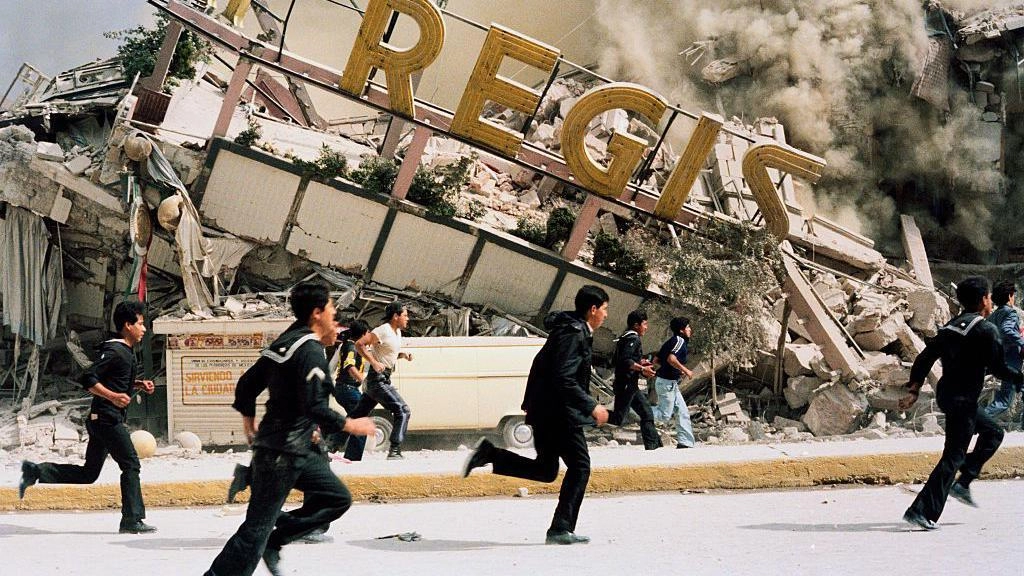
That earthquake was the most catastrophic in the Mexican capital to date, with more than 200 buildings collapsed and an official death toll of around 3,000 that has been questioned for years.
As head of civil works supervision in the Benito Juarez municipality, in the center-south of the city, Lezama took it upon himself to record the damage caused by the earthquake in that area by taking a hundred photographs.
On the occasion of the 40th anniversary of the devastating earthquake that shook the Mexican capital, we present Lezama's testimony and the images he took of the catastrophe.
When the earthquake occurred, I was about to leave the house.
Suddenly I felt a very strong push and heard the house thunder and heard as if the houses were hitting each other.
I remember my grandmother shouting 'Blessed Jesus!' and my little sisters were shouting too. My first reaction was to check on everyone; my other siblings were already on their way to school.
At first, I didn't realize how long the earthquake lasted, but it felt like it had lasted 5 minutes.
My phone stopped working; it was a totally different world than now with cell phones. My parents were fine, and I decided to go to work.
I had felt the earthquake was very strong, but I didn't realize how powerful it was. I wasn't expecting it until I got outside.
There was a sea of ??people on the street, many of them wanting to communicate with their loved ones. Since there wasn't much transportation, people walked everywhere.
I was able to take a trolleybus, but halfway through, I couldn't move forward and I could see many collapsed buildings.
I walked to work and saw more disaster, many people walking in the street, scared like me, amazed... it was a feeling of anxiety,uncertainty... we had never seen anything like that.
More than the impact of the fallen buildings, it was the screams of the people. The terrified screams.
It was like a bombed city.
When I got to work, we turned on the radio and started hearing news that everything was very bad.
There was a meeting of chiefs and then they requested the preparation of damage reports to know the condition of the Benito Juarez borough and how to channel aid.
Then we defined the most affected sectors and formed crews to take a census of which buildings had failed and at the same time see what needs there were to channel aid. A report with 'Street such and such, so many houses affected, food, medical help needed' or things like that.
But when we were on the street, it was like a bombed city. Just like you see photos of Gaza now, there were parts that looked like this.
I carried a camera because of my job and I liked taking photos. It was a 110mm Instamatic camera. And with my government ID, I was able to access many places.
As time went by, the streets began to empty, and we started recording emergency situations. If there was a strong smell of gas, we would direct someone who could take care of them or cut off the power.
The same people began to organize to help trapped survivors. We would see if they needed shovels, trucks to remove debris, if they needed food.
"Is anyone here?"
At that time, we civilians didn't know what to do. There were no instructions on what to do during an earthquake, not to stand next to things that could fail or anything; there wasn't that culture. There were no drills.
Without phones, there was a very ugly uncertainty. The first thing anyone wanted to know was about their own people, but there was no way to communicate. So it was up to you to move or contact someone who knew something.
When we went out with the crews, we spoke to people, and there were many empathetic people, the vast majority, but others were not.
Some, even if they had suffered the damage themselves, helped their neighbors. But others, perhaps very selfishly, only cared about saving their material possessions.
But I saw more empathetic people, willing to help. People took the emergency into their own hands.
First, there were brigades with volunteers who came to pull people out alive. 'Is anyone here? Is anyone here?' and if they answered or made noise, they all started digging to get the people out.
You end up getting to know the people when these types of emergencies happen.
We lived in the Benito Juarez delegation building for about two weeks,we half washed in the office bathroom to be there 24 hours a day receiving people, channeling help.And while we were there, they brought us food without asking for anything in return, so we could keep working.
Businessmen did too. There were large restaurants that said, 'We can donate 800 meals. Where do we send them?'
The "arches" of the disaster
In the end, we took a census of all the affected houses and created a map marking those that had failed. There we realized something: arches of houses that collapsed were marked.
Some time later, a geologist from the National Autonomous University of Mexico told us that this made sense, because the city's subsoil had very high water tables. So, during the earthquake, the accumulations of water and earth had behaved like a liquid that formed waves.
At the crest of the earthquake, regardless of whether the building was new or old, they collapsed. Graphically, the arches were a clear example of this.
Because of my profession, I know that buildings channel their loads through structural elements like columns, beams, and piers. Looking at my photos, I noticed how the columns of many buildings, especially the larger ones, failed. The experts pointed out how they lacked rods and retaining rings.
From then on, there were engineering meetings, and all the construction calculations were increased in the codes. That's why today in Mexico City, significantly more materials are used to withstand earthquakes like the one in 2017, which caused damage but not with the magnitude of 1985.
After 2017, the load calculations for elements increased again.
The fear left by the aftershock
On the tours, I started saying to many people, 'Please, get out of here because if there's an aftershock, this is going to fall down.' And the next day, at night, there was a very strong aftershock (7.5).
For many, that was a bigger scare than the earthquake itself, because they had experienced the day before. The power went out in many places, and that kind of amplified the fear of the aftershock.
We were at the delegation and many colleagues had a nervous breakdown.
It didn't last that long, but it was felt very strongly, and everyone was worried that the situation was going to get worse, a fear that felt very unpleasant.
And all the census we had done was no longer useful. We went out on the streets again, all night, to survey them, and we detected many gas leaks. There were people sleeping on the streets even though it was raining.
But when I returned to some places, they told me, 'It's a good thing you told us not to stay there because it just fell down.' I found it incredible,but I hope it was of some use.
Government plunder
We in Benito Juarez were at a local, medium-low level, Without decision-making power in many things. But we felt that the federal government's aid was, as the saying goes, 'to cover the eye of the male.' To show that the government was doing something.
On the inside, we knew they had resources to manage the situation better. As the days went by, we learned they had tents for people sleeping on the streets, and they never distributed them; they divided them among themselves.
I remember there was a high-rise building, owned by wealthy people, that collapsed and everyone died. Since no one complained, they took about 15 luxury cars from the basement, which didn't collapse, and disappeared. They told us they would take care of it and that we should leave. The safes, containing jewelry and dollars, were opened.
They said they were going to gather the things for a collection, but nothing ever happened; the bosses divided them up.
As Octavio Paz said, politicians in Mexico view their position as a patrimonial asset, which they take for themselves and the rest doesn't matter. And I saw it there; they distributed things freely.
We found out about many of these things.
The smell that gave it away
They also wanted to minimize the damage. It was said that between 3,000 and 6,000 people were dead. But unofficially, government officials were handling the figure of more than 50,000 dead, but that discredited them.
As I was walking around on the street, I may not believe it was 50,000, but it was a larger number that was never acknowledged. That's something I remember very much.
About a week after the earthquake, when we returned to the buildings, the smell of corpses was horrendous. You never forget that.
The concentration of the smell wasn't that of one deceased person, it was that of many more. That's why I suspect there were quite a few more than the government said.
You never forget that. Sometimes I look at the photos I took and the first thing I remember is the smell.
My time capsule
Since the earthquake happened, I made a time capsule. I saved the photos, newspapers, and magazines from that time.
At the time, people used to tell me I was like Peter Parker because I always carried my camera and would suddenly take a picture.
Some time after the earthquake, some of my photos were part of an exhibition, just a few, since I took about 100. Back then, you had to take great care of every shot, unlike now.
Some were good, others not so much. But for me, the important thing was to see what went wrong. I would have liked to have more time.But when I came across a building that had failed, I would think about what was the best shot to capture what I was seeing, so that the magnitude of what had happened could be seen.
I think that the experience of 1985 helped that in 2017 there were fewer damaged buildings, thanks to the building regulations. Although it was a hard learning process.
It was an event that left a lasting impression on many people. But I also feel that it made people realize that if they came together, they could do things and make a difference.