

Tony Luna: From homeless child to deacon
Shares a moving testimony about how he became homeless as a teenager after his family was detained and deported
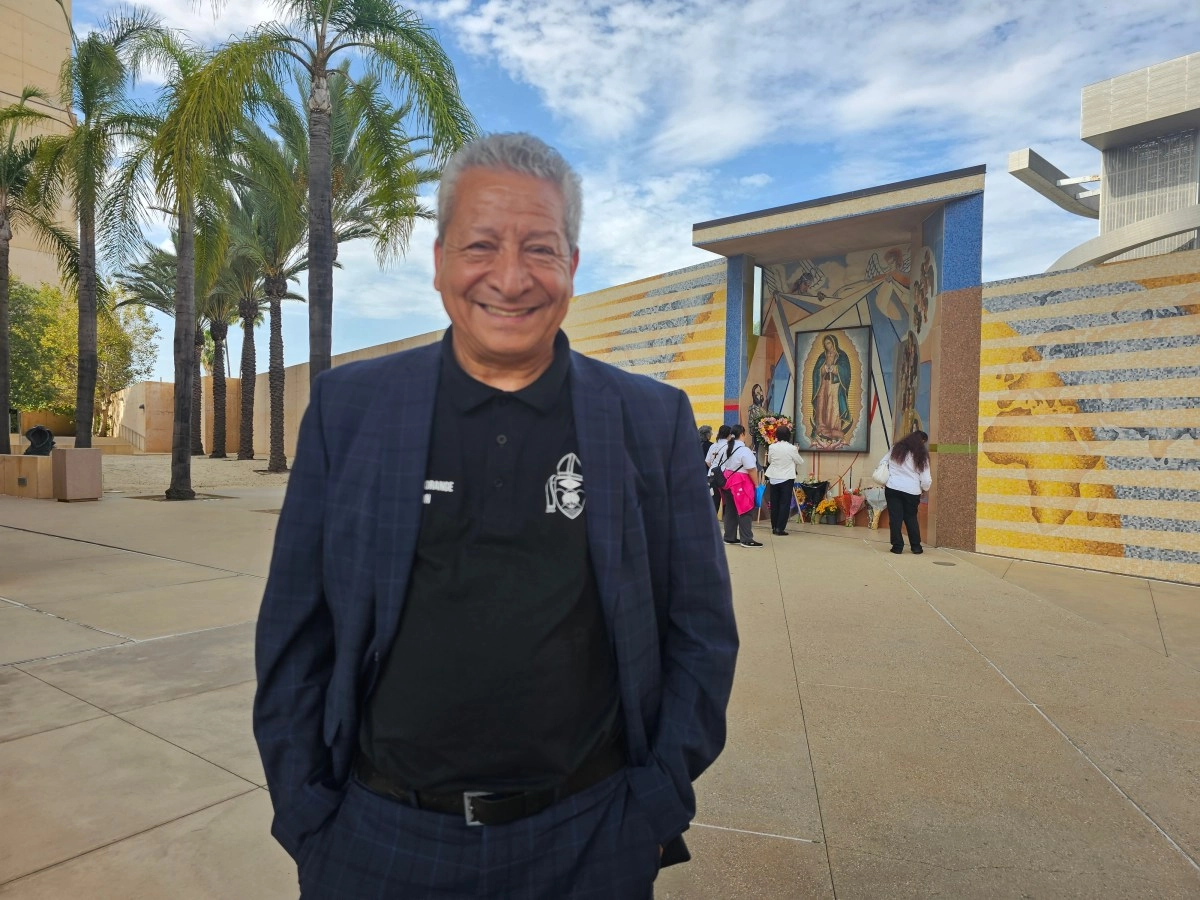

When his brothers were deported in the 70s, Tony Luna, who was nine years old at the time, became a homeless child overnight, living on the streets, surviving on food he found in garbage cans.
Decades later at the Cathedral of Our Lady of the Angels, filled with emotion, Tony, who is now a deacon at Saint Philip Benizi Church in the Diocese of Orange County, recalled that time of fear and hopelessness.
The saddest thing, he says, is that today that story is repeated with the thousands of children who are separated from their parents because of immigration raids.
Born in Mexico, Tony emigrated to Southern California in the 1970s.
“When my father died, my mother, out of desperation, sent four of the ten of us siblings to the United States. The pain of losing my father was compounded by the grief of not being able to have my mother nearby. When you're growing up, you really need your mother,” he says.
It was a woman from Texas who registered him at the Abraham Lincoln School in Orange, where he began attending fourth grade.
“He didn't speak a lick of English, and no one spoke Spanish. It was the manager of the apartments where they lived who, along with another neighbor, revealed to him that they had been deported and asked him not to open the door to anyone.
“It was the time when immigration would come knocking on your door to arrest you. Scared that they were going to come for me too, I grabbed two shirts, two pairs of pants, a jacket, and a pair of sneakers and went out to the street.”
But he didn't stray far from the apartment he shared with his brothers.
“I remembered the words my dad used to tell me. If I ever got lost, he told me not to stray far so they could find me.” So he stayed in the neighborhood.
On the streets, Tony was scared and very hungry.
“He slept in the parking lots of the apartment buildings. He never chose the same one. I would go to supermarket trash cans to look for food. Sometimes they would find fruit, cookies, and bread.That's how I fed myself and that's how I survived.
She says that on one occasion, a physical education teacher with Mexican roots approached her, and she felt happy that someone had finally noticed her life of homelessness and could offer help.
"I left crying out of helplessness because he made me feel worse when he told me he had noticed me collecting sandwiches from the street, and that Mexicans didn't do that. 'Why don't you tell your family,' he asked me. 'But I thought if I did that, they would take me to the authorities.' The conversation with the teacher dashed his hopes of receiving any kind of support. His luck changed when one time he was collecting newspapers and cardboard to sell, Maria, a woman from the neighborhood, appeared and asked him what he was doing. 'She told me that her son Arturo had told her he was living on the streets. I started to cry and cry. 'Don't cry,' the woman told me. 'Look, you're going to come live at my house and eat the same things we eat. And if your family shows up, you'll go with them.' That gave me dignity and my fears went away.”
At that time I was 14 years old.
Tony considers Maria as his angel, since she gave him a roof, and just as she predicted, one day one of his brothers returned to the United States and appeared to him.
“He knocked on Maria's door. The first thing I asked him was 'why did you leave me? We didn't leave you,' he told me. It was life.' ”
Tony returned to live with his brother, and says that over the years, when he was able to fix his status and return to Mexico to see his mother, and people asked him what happened to him when his brothers were deported and he was left on the streets, he would answer “God came and I was with a good family.”
However, Tony admits that it was very difficult for him to overcome the helplessness, the family separation, and the deportation of his brothers.
“I went for many years without talking about anything, I lived in darkness, I drank too much alcohol, I was bitter. Until one day I asked myself if I was going to live like this forever, if I was good, and I made the decision to forgive and make a change.”
His wife, Elsa, with whom he is about to celebrate 40 years of marriage, helped him a lot.
“We started going to church and that's when the call of my vocation came.“I understood why what I had experienced had happened to me and that my life had a purpose in the Glory of God.”
Through the diaconate, he enjoys helping people as a spiritual companion.
“Unfortunately, with everything we are experiencing now, history repeats itself. We see parents, young people, and children sleeping on the streets. Deportations are worse than before. That's why we have to motivate the children and tell them that they are here for a purpose.
“Every year at this Mass, we celebrate our journey to this country, our traditions, and our culture. "We remember the place where we were born, our families and friends. We share our hopes for the future," Archbishop Gomez said during the homily, in which he was joined by bishops and priests, students from Loyola Marymount University, and pro-immigrant community leaders.
“But today, once again, we gather in a time of fear and uncertainty. I know that many of you and your loved ones are experiencing difficulties due to the new immigration enforcement measures. These measures have generated fear and anxiety in our parishes, communities, workplaces, and homes.”
He added: “St. Paul tells us today, in the second reading, that we are to pray for those in authority. And so it should be. We must pray that they finally do the right thing and fix this broken immigration system."
But also," he said, "we must accompany our prayer with action.
"That's why it's time to come together to tell our stories, the stories of our families, our communities, and our parishes. This is the story of the United States; it's the story that has been told since the beginning of this country. It's the story of good, hard-working men and women, people of faith."