

Sellers on wheels suffer by the parking lots
Small business owners ask for help from the city of Anaheim

Trying to find a parking space in the neighborhood north of Ponderosa Park in Anaheim seems to be impossible.
Martha Martinez, a resident of the area for more than 17 years, almost never has the opportunity to park in a public space on Sprague Street after arriving home from work.
“The truth is, there is a lot of struggle for parking because there are neighbors who really have three or four cars and they don't move them,” said Martinez. “So, the city is supposed to say it’s public, it’s for everyone to come and go.”
The Latina mother added that she has received several tickets after parking in the red zone at the end of the cul-de-sac and hopes for a change to improve the situation.
At any given time, you can see cars parked in red zones or families calling to say there are spots available in the area, which consists of a majority of low-income families.
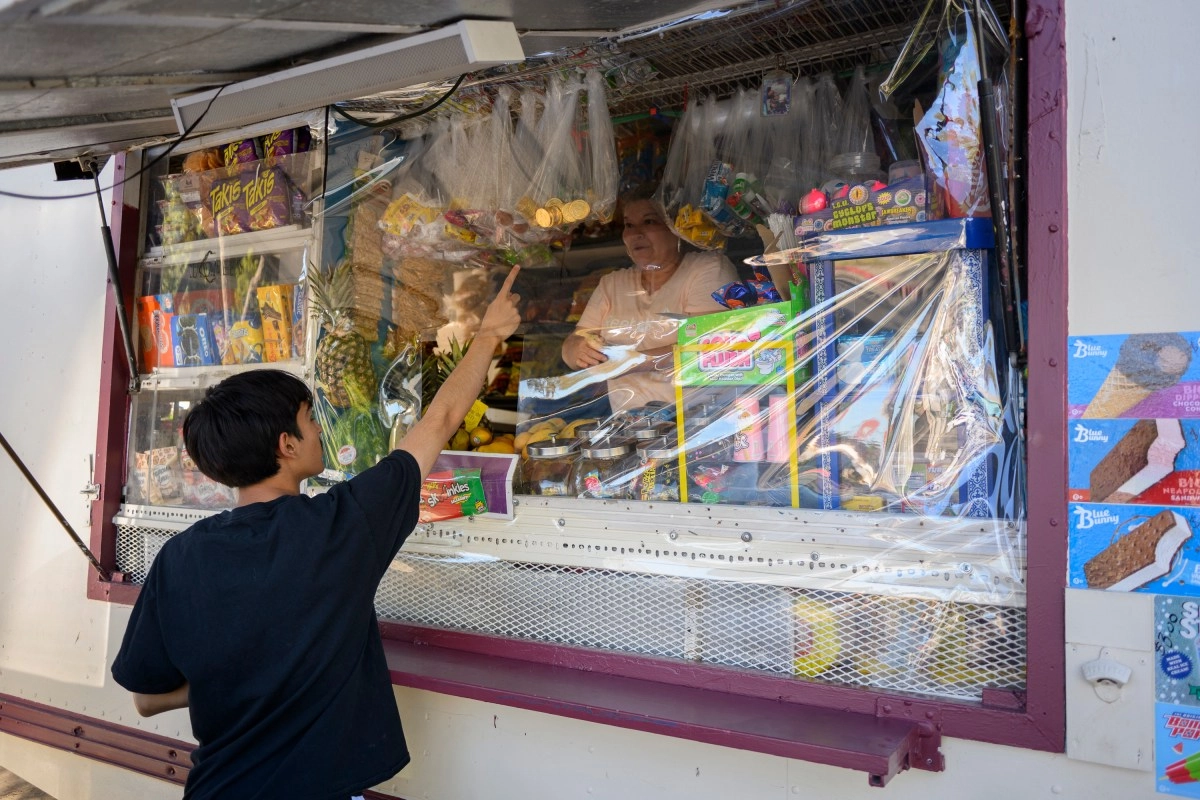
For almost 10 years, a produce truck named Ashley y Chucho has taken up space to serve the community with all kinds of basic needs: milk, eggs, garlic, water, and of course candy and snacks.
The owners of Ashley y Chucho, Martina Estrada and her husband, Jesús Hernández, have watched young people grow up, lending their ears to those who need to be heard, and providing the products that families need without having to leave the neighborhood.
But the city of Anaheim recently shared with La Opinion that it has prioritized enforcing its parking code, 14.32.206, which restricts parking for oversized vehicles like produce trucks, after dozens of complaints from area residents about the lack of parking.
“We’ve been out issuing tickets [to produce trucks] because we’ve received many complaints from working-class families in the neighborhood who are left without access to parking,” explained Mike Lyster, a spokesperson for the city of Anaheim. “And that means a family might have to try to park two or three blocks away and then walk to their apartments because one of these vehicles is in a painted space.”
However, The spokesperson explained that the city recognizes that the produce truck service is related to the parking problem because people may not want to leave their parking space to drive to a store.
“These vendors come in and are like a mini-market on wheels, providing a service to the community,” Lyster said. “So I want to make sure we recognize that, foster that, and also encourage immigrant entrepreneurs who do it the right way.”
In February, Martina Estrada, co-owner of Ashley and Chucho, said she received her first ticket in her 10 years of business, and seven produce trucks in the neighborhood have been affected by the tickets.
A group of owners, including Estrada, banded together to ask for support from the city during a city council meeting on April 8 so they could work peacefully, and the fines stopped for a while. However, Estrada shared that last month she received more than four fines in one week.
To date, Ashley y Chucho's mobile store has been fined at least eight times.
The Mexican woman emphasized that she feels it is unfair because she has all her permits in order and follows all the rules, as she has for the past 10 years.
"It's a service to the community, and we're not hurting anyone," Estrada said. "If they're fighting over the parking spaces, I don't believe that removing the trucks, which they say will solve the problem, will solve the problem with six parking spaces."
Furthermore, sales have decreased in recent years. Whereas the family used to earn $1,000 a day, they now only earn $250 a day, and she notes that with the daily fines that cost around $80, their earnings have dropped even further.
“There are no sales,” the entrepreneur said. “That’s why it doesn’t seem fair to me that we’re going through this because we depend on our jobs.”
However, the Anaheim city spokesperson emphasized that the problem really lies with the lack of parking, not with the vendors.
“Even in that neighborhood, they’re taking away someone’s parking space for eight hours,” Lyster said.
The spokesperson noted that the city has previously tried to improve the situation by painting sloping parking spaces in 2016.
Maria Noemi Bernal, a neighborhood resident, said the parking situation is complicated because people who live on other streets park in that area.
Furthermore, the Latina shared that she preferred the produce barter to remain due to the community's need.
“That barter is very necessary because here sometimes you need a tomato, an onion, or something to drink…” Bernal said. “We can't go all the way to the supermarket to get it.”
Kevin Munoz grew up buying snacks from Ashley and Chucho's produce truck and shared that he doesn't think getting rid of the trucks in the area will really make a big difference.
“There are 10 carts on the red curb,” Munoz said. “What are two parking spaces going to do? It's going to reduce it to eight.”
Both Munoz and Lyster shared that the area consists of multi-generational apartments or simply multiple families in one unit, resulting in a lack of parking.
“As long as people can't afford their own housing and have to go live with other people… It's only going to get worse,” Munoz said.
Additionally, the lack of produce trucks would be a huge loss to the community, according to Munoz.
“I grew up around here, and their disappearance will be a part of us,” the resident said. “Everyone in this community, whether they like it or not, and those who ask for their removal, are going to miss them too.”
The family has discussed the possibility of a future without being able to have their mobile store in the same community, and through tears, Estrada said that maybe something better awaits.
“It does make me sad, it makes me nostalgic because this is where I started,” Estrada said. “So maybe God has a store for me… my dream is to have a bigger store, but a store, a warehouse.”